




'Toothless Bills' harm reform agenda
By tabling two of three main reform Bills on Dec 12, Prime Minister Abdullah Badawi has shown his hand and, not surprisingly, both have run into strong opposition within and outside Parliament.
His hopes of forging a consensus through the two crucial Bills, designed to give him a positive legacy of reform as he prepares to leave office next March, have been dashed by the harsh attacks.
By tabling two of three main reform Bills on Dec 12, Prime Minister Abdullah Badawi has shown his hand and, not surprisingly, both have run into strong opposition within and outside Parliament.
His hopes of forging a consensus through the two crucial Bills, designed to give him a positive legacy of reform as he prepares to leave office next March, have been dashed by the harsh attacks.
One Bill seeks to clean up the judiciary by providing for ‘independent selection’ of judges, while the other aims to give greater powers to a new body that will replace the Anti-Corruption Agency.
However, opposition lawmakers, lawyers, retired judges and even government backbenchers say the Bills have been so heavily watered down that they have little bite.
 "We are deeply disappointed. Although there are some improvements, the executive still has an overbearing presence," said Bar Council presiden Ambiga Sreenevasan.
Critics say that, under the Judicial Appointments Commission (JAC) Bill, the executive would continue to have undue influence in the selection process.
"Under the JAC the selection is done by a committee, some of whose members are appointed by the government," Sreenevasan told IPS .
"The Bill gives power to the government to appoint or sack committee members without giving reasons."
Of the proposed nine members of the commission, five would be appointed directly by the government.
Politicians and others connected with the government could end up in the committee and compromise its independence," she said.
In addition, the prime minister would have unfettered power to amend provisions for the JAC two years after the Bill is passed.
"We are worried - this last provision is highly unusual," Ambiga added.
At present, the chief justice draws up a list of candidates as judges from which the prime minister can choose and submit for royal assent, which is rarely withheld.
Last August a judicial inquiry concluded that the selection process was open to abuse, and politicians and businessmen had colluded with senior judges to promote individuals unfit for the Bench.
‘Convoluted systems’
The Malaysian Anti-Corruption Commission (MACC) Bill, which was passed on Dec 16, gives wide new powers to officers to investigate and seize records, including bank accounts.
But critics say that the body cannot prosecute independently as it must seek permission from the attorney-general.
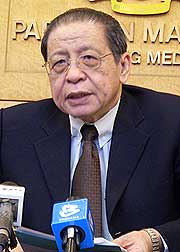 "We want the MACC to be placed under parliamentary [control] and be armed with independent powers to prosecute," said veteran opposition lawmaker Lim Kit Siang.
Abdullah has defended the Bills saying they would restore judicial confidence and fight corruption and are a major step forward for the country.
"My promise to the people is to institute reforms and I am doing just that," he told Parliament when tabling the bills.
"I am fulfilling my promise of reform before I leave. Let’s all close ranks for the sake of the nation."
Opposition lawmakers asked for a delay of at least three weeks for them to study the Bills and recommend changes, but the government, which has a 32-seat majority in the 222-seat House, is adamant they are passed without delay.
Opposition leader Anwar Ibrahim, while welcoming the initiatives to fight corruption and clean up the judiciary, said changes are needed to ensure the Bills are independent and free of political interference.
 Anwar said anti-corruption officers must be given full discretion to charge in court anyone found involved in corrupt practices without prior reference to the attorney general's chambers.
The abrupt manner in which the two Bills were introduced, when the current Parliament sitting was nearing an end, had sparked an uproar and fuelled charges that he delayed them in order to catch the opposition off guard and bludgeon the bills through.
 The cloak of secrecy that had enveloped the drafting of the Bills does not help create for Abdullah
(right)
the image of an inclusive reformer.
The cloak of secrecy that had enveloped the drafting of the Bills does not help create for Abdullah
(right)
the image of an inclusive reformer.
"What we need is a simple, independent commission to select people of the highest integrity as judges and for another commission to catch corrupt crooks and effectively prosecute them," said a senior lawyer.
"What we have now are convoluted systems because of numerous compromises made to satisfy political factions... the key aims are lost in the urge to satisfy the entrenched political forces."
A politically weak Abdullah has apparently succumbed strong opposition to the Bills.
"It was a battle between the weak reformer and the strong entrenched forces. The convoluted, watered-down versions are the result," added the lawyer. - IPS


