




Malaysia's poor human rights record highlighted in report
Popular politicisation of race and religious intolerance are reportedly the major regressive trends highlighted in Malaysian human rights group Suaram’s Overview Report of 2008, which was released on Tuesday. The overview is an annual report on the state of the country’s civil rights status.
Popular politicisation of race and religious intolerance are reportedly the major regressive trends highlighted in Malaysian human rights group Suaram’s Overview Report of 2008, which was released on Tuesday. The overview is an annual report on the state of the country’s civil rights status.
 Suaram documentation and monitoring co-ordinator John Liu noted that Barisan Nasional’s loss of its two-thirds majority in Parliament during the 12th general election led it to continually invoking the racial card to consolidate power and to justify control.
"During the year under review, the BN government, predominantly made up of race-based political parties, continued to tolerate and perpetuate racial and religious intolerance," Liu stated in the report.
"Racial discrimination continues to be institutionalised in Malaysia, while the assertion of racial and religious intolerance by non-state actors has been tolerated by the government."
Suaram, in the report also added that there would be pertinent implications on human rights and fundamental freedom in Malaysia when current premier Abdullah Ahmad Badawi relinquishes the leadership his deputy Najib Abdul Razak next year.
Intolerance, said the report, was evident in Abdullah’s statements regarding the open forums hosted by the Bar Council to discuss the social contract in August and another one on civil and syariah laws.
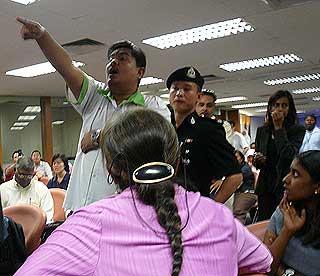 The council’s
forum
on ‘Conversion to Islam’ on Aug 9 was halted halfway through its proceedings when a angry mob gathered outside the building to
protest
against an open discussion on Islam.
The council’s
forum
on ‘Conversion to Islam’ on Aug 9 was halted halfway through its proceedings when a angry mob gathered outside the building to
protest
against an open discussion on Islam.
The forum was collectively abhorred by not only government representatives but opposition parties such as PKR and PAS.
ISA a grave concern
Besides that, nine other issues were highlighted as grave concerns that had caused the erosion of human rights in Malaysia despite the unprecedented results of the general election.
The Internal Security Act (ISA) was a grave concern, according to the report, as 2008 saw the first attempt to use the preventive law to restrict critics.
 The report referenced a series of arrests, starting with popular blogger
Raja Petra Kamaruddin
on Sept 12, followed by journalist
Tan Hoon Cheng
from Chinese language newspaper
Sin Chew Daily
and Seputeh parliamentarian
Teresa Kok
all on the same day.
The report referenced a series of arrests, starting with popular blogger
Raja Petra Kamaruddin
on Sept 12, followed by journalist
Tan Hoon Cheng
from Chinese language newspaper
Sin Chew Daily
and Seputeh parliamentarian
Teresa Kok
all on the same day.
Abuse of police powers was also a key trend in the report, marked by a higher number of deaths under police custody, which according to the home ministry, stood at 1,535 between 2003 and 2007.
The numbers make up deaths in prisons and rehabilitation and immigration centres.
Meanwhile, the government's failure to implement the Independent Police Complaints and Misconduct Commission (IPCMC) and other human rights related suggestions in the Royal Police Commission's report were part of the highlights in Suaram’s report.
It said the government’s hesitation was a result of abuse of powers, for example, in the case of the Bandar Mahkota Cheras fracas .
Pitfalls of freedom
Other highlights included the restricted freedom of speech and expression, as well as the freedom of assembly and association.
French-based watchdog group Reporters Sans Frontieres put Malaysia's place on its press freedom index at number 132 of 195, the country’s lowest ranking ever.
Suaram's report said the major cause of the decline in rank was the government’s action against Tamil daily Makkal Osai , which was stripped of its printing license for violating provisions under the Printing Presses and Publications Act (PPPA).
The newspaper was allegedly banned for its critical take on MIC leadership and also for providing lengthy coverage to the mass rally organised by Hindu Rights Action Force (Hindraf).
 Other prominent occasions were government-issued instructions to English daily
The
Sun
, Chinese language newspaper
Sin Chew Daily
and opposition-owned
Suara Keadilan
, to submit
show-cause
letters to the home ministry on their news coverage of a number of political issues. The show-cause letters were issued the same week Raja Petra, Tan and Kok were arrested under the ISA.
Other prominent occasions were government-issued instructions to English daily
The
Sun
, Chinese language newspaper
Sin Chew Daily
and opposition-owned
Suara Keadilan
, to submit
show-cause
letters to the home ministry on their news coverage of a number of political issues. The show-cause letters were issued the same week Raja Petra, Tan and Kok were arrested under the ISA.
"The timing of the show-cause letters demonstrated the BN government's tough repression when faced with serious political crisis and a challenge to power," said the report.
Controversial website Malaysia Today ’s block , followed by the arrest of the website editor Raja Petra and the arrest of blogger Syed Azidi Syed Aziz, were also noted as pitfalls in the report.
The end of 2007 was marked with a number of never-before-seen street rallies, demonstrations, protests and peaceful assemblies which continued into this year.
Some of the most significant ones were organised by Hindraf and Coalition for Free and Fair Election (Bersih).
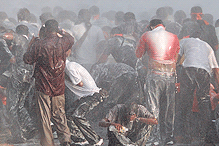 Hindraf faced more obstacles in October when the home ministry declared the group unlawful. However,
protests
by government related groups like MIC youth, against the military offence of the Sri Lankan government against Tamil minorities, was tolerated.
Hindraf faced more obstacles in October when the home ministry declared the group unlawful. However,
protests
by government related groups like MIC youth, against the military offence of the Sri Lankan government against Tamil minorities, was tolerated.
"There was selective prosecution and double standards in recognising the right to freedom of assembly, with those opposing government policies targeted for arrest and harsh crackdowns," said the report.
Nevertheless, the government, according to Suaram, had finally taken a step forward by recognising the Socialist Party of Malaysia (PSM) as a legitimate political party after 10 years of struggle.
Eroding integrity of the judiciary
The Lingam tape scandal on judicial appointments was also a concern in the report, which questioned the integrity of the country’s judiciary.
 "Although the government has announced measures which would be taken to improve the independence of the judiciary, serious questions relating to the judiciary in Malaysia continued to be raised throughout the year."
Besides the judicial appointments controversy, the report highlighted the appointment of Chief Justice Zaki Azmi, the involvement of attorney-general Abdul Gani Patail in the high-profile murder case of Mongolian national Altantuya Shaariibuu, and the sodomy allegations against Opposition Leader Anwar Ibrahim.
The suspicions surrounding the involvement of Deputy Prime Minister Najib Abdul Razak in the Shaariibuu murder case and the sudden disappearance of private investigator P Balasubramaniam were also highlighted in the report.
Bad place for refugees
According to Suaram, cases of exploitation of documented and undocumented migrant workers, and harassment of refugees and asylum seekers continue to be reported on a regular basis.
The survey reported that Malaysia is "another country that picks and chooses the groups to which if offers protection. Malaysia gave it to some groups of Muslim refugees, but detained, caned and deported others.
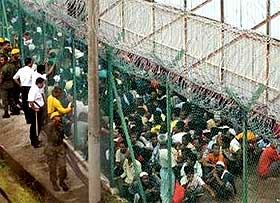 "In some cases, Malaysian officials turned deportees directly over to human smugglers who extorted fees for smuggling the refugees back into Malaysia or sold them into slavery in Thai fishing boats and brothels if they could not pay," said the report.
The survey added that a reflection of the unbearable and and inhuman conditions of the detention centres was seen in the incident at the Lenggeng Immigration Detention Centre where an administration building was set on fire by detainees.
The Human Rights Commission of Malaysia (Suhakam)’s lack of independence from the government and its ineffectiveness in promoting and protecting human rights was another disappointment listed in the report.
"One of the main problems pertaining to Suhakam's independence is the fact that it is placed under the direct jurisdiction of the prime minister's department, thus heavily compromising its independence from the government," said Suaram.
The report concluded that Malaysia’s loss of credibility at the international level for its lack of commitment in promoting and protecting human rights, was best illustrated in the possible downgrading of the Suhakam.


