




Doublespeak on the LGBT issue
After a lull, the National Fatwa Council seems to be on a ‘banning spree’ again.
Most recently, the council ruled that Muslims were not allowed to practise yoga. Prior to that, it had announced a ban on ‘tomboyish’ behaviour, citing the increasing number of young women ‘behaving like men’.
While the yoga ban has resulted in massive public outcry and criticism, the council’s earlier religious ruling against ‘tomboyism’ and lesbianism largely went unnoticed, either by the general public or by politicians of all persuasions.
After a lull, the National Fatwa Council seems to be on a ‘banning spree’ again.
Most recently, the council ruled that Muslims were not allowed to practise yoga. Prior to that, it had announced a ban on ‘tomboyish’ behaviour, citing the increasing number of young women ‘behaving like men’.
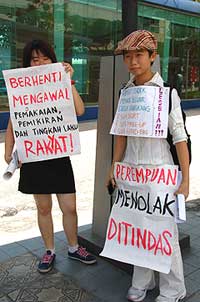 While the yoga ban has resulted in massive public outcry and criticism, the council’s earlier religious ruling against ‘tomboyism’ and lesbianism largely went unnoticed, either by the general public or by politicians of all persuasions.
Why?
The answer lies perhaps in the ambivalence towards or, worse, antagonism of the Malaysian public against the issue of homosexuality. Homophobia may be too strong a word to be employed here, but a sense of uneasiness over lesbian/gay relationship is no doubt pervasive.
When a Malaysiakini reader wrote to refute the claim that the lesbian, gay, bisexual and transgender/transsexual (LGBT) community was being persecuted, it only revealed the shallow understanding the writer has on the issue. Most interestingly, the very title of the letter betrays the writer’s own phobia for homosexuality.
It is true that the Malaysian government simply goes after anyone that does not fit in with the Barisan Nasional ideology. However, as far as I can see, several social groups have been hardest hit in the past: the LGBT people, migrant workers (documented or undocumented), and asylum-seekers/refugees (I am sure there must be other groups at similar risk but they currently escape me).
In all these instances, public sympathy was feeble at best.
The writer’s advice for gays to behave discreetly in order to avoid public attention only lays bare his pretension to be seen as "just-minded". In his opinion, LGBT people simply cannot expect to walk with their heads held high because inherently, they are "defective" compared to the "straight community".
This mentality is no different from the age of white supremacy in which it was bad enough to be a coloured person, but even worse to be seen sitting in a public bus!
The complexities of sexuality
On one hand, the writer criticised gays for "organising events only for themselves", while on the other, he blamed gays for affecting "normal male-to-male relationships". And it is precisely this demonstration of straight hypocrisy that worsens the sense of persecution on the part of LGBT groups.
Rest assured, there will be more "LGBT-only" nights or parties should these double standards continue!
But I am not here to drive a wedge between LGBT and ‘normal’ folks. In fact, a dichotomy as such and the militancy of some gay rights campaigners have, to some extent, done much to destroy the mutual understanding between the two.
There is also no denying that, with the issue of homosexuality coming to fore in many societies, the anxieties of ‘normal’ people have to be addressed in a healthy manner.
 Gary Chaw, a Malaysian artist, was named Best Male Mandarin Singer at the 19th Golden Melody Awards in Taipei last July. In his acceptance speech, the over enthusiastic Chaw had said: "Get it right: I am not gay!"
It seemed like the singer had a chip on his shoulder. Expectedly, his words caused fury within the vibrant gay community in Taiwan. After all, the island state has one of the most self-reliant and liberal societies in Asia. Now I hear some Malaysians are boycotting Chaw's albums too.
Chaw did not have an easy start in Taiwan. Faced with stiff competition in the entertainment industry there, he found his "niche" in the gay community, making suggestive remarks like "I don't mind having a same sex person as my lover" and "That I am not a gay person today does not mean I won't be one tomorrow", effectively endearing himself to the gay population.
Little wonder that many saw Chaw’s announcement as a betrayal. His latest concert in Taipei was only 70 percent full thanks to the concerted effort by the gay community there to boycott it.
I agree that Chaw should be held responsible for their behaviour. The Irish have a saying: Let every man praise the bridge that he goes over. Chaw seems to have forgotten his humble beginnings after making it big in Taiwan.
But one should step back and consider this: Was Chaw wrong in wanting to make his sexuality clear?
I know how it feels to be longing for acceptance as a gay person, and I understand perfectly if Chaw earnestly yearned for acceptance as a heterosexual man. The way he went about doing it was indeed immature, but does that negate his sincerity? I don’t think so.
I guess the gay community, whether in Taiwan, Malaysia or elsewhere, needs to wisen up on the issue. Everyone is entitled to the right to assert one's sexuality. If a gay person mistakenly regarded as "straight" should feel aggrieved, why deny this right to those who are popularly perceived as gay when they are in fact otherwise?
Should they not be allowed to express their sexuality just like everyone else?
Swimming with the sharks
And we certainly do not hope to live in a society where the "weaker sex", the disabled, the elderly, the socially unproductive, or even the impotent are stigmatised.
To me, all the condemnation over Chaw's remarks is just barking up the wrong tree. Here in Malaysia, we have Anwar Ibrahim who is eager to clear his name. With its leader being embroiled in a sodomy controversy, the PKR leadership is cautious to not make any ‘wrong’ moves that could render the party in a more difficult position.
Hence, I am least surprised that PKR leaders have been reluctant to comment on the politically motivated ‘investigative journalism’ against homosexuality by Bernama a few months back, which was rebutted excellently here .
And both the DAP and PKR are conspicuously silent on the latest fatwa on tomboyism and lesbianism. Being political parties, keeping a distance from the ‘sensitive and dangerous’ issue is strategically vital to their fortunes. It only indicates the limited trust and hope that one can place in politicians.
And how hopeful can one be of a ‘progressive’ politician like Jeff Ooi, who has no qualms using phrases such as "Desperate Housewives" and "The Pain of Sodomy" as openings of his parliamentary diaries?
Quite clearly, paternalism and male chauvinism abound despite the March 8 tsunami. For feminists and LGBT activists to pin hopes on this ‘new breed’ of politicians is akin to them swimming with sharks.
Doesn't Chaw and the Malaysiakini reader look innocent and na ï ve in comparison to all the calculative politicians that we have or are about to elect?


