




Code of ethics for bloggers mooted
Home Minister Syed Hamid Albar has suggested that a code of ethics be drawn up for bloggers in the country in order to safeguard the nation from racial or religious conflict.
Home Minister Syed Hamid Albar has suggested that a code of ethics be drawn up for bloggers in the country in order to safeguard the nation from racial or religious conflict.
Speaking at the Bloggers Buff 2008 in PWTC yesterday, Syed Hamid said the code was necessary as some blogs contained libelous and sensitive racial and religious materials.
“The Internet is bringing people into the world of written reporting who have had no training; have no one to learn from; no sense of responsibility; and no sense of their place in the reporting ecosystem.
“A code of ethics will serve as a guide. Even professional journalists are guided by their own professional code of conduct. I see no reason why citizen journalists should not want or need one,” he told a crowd of about 40 bloggers.
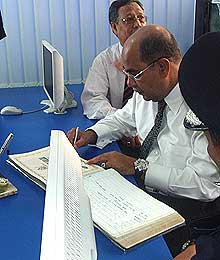 However, he said that he was not suggesting new laws adding that “this country has enough laws”.
Syed Hamid’s role as a keynote speaker was a last-minute replacement for former prime minister-turned-popular blogger Dr Mahathir Mohamad.
‘10 years behind time’
On how blogs had an impact on politics, Syed Hamid said the Barisan Nasional coalition was “10 years behind time” when compared to the use of the Internet by its critics.
He said that since the 1998 Reformasi era, dissidents had been using the Internet to attack the government right up until the March 2008 election.
“This was partly due to the liberal government policy towards the Internet. This was probably a fatal mistake of the government,” he said.
Yet, Syed Hamid believes that the tide is beginning to change as more BN elected reps and leaders have taken up blogging which also allows them to solicit views from the public.
“Interestingly, (now) cyberspace is no longer the private domain of the anti-establishment and cyber activists who sympathise with the opposition. Nor are they limited to opposition politicians.
“Moreover, access to the Internet is no longer limited to the urban and sub-urban electorates, as was the case in the run-up to the 12th general election,” he added.
Internet news portals
In his speech, Syed Hamid also touched on the commercial viability of Internet news portals.
 “The ones making money are not the socio-political bloggers but news portals that have emulated the likes of
Malaysiakini.
These portals include
The Nut Graph, Malaysian Insider, Agenda Daily
, and
Malaysia Aktif.
“The ones making money are not the socio-political bloggers but news portals that have emulated the likes of
Malaysiakini.
These portals include
The Nut Graph, Malaysian Insider, Agenda Daily
, and
Malaysia Aktif.
“None of them needed a license from the Ministry of Home Affairs to operate. All they needed was, perhaps, an ordinary business license,” he said.
The minister noted that these news portals were self-financed through advertising and sponsors and were administered by former mainstream media journalists.
“To me, what is mainstream is no longer mainstream. They so-called alternative media is now the mainstream,” he said.
During the question-and-answer session, Syed Hamid was asked by a participant why the government banned popular website Malaysia Today despite the Multimedia Super Corridor Bill of Guarantee which includes a clause stating that the Internet would not be subject to censorship.
“I think everybody gets into an euphoria over the Bill of Guarantee. Under the bill, you have the right to do anything you want, so long as you don’t breach the law,” he replied.


