




How to end terrorism
How to end terrorism? Well, a new study by a think tank in Santa Monica, which gets most of its contracts from the US government, says, do just about everything opposite from the way Washington is doing it now.
It didn’t take a PhD in world politics to have the suspicion, back on Sept 11, as I did, that it was a fundamental error, in the first place, to call it a ‘war on terrorism’.
How to end terrorism? Well, a new study by a think tank in Santa Monica, which gets most of its contracts from the US government, says, do just about everything opposite from the way Washington is doing it now.
It didn’t take a PhD in world politics to have the suspicion, back on Sept 11, as I did, that it was a fundamental error, in the first place, to call it a ‘war on terrorism’.
The phrase falsely suggests that a battlefield solution to terrorism will work, and ‘symbolically conveys warrior status on terrorists,’ the report says.
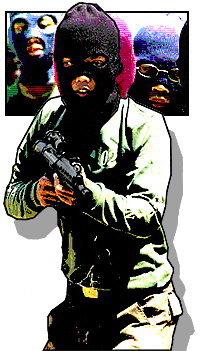 "Terrorists should be perceived and described as criminals, not holy warriors," Seth Jones and Martin Libicki, the authors wrote in ‘How Terrorist Groups End: Lessons for Countering al-Qaeda,’ a 200-page volume published last week.
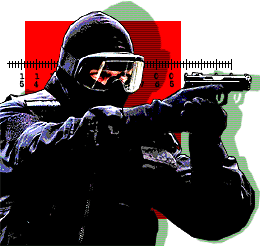
In fact the success the world has had comes from precisely the kind of diligent police work and intelligence networking that we have seen emanating from Southeast Asia.
The new governor of Bali, I Made Mangku Pastika, as the then head of the police, used no bombast but did make use of Australian and Asean cooperation, and within two years most of the Bali bombers had been locked up, sentenced, and now - in the worst cases - even await execution.
There was no Guantanamo, civil liberties of Indonesians have expanded not contracted in this period - and the Balinese have locked in their victory by choosing the great policeman as their first elected raja .
Of course, Washington had a different problem from Jakarta’s, being a superpower. It needed to send a message. But what message? And did it understand who was getting the message?
True, governments and peoples around the world conveyed sympathy to America for its loss. But crocodile tears?
A message problem
I got an e-mail an hour after the towers went down from a French (and pro-American) PhD of mine, asking how many more bullets America would take for Israel - and arguing, as did a young state senator from Illinois who was brought up in Jakarta, not to mention Dr Mahathir Mohammed, that a solution to the Palestine problem would accomplish far more than declaring war on terrorism.
I also got a more ominous e-mail from Indonesia from another PhD candidate of mine, saying that she and her husband had opened a special box of chocolates and champagne for the occasion.
That reflected the private view of billions, I suspected, at an American come-uppance. And I wasn’t the least bit surprised, though those in America to whom I tried to convey the message were outraged, in their ignorance at underlying attitudes of so many all over the world.
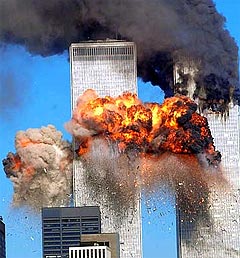 It seemed to me that Washington needed to know the mind of those to whom it was conveying its message. It was not interested in the least, whence the dismal failure of so much of its policy since 2001.
As an information chief in Reagan’s Washington , I could only laugh when the Bush administration though it only needed to make its message more palatable with fine tuning.
The problem was with the message itself.
The Rand study - I’ve worked for them and yes, they are good,--concluded that 40% of terrorist groups fade out when their goals are met, if they are narrow and secular, and a roughly equal amount end because their leaders are caught, again by good police work.
The military is just the wrong way to go, it said.
So al Qaeda has survived, hindered only by the vast scope of its unlimited ambitions. Holy warriors are knocked off and sure enough, a hundred jihadists are ready to take their place.
But ‘Al-Qaeda's probability of success in actually overthrowing any government is close to zero,’ Rand concludes.
Tread softly, softly
Ted Robert Gurr wrote a great book Why Men Rebel a generation ago, in which he observed that in all people’s minds is a great equation - the justice and fairness of their tribe, society, or nation, in bringing benefits, versus the benefits those wishing to reverse the status quo can bring. And, of course, who has the will to prevail as intervening variable.
Harry Lee in the first volume of his autobiography says of the crucial election that brought him to power that the Chinese waited to make up their minds until they’d decided who’d win - and then voted.
If I’m not mistaken, the Lee family still rules Singapore half-a-century later.
 But people are like that everywhere. If governments deliver the goods, the people re-elect them. If they can’t vote, they can still vote with their feet.
They can decide whether to go into rebellion, to support terrorist cadre, to crash planes into citadels of capitalism.
The worst thing Washington can do, the Rand study concludes, is to deploy military forces. It’s the wrong message, it encourages its own opposition, and just proves Al Qaeda’s point.
We don’t have to elect police chiefs everywhere - though when the Philippines did just that it got an end to all its insurgencies and the biggest boost to democracy ever.
Tread softly, softly, help the police everywhere - and give aid to education and medical systems, not armies, is what Washington should learn from this new study.
W SCOTT THOMPSON is a national security expert who served four American Presidents and is a professor emeritus at the Fletcher School of Law and Diplomacy. He is the author or editor of 13 books on world political issues and resides in Washington, Bali and Manila.


