




Race in America
“A black man in the White House? You gotta be kidding!”
I remember with some pain one milestone in the march toward racial equality. It was December 1962.
There is nothing in the life of an ambitious and reasonably accomplished college senior in America higher than a Rhodes Scholarship: it’s a huge amount of money, three free years at Oxford, but its prestige, which one carries through life, transcends the material considerations.
“A black man in the White House? You gotta be kidding!”
I remember with some pain one milestone in the march toward racial equality. It was December 1962.
There is nothing in the life of an ambitious and reasonably accomplished college senior in America higher than a Rhodes Scholarship: it’s a huge amount of money, three free years at Oxford, but its prestige, which one carries through life, transcends the material considerations.
The two guys (it was then restricted to unmarried males) winning in California, the largest state, were yours truly, a Stanford senior, and Stan Sanders, a ‘little All American’ football star and accomplished scholar at Whittier College, where Richard Nixon had gone. He was the first black nominated since 1906.
A Los Angeles Times reporter visited me at my family house, astride a foothill looking out at the San Bernardino Mountains. It made us look rich, though my father was a not so well-paid university executive.
Stan’s house was in Watts, a black lower-class area that was to become famous for a race rampage. I was mortified by the invidious comparison the reporter drew; I had never even had an allowance and had started a newspaper delivery route at age 6.
But it drove home that even among the ‘enlightened’ - my father’s life was dominated by a quest for opportunity for the even smaller minority American Indians - there were overwhelming economic advantages that led to so many opportunities. And until I read the article, about all the obstacles Stan had had to face, I hadn’t counted my blessings - or my undeserved advantages.
Of course Stan went on to be a great success, partner in a powerful Los Angeles law firm and once a mayoralty candidate. But there were very few Stans in those days. The staggering success of Barack Obama rested on the shoulders of those earlier pioneers of equality, however.
 Flip forward 40 years. An exhaustive investigation of attitudes in America reported that the quest for racial equality was behind us - attitudes, that is, not practice. But that was an enormous gain. African Americans were in the corporate super structures, high academe, everywhere.
But when that study was published, I got to know a black part-time carpenter working on my house in Washington. At that time 44 percent of black Washington men between their teens and mid-forties were either going in, in, or coming out of the penal system - and Washington has long been a politically black city.
A long interview among young black women of the city revealed that they didn’t consider a man whole unless he’d ‘done time.’ These were the women that would raise their children as single mothers while the putative fathers clogged the jails. My carpenter friend Joel was a tall handsome 28-year-old who demonstrated how he could steal from my wallet even while I was watching it.
I decided to help him. I gave him an old car to pursue or get to jobs. He took me to his mother’s house, where she raised his two children by one of his girlfriends, who in despair had skipped town. The 45-year-old mother had rehabilitated herself from drugs and held down a menial but safe job in the government. But she fed the children coke and potato chips for breakfast - precisely what Obama has inveighed against in telling his community to clean up its act.
It wasn’t long before I got 40 parking tickets for the old car still in my name - of course Joel had ‘forgotten’ to re-register it. I remembered that ‘no good deed goes unpunished’. And the next week I found that he was back in jail, for joy-riding the car and breaking parole. The problems of the black community are deeply ingrained.
Start with self-respect
Obama with the exception of one historic speech has avoided the race issue during the campaign. Because he is the race issue. As president he will have stupendous moral authority all around the world - because of his immense achievement and the clarity of his voice and vision.
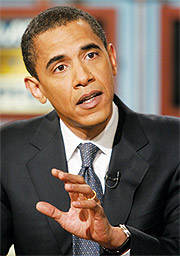 But you can be sure that he will never be far from the black community with which he has chosen to identify, despite the Asian or white-dominated schools he attended from start to finish. Because he has no choice. A black-coloured person doesn’t get the benefit of the doubt: he is black even if only half so. And he will be exhorting; he will be speaking from a bully pulpit for the American black community.
Crime is a huge problem in America, compared with the rest of the rich world. Jail a far greater destination, capital punishment huge, recidivism overwhelming. Let’s not mince words: blacks are only about a tenth of the population, but depending on the locale, almost everywhere a multiple percentage of the crime. Because it’s structured in and from slavery and an ensuing century of massive segregation.
But these are problems for which we’ve postponed the essential solution. It will start with something much bigger than food stamps, ‘affirmative action’ for college admission, or any other hand-out. It’s called self-respect.
Obama has an historic opportunity to give the American black community, bursting with pride in having a brother in the White House, the self-respect it must have to take the big step toward responsibility and fulfillment.
Obama will change the map for American foreign policy and he will succeed because the world will pay attention and give him respect. But the biggest achievement he can envisage is for the transformation of his own people into its own self-respect.
W SCOTT THOMPSON is a national security expert who served for American Presidents and is a professor emeritus at the Fletcher School of Law and Diplomacy. He is the author or editor of 13 books on world political issues and resides in Washington, Bali and Manila.


