




Selangor 'on track' with pledges
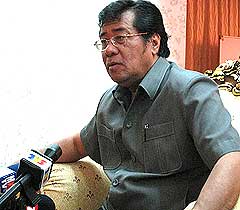
First 100 days S elangor Menteri Besar Khalid Ibrahim could not quite hide his pride in his Pakatan Rakyat state government, as it counts down to marking 100 days in power on Friday.
First 100 days Selangor Menteri Besar Khalid Ibrahim could not quite hide his pride in his Pakatan Rakyat state government, as it counts down to marking 100 days in power on Friday.
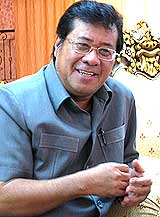 He declared that his government will be able to fulfill as much as 70 percent of its election pledges by then.
This covers several new plans - including welfare schemes and the setting up of funds - which are to be unveiled at a celebration of Pakatan’s 100th day in power in Shah Alam.
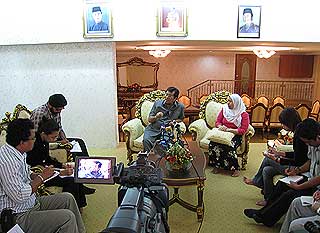
“We would have completed 60-70 percent (of the pledges) but there are issues that we are worried about,” he told a joint interview with English-language dailies at his official residence in Shah Alam on Saturday.
“Our manifesto was sometimes overzealous and (was meant to be) for everyone, so now we have to go back to the basics and give to the needy (first).
Topping the list of “achievements” was the decision to give the first 20 cubic metres water free of charge from this month.
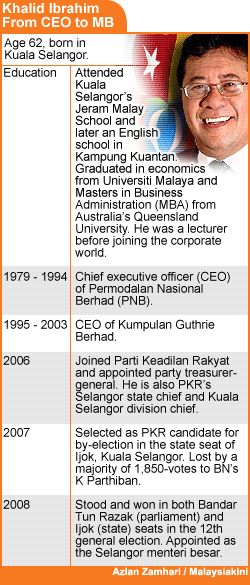 Khalid, 62, was named as the menteri besar after PKR, DAP and PAS jointly took 36 out of 56 seats in Selangor and formed the government after the general election on March 8.
He described the efforts to form the state government - which were delayed due to differences over the line-up - as the most challenging episode.
But he laughingly stressed that the alliance was not a “shotgun marriage” among the three parties that have since formed the Pakatan Rakyat.
A former chief executive officer of government investment outfit Permodalan Nasional Bhd and plantation giant Guthrie Group, Khalid admitted that he was not trained to be a politician.
And this was proven in his replies during the 90-minute candid interview, where he was quizzed over the progress of his pledges.
He was also frank about his mistakes, which will be published in the second part of the interview tomorrow.
Edited excerpts of the first part of the interview follow.
It has been almost 100 days since you were appointed menteri besar. As the first non-Barisan Nasional (BN) or Umno person to rule the state, what reforms have you initiated?
When we came in, people couldn’t see a clear difference. We said that, by electing us, the people have a right over the state’s resources. For BN, by winning the election means ‘the government is in charge of the state’. But for Pakatan Rakyat, the concept is that people have the power.
 Why is this difference so important? Because every policy I issue in the future has to be discussed from the Pakatan view, as to how these actions will benefit the people. Of course, from BN’s point of view, [...] they think they will have to decide for the people. We think of what the people want. [...] That means they trust us to manage their resources.
This is highlighted in the issue of free water (and) difference in thinking. BN thinks privatisation is good for the people [... while] Pakatan has to think how this privatisation will benefit the people. How much do entrepreneurs benefit? How much will the state and consumers benefit?
(We are) redesigning the concept of privatisation (which used to) have only two parties, the government - as if representing the rakyat - and the entrepreneurs. Pakatan considers three parties - the government as the trustee or the manager, the entrepreneurs who are interested in (the projects) and the people. All three parties must see the benefit. That is a radical change from the current concept. [...] We are promoting a people’s economy.
How would you describe your first 100 days in office - your challenging moments and the future challenges?
The challenging part was to get a foot into Selangor. You know you have won an election and you have 36 seats - PKR’s 15, DAP’s 13 and PAS’ eight. When you are packaging it to get the sultan’s approval, it’s not just a tough moment but an unnerving moment. It’s not a shotgun marriage, but was still a marriage of a group that understands each other but hadn’t exchanged rings (laughs) . But the rings have been exchanged (and Pakatan has been formed).

 I give (PKR
de facto
leader) Anwar (Ibrahim,
left
), (DAP supremo Lim) Kit Siang
(right)
and (PAS president) Abdul Hadi (Awang) credit for (bringing us together). I don’t know how they were able to mix (different) ideologies and come (up with the Pakatan alliance) but it’s a good thing.
I give (PKR
de facto
leader) Anwar (Ibrahim,
left
), (DAP supremo Lim) Kit Siang
(right)
and (PAS president) Abdul Hadi (Awang) credit for (bringing us together). I don’t know how they were able to mix (different) ideologies and come (up with the Pakatan alliance) but it’s a good thing.
I come from the corporate world, which is different. It’s tough because I am not trained to be a politician, I am more trained for (the corporate) world (and to answer such questions as costs and risks).
Looking at the election manifesto, how much do you think you have covered as you approach 100 days in office?
We are going to announce some (new measures about) our management and the welfare of the state. (By Friday) we would have completed 60-70 percent (of the pledges) but there are issues that we are worried about. Our manifesto was sometimes overzealous and (was meant to be) for everyone, so now we have to go back to the basics and give to the needy (first).
There are areas which may need a second or third look, like the reduction of the assessment rate. We also have a technical problem as we didn’t realise that all contracts given by the previous government are negotiable contracts where profitability is already billed in. In most cases, there is over 30 percent reward for those who get the contract - that’s why people are very eager to get that contract, they like to be very nice to the menteri besar, sometimes kiss his hand.
You need time to reduce that reward to seven percent or so. Revenue from advertising is sometimes not calculated. We have to bring in as much revenue and cost-controls as possible, to (generate) funds for maintenance for the local councils. Then we can declare a reduction (in the assessment rate). At the moment we are still struggling.
What about Pakatan’s promise to reduce oil prices?
I’m quite happy if they change the government and we go into the federal government. You can then see how marvellously we would do. Let Pakatan take over, the people will have a choice. We are hoping that things will happen sooner rather than later.
During the pre-Pakatan days, there were two sets of manifestos, one from the DAP and one from Barisan Alternatif (comprising PKR and PAS)...
We will reconcile that.
How?
We have to work it out. At the end of the day, common sense prevails. (At present,) the base is correct, it is solid (on issues like providing) support to the needy and merakyatkan economi (achieving a people-based economy). The base is now correct (but we’re adjusting our views on certain issues along the way).
You said 60-70 percent of the pledges have been fulfilled. When your term is up four or five years down the road...
Then we will have more than 130 percent (covered), we will have extra (grins). We have to be realistic about what we can deliver and we will deliver. BN also delivered, they said the price (of fuel) will go up and the price did go up.
When you took over, you promised to declassify documents that were under the Official Secrets Act (OSA). Have you done so?
Yes, I have. For example, during the Anti-Corruption Agency (ACA) investigations (into alleged corruption involving a staff-member of the menteri besar’s office), I told the ACA that it is at liberty to come into the office and work with us. That is a declassification exercise.
You have yet to release declassified documents to the public...
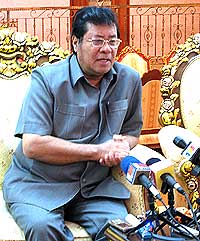 I have released...but I can’t release everything because I don’t know which document is classified secret by the state and which is classified by the federal government...I have suggested in Parliament that the OSA should be changed and someone asked if I can do this in Selangor by introducing a (Freedom of Information) bill.
However, there is a provision in the Federal Constitution (that state laws which are not consistent with federal legislation) can be declared null and void. So it would be a waste of time (to bring in a Freedom of Information Bill to replace the OSA). We can make (information) available. I think we are making things quite open compared with the previous group of people.
What about information on projects affecting green lungs, where residents sometimes want to know the status?
That will be made available...
Let’s go back to the example you cited just now, the documents that you said you declassified and gave it to the ACA. Why can’t the public get the information as well since the case after all is of public interest?
[sic] I also didn’t even know where is the letter. Now we are searching for it, it is not I can just (search for) it in the computer, no, no (laughs).
What progress has been made on the public declaration of assets by executive councillors?
We are holding on to this. We are discussing it with (accounting firm) Ernst & Young because there are certain details that people are quite sensitive about. For example, they don’t want to reveal which piece of land (they own but we can give the total number of plots). So what Ernst & Young may want to do is to give the total valuation.
It’s fair enough - of course (people) have the right to information, but (the exco has) the right to privacy...if people want the details, it will be made available (through the accounting firm and the exco members). The record-keeping must be done.
In some Pakatan states, not in Selangor, some exco members are worried about security risks to their children when they reveal their wealth. This is also an issue but we said ‘let’s face it, we have an obligation to do it’.
The pledge for free water means that rich people who live in bungalows will also benefit....
 The rich consume more, so they will have to pay more. Twenty cubic metres is not the total amount of consumption by households, it is (the average minimum) consumption. Normally people use up to 30 cubic metres - and rich people use much more.
So it is better to give (it to all in order not to discriminate)...water, education for all and basic health services should be free of charge, but we can’t give scholarships to the rich. We are not totally egalitarian, if you look at my face, you wouldn’t believe I am an egalitarian (laughs). I believe society should be given what is due.
Now that you are giving the free water, the state revenue will be affected. How are you addressing that issue?
Ah, that’s the trick. The way I have done it, (the reimbursement of water bills) is not from the state government’s resources. It’s the state government’s investment wing - KDEB (Kumpulan Dahrul Ehsan Bhd) - which is funding the project. It is time for the private sector, if it has made a lot of profit, to give dividends straight to the people. That is how it is done.
Later on, we will come out with a circular on (the mechanism). I will not tell you now because I am told to make sure that I will not reveal the restructuring mechanism, otherwise later on other states will (have to) pay Selangor a consultation fee (laughs). Other states would have love to do it, even though it looks simple.
Do you see a need for a common policy in all Pakatan states on free water? People see inconsistency when free water is available in Selangor but not in Penang?
There will be a meeting of Pakatan menteri besars and chief minister. We will work out the policies and parameters (that should be made uniform). For Selangor, we can’t be stopped from doing this because it’s part of our manifesto (to give free water).
Will there be any more teething problems for the state government after the 100 days?
 In business, you can project (the problem); in politics, I think things will continue. I think the basic issues have been thrashed out except in dealing with the communities. The expectations of the people are reasonably high. Not only do they want an efficient state, but they want (the efficiency) to be translated (into) security, cleanliness, environmental-friendly (policies). They have a list of checklist. They are quite good at demands.
(Selangor) can have all the money in the world, but if (it has) a bad manager, then that is a problem.
What do you see as the biggest challenge after the 100 days?
One challenge is that (I have yet to go on the ground and when I do so, the people may tell me) apa ni, longkang masih kotor (what’s this, the drains are still dirty).
You can clean up for two days and the next day, it will be the same...These are issues that you have to grapple with.
Tomorrow: My mistakes in the first 100 days
This is the first instalment of a week-long special issue that Malaysiakini will run from today for the 100th day in power for the Pakatan Rakyat states.


