




MCA eschewing democratic principles in leadership disputes
“Charity should always begin at home,” the wise saying goes. But often than not, this may not always be necessarily true in the complicated and contentious domain of “real-politick” when political power of its incumbency is under challenged and the party is stifled with divisive factionalism.
It is only when “controversial disputes” are spilled open and “dirty linen being washed in public” that enable its party members and non-partisan observers to take a much desired “glimpse” into the self-acclaimed “internal democracy” within the political party.
“Charity should always begin at home,” the wise saying goes. But often than not, this may not always be necessarily true in the complicated and contentious domain of “real-politick” when political power of its incumbency is under challenged and the party is stifled with divisive factionalism.
It is only when “controversial disputes” are spilled open and “dirty linen being washed in public” that enable its party members and non-partisan observers to take a much desired “glimpse” into the self-acclaimed “internal democracy” within the political party.
Hence, even though the values and objectives of democratic principles may be common and professed “theoretically” by politicians in power, the means of realizing or satisfying them during disputes may be most contradictory.
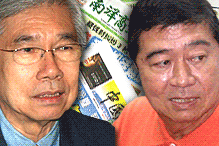 “The fish always rots in the head first,” best described by former MCA president Dr Ling Liong Sik, figuratively pointed to the “leadership rot and decay” that invariably begin from the highest level of the political leadership.
In 2001 when the MCA was already split into two major factions, commonly now known as the Ling (Liong Sik)-Lim (Ah Lek) leadership tussle, exacerbated by the controversial purchase of Nanyang Siang Pau, the infamous August 3 MCA Youth AGM (2001) fracas chair-throwing incident precipitated “an insightful” analysis into the leadership values and political culture of the party.
Will the benefit of hindsight on the situational outcome of the August 3 MCA Youth fracas, provide some pointers on the future outcome of the current “snoop squad” controversy issue under president Ong Ka Ting’s leadership?
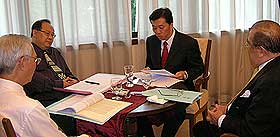 The report findings on the “fact-gathering” exercise conducted by the three-man probe committee led by Dr Sak Cheng Lum and other members, lawyer Roger Tan and party veteran Michael Chen, is expected to be ready by early June, and will be submitted to the presidential council anytime after that.
Moving towards irrelevancy
While some may say that in politics, nothing is contemptible, both party and political observers are watching and awaiting the next move of the incumbent leadership on the basis of the report findings.
More so, in view of the fact that the process of the party election is currently taking place now. Will the decisions taken impact on this election outcome? Will political principles on values of accountability and transparency be reflected in the outcome?
All these remain to be seen but one thing is sure, only a few in the public domain will be holding their breathe as the party is widely perceived as being marginalised and moving towards the direction of irrelevancy after the outcome of the March 8 general election.
While it is arguable whether the contentious issues in leadership dispute during Liong Sik’s tenure had a bearing on the negative “psyche” among the mindsets of the Chinese community, the Nanyang issue in particular, the aftermath had contributed to a general dissatisfaction, against the party in terms of ebbing support over the years.
The handling of the Aug 3 fracas continues to have a negative “imprint” in the memory of many elderly Chinese who follow MCA politics.
Till today, many can recall their perceptions and judgement upon the lack of democratic principles, accountability and the failure of the party leadership in upholding the value of press freedom in particular, and lack of transparency of the previous leadership in handling the controversial internal party disputes.
After the youth wing fracas broke out in August 2001, the presidential council led by former president Ling Liong Sik (Team A leader) on September 9 decided to appoint a six-member team of party veterans to investigate the youth wing’s chair-throwing incident.
The six veterans appointed to investigate the incident were Wee Khoon Hock (former Kelantan state chairman), Kam Woon Wah (former secretary general), Wong Seng Chow (former deputy transport minister), Chan Kit Chee (former Perak state chairman) and Wang Choon Wing (former deputy youth and sports minister).
Supporting the decision were Team A leaders which included former vice president Ong Ka Ting (now president) and former national organising secretary Ong Ka Chuan, now secretary general.
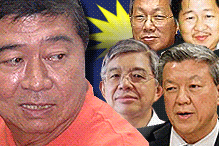 Other notables in Team A faction aligned to Liong Sik were Ong Ka Ting, Ong Ka Chuan, Fong Chan Onn, Dr Chua Soi Lek, Lim Siang Chai, Dr Ng Yen Yen, Lau Yin Pin, Hon Choon Kim, Yew Teong Look and Loh Seng Kok.
Among those “high profiled” leaders supporting Team B led by Lim Ah Lek were Chan Kong Choy, Chua Jui Meng, Ong Tee Keat, Fu Ah Kiow, Dr Tan Yee Kew, Liow Tiong Lai, Wong Mook Leong and Tang See Hang.
History repeats itself?
Will history repeat itself in this dispute?
Soon after the announcement of Chor (Chee Heung, who was deputy home affairs minister then) coordinating the six-man committee probing the youth fracas, Lim Ah Lek objected vehemently on the following ground:
1) Ah Lek openly criticised Ling’s move as “unconstitutional,” as an attempt to bypass the disciplinary committee established under the party constitution;
2) Against the appointment of Chor as the coordinator (conflict of interest in view of the police investigation, as he was the deputy home minister and that Chor had publicly declared himself as not impartial);
3) Can the veteran committee consisting of party elders be impartial?
4) Accused Ling of using his majority support in the presidential council to “bulldoze” decisions without consultation (on appointment of party veterans);
5) Failure of Ling to uphold a final decision (agreed upon by Team B) that the committee of elders forward its findings to the disciplinary committee which would later send the same to the presidential council, including any appeal to the central committee.
Ah Lek accused Liong Sik of not being “sincere” in investigating the fracas. “It can be seen that the president’s (Ling) intention was to delay and frustrate the investigation, and skew the report in his favour. Is it because of his guilty conscience?” Ah Lek had asked sarcastically.
Chor told theSun on Oct 19 that year that “MCA affairs have nothing to do with the police or other authorities,” in response to the fact that police were investigating the incident.
“The police have their duties to do and the political parties have their internal system with their own rules to undertake inquiries.”
Former acting youth secretary general Liow Tiong Lai (Team B) said, “MCA Youth will respect the views of the panel but will not be bound by their decision.” He was also reportedly to have said that “the setting up of the coordination committee has sidelined the disciplinary committee and such a move will set a bad precedent.”
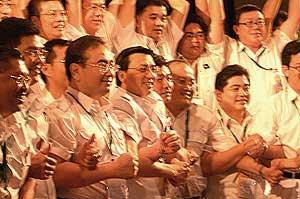 Liow who is currently health minister was right on one count. History has repeated itself with the appointment of the three-man probe committee on the snoop squad.
In the Youth fracas, Liow as youth secretary general chaired a five-man committee to prepare an independent report.
More importantly, former Youth chief Ong Tee Keat who was the target of several complaints against him for the controversial chair-throwing incident, criticised the six-man panel’s recommended decision not to investigate “other” members involved in the fracas.
The reasons given by the investigation committee included (quote) : “the difficulty for us to exactly determine who really threw the chair, or the plastic bottle or who were punching the other member as this would mean that we (the committee) are taking over the role of the police as a number of police reports have been lodged regarding the ruckus.”
The report findings, continued:
“We understand that the police have already started investigation by recording statements from persons involved. Let the police identify who did what, but after the police investigation (related allegations of money politics and “gangsterism” to the ruckus) is over and the case or cases are determined, the party should decide what disciplinary action is to be taken against the offending member.”
The police report never made it to light since the MCA Youth fracas took place in 2001 and the aftermath of the leadership tussle extended to 2003 when Liong Sik finally stepped down initiated the beginning of the “Ong” leadership.


