




EC chief: Cabinet rejected indelible ink
Election Commission chairperson Abdul Rashid Abdul Rahman today dropped a bombshell by revealing that the cabinet had rejected the use of indelible ink in the March 8 general election on the day Parliament was dissolved.
Election Commission chairperson Abdul Rashid Abdul Rahman today dropped a bombshell by revealing that the cabinet had rejected the use of indelible ink in the March 8 general election on the day Parliament was dissolved.
“I have not told the country about this (before) but what happened was that cabinet rejected our proposed law (on indelible ink) on Feb 13 - the day dissolution of Parliament was done,” he revealed at a seminar on elections in International Islamic University Malaysia (IIUM) today.
Taking a rare departure from his normally reserved persona, Rashid revealed that the EC was all set to impose indelible ink on voters when casting their ballot on March 8 - a move aimed at dispelling fears of cheating in elections.
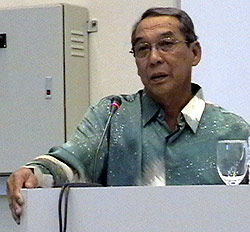 “We were under pressure by a lot of parties (to use the indelible ink). I won’t say it was just the opposition but even the NGOs are telling us to do something to dispel the fear of cheating in elections.
“We do believe that in order to convince people (that we were independent), we have got to do something and the least we could was to agree to the use of indelible ink.
“We were very serious. We put up a regulation on this and submitted it to the cabinet,” he added.
Last year, the EC had agreed to use the ink in the 12th General Elections to put to rest claims of multiple voting.
However, the plan was cancelled four days before the March 8 polling day.
A princely sum of RM2.9 million for about 48,000 bottles of the ink was bought from India, but Rashid had to call off the move on claims, that were never substantiated, that elements of sabotage had been detected by the police.
Last Tuesday, Home Minister Syed Hamid Albar told Parliament that the EC's decision to scrap the ink was based on 'hearsay evidence' .
Cabinet ordered me to take responsibility
Admitting that he had avoided this subject since the election results were announced, the chairperson appeared relaxed today and related how he was made responsible over the cabinet’s decision.
 He disclosed that the cabinet was swayed by the police information that political parties had purchased indelible ink overseas.
“I was told that PAS in the east coast bought ink from Thailand. Then Umno came to know (about this) and Umno also bought the ink.
“This was given to me in black and white by the police and the same report went to the cabinet and they believed that this was happening,” he said.
Aside from security reasons, Rashid also noted that the cabinet said voting is a constitutional right under Article 119 of the Federal Constitution whereby the indelible ink process cannot be forced onto people as it goes against the fundamental right of a person to vote.
“Voting is your fundamental right and even if you reject the use of the ink, you must be given a ballot paper. It is an implied human right. You should not be putting roadblocks to prevent anybody from voting,” he said.
According to Rashid - after being informed about the cabinet’s decision to cancel the use of the ink - he was ordered to be responsible for the controversial scrapping of the indelible ink.
“And I was called and told about it and I was told to take the whole responsibility for agreeing to the ink. I took the whole responsibility."
He quipped that as EC chief he had for many years been taking the "responsibility" for some of the controversial decisions made.
“It’s not easy to be EC chairman and I took the responsibility but that cost me dearly to me and to my house. They threw red paint on my house and my gate,” he lamented.
Abdul Rashid, who is due to retire in December, has been helping to organise elections in Malaysia over the past three decades.
Naming names
On March 6 - two days after the cancellation of the ink - vandals splashed the outside of Rashid’s house in Bukit Pantai, Kuala Lumpur with bright red paint which he described as “politically motivated”.
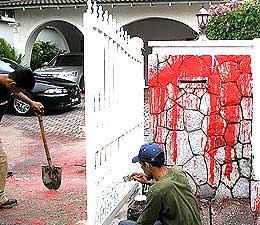 Naming names for the first time, the chairperson alluded that his suspicion was based on a political rally that was held nearby his home that night.
“(PKR de facto leader) Anwar Ibrahim was giving speeches in Bangsar near my house and his fiery speeches woke up some samseng boys [...] but I didn’t tell (the police), I did not want to cause problems,” he said.
During the press conference, Rashid also disclosed that opposition parties had sent representatives to apologise for remarks made during the elections.
“The opposition had sent representative to apologise immediately after the elections ended. They sent people to say sorry, this is all politics.
“They were a bit personal with me, they felt very sorry because basically I wasn’t their enemy. I accepted their apologies,” he said.
Rashid faced numerous criticisms during the run-up of the general elections from opposition and civil society. He was accused for failing to act independently on behalf the EC and was perceived to be influenced by the executive.
The seminar entitled ‘National Seminar on Election 2008: Democracy at work’ was organised by the Electoral Studies Research Unit in IIUM.
In an immediate response, Prime Minister Abdullah Ahmad Badawi said that the scrapping of the indelible ink was a cabinet's suggestion to EC, and not a directive.


