




PM: Certain parties exploiting MB issue
Certain quarters are exploiting the Terengganu menteri besar issue to further their personal agendas, said Prime Minister Abdullah Ahmad Badawi today.
Certain quarters are exploiting the Terengganu menteri besar issue to further their personal agendas, said Prime Minister Abdullah Ahmad Badawi today.
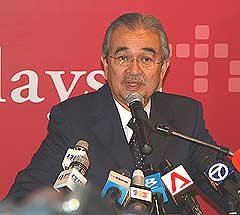 Despite this, Abdullah advised against tempers flaring.
"We know the situation on the ground. There are people exploiting the situation for their own ends. So there is a lot of confusion," he told a press conference in Kuala Lumpur.
"We have to remain cool and at the same time, not become oblivious of the issue which needs to be addressed," he stressed.
Abdullah was asked to comment on whether he still supported former Terengganu menteri besar Idris Jusoh to continue for another term.
The premier, in his capacity as Barisan Nasional (BN) chairperson, had nominated Idrish for the post but Sultan Mizan Zainal Abidin, who is also the current Yang di-Peruan Agong, appointed Kijal assemblyperson Ahmad Said instead.
Following this, Ahmad took office this morning despite 22 Umno state assemblypersons objecting the Sultan’s appointment. This leaves Ahmad as a potential menteri besar without a government.
Meeting the King
Despite being pressed by reporters on the issue, Abdullah refused to divulge a possible solution to the impasse. He also refused to confirm if Ahmad had been sacked from Umno as reported previously.
However, Abdullah confirmed that he would have an audience with the Yang di-Pertuan Agong soon to discuss the matter.
To another question, Abdullah said that he would resolve the crisis in Terengganu "as soon as possible." "I wish I could have done it (resolved the problems) yesterday," he added.
Abdullah was speaking to reporters after delivering his keynote address at the Invest Malaysia 2008 conference at the Mandarin Oriental Hotel.
Towards the end of his address, Abdullah deviated from his speech on investment policies to the voting trends among youths and the impact of the internet on the general election.
Cyber war
Admitting that the voters, particular the young technologically savvy ones, had sent a "strong signal" to the government, the prime minister pledged that the government would respond accordingly.
"We need to respond to the enthusiasm and ideals shown by the young people," he said.
Abdullah also admitted that BN had ignored the impact of the internet during the run-up to the general election.
"We thought it was not important... it was a very, very big mistake... we thought that newspapers were enough" said Abdullah, adding that not enough attention was given to the ‘cyber war’.
He said that young voters were influenced by SMSes and internet campaigns and this in return, affected BN’s performance in the polls.


