




For Kamarul, neutrality was not an option
When lurid allegations of sexual misconduct swirled around Anwar Ibrahim in September 1998, a Malay College classmate of his, Kamarul Bahrain Abbas, now PKR parliamentary candidate for Telok Kemang found himself in pained bewilderment.
When lurid allegations of sexual misconduct swirled around Anwar Ibrahim in September 1998, a Malay College classmate of his, Kamarul Bahrain Abbas, now PKR parliamentary candidate for Telok Kemang found himself in pained bewilderment.
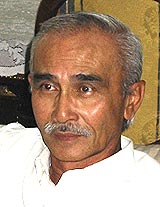 In the enveloping hysteria in which it was difficult to sift fact from fiction, Kamarul, on whom a first, favourable impression of Anwar formed in his teens had become a lasting stereotype, opted to drive from his Bangsar home a short distance to Anwar’s in Damansara Heights and posed a searing question to the sacked deputy prime minister and wife Azizah.
“Are those stories true or not?” said Kamarul, recalling the encounter in an interview with Malaysiakini during a break in campaigning for the seaside ward in Negri Sembilan where he is up against MIC stalwart and incumbent member of parliament S Sothinathan.
“Anwar and Azizah’s answer was ‘Not true’, and that was enough to trip me from pained bystander to committed supporter of the cause of reformasi,” said the businessman who, although close to Anwar during their days in Malay College, saw him only sporadically in the intervening years between leaving school in the mid-1960s to his ejection from government in 1998.
Soon Kamarul, hitherto a nominal member of Umno, became treasurer of the newly formed PKR, moving on to the secretary-general’s post before being replaced by Khalid Ibrahim last year.
The bonds of friendship
Clearly, for Kamarul, to quote Dante, a poet Anwar is fond of citing, the hottest places in hell are reserved for those who in times of great moral crisis maintain their neutrality.
 “Neutrality was not an option,” said Kamarul, a white-haired figure of lean frame and laconic expression.
Although Kamarul was in business, he did not see Anwar for any favours in the latter’s days as finance minister (1990-93) and saw him only a couple of times after leaving Malay College, once when he was just released from ISA detention in the mid-70s and after that when he newly joined government in 1982.
Lack of close contact did not mean that the bonds of friendship, forged in the years when memory is absorbent like a sponge, had withered with time.
“I followed his career from a distance and saw that it was on course to do the things his friends could sense he was going to do when we were in school. That’s why when he fell, I needed to know the truth and there was no better way than to ask him straight.”
Aiming for an upset win
Rarely can have so fateful a commitment – because of it, Kamarul was to lose out in business - hinged on a single answer. But Kamarul shook off the temptation to engage in sterile speculation of the what-might-have-been had the 1988 crisis not occurred and addressed the urgent question of the day: How does he rate his chances against his opponent in the coming poll?
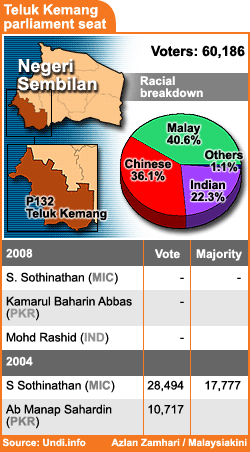
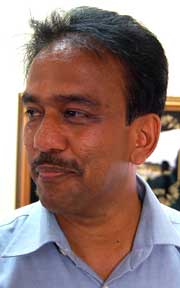 “From the response to our campaign, I rate my chances as even. In all three communities, we encountered a feeling that change is necessary for progress,” said Kamarul, who will need to reverse Sothinathan’s (
right
) huge majority of almost 18,000 in the 2004 elections.
“From the response to our campaign, I rate my chances as even. In all three communities, we encountered a feeling that change is necessary for progress,” said Kamarul, who will need to reverse Sothinathan’s (
right
) huge majority of almost 18,000 in the 2004 elections.
Teluk Kemang is a mixed seat with 40.6% of its 60,186 voters are Malays, Chinese (36.1%) and Indians (22.2%).
He continued: “If the government says the economy is doing well, why does the Chinese shopkeeper tell me his business has not improved, why does the Malay government servant and factory hand tell me prices have risen but incomes have not kept pace with the increases, and why do Hindraf supporters rally to the PKR banner?”
Kamarul said the facts on the ground belie rosy government rhetoric and that gives him confidence he could pull off an upset. Besides, the ordinary wage earner feels left out which is why, said Kamarul, he hearkens to the call for change.
“You look at this road out here,” he said, pointing to the Port Dickson coastal road that connects the beach resorts to the town. “Have you seen a bus other than a tour one ply the route? Do you know what it costs the ordinary person to go to town to get some official business done?”
He summed up: “The people know that this is a government for the elites and not for the ordinary people. They know that it is no longer a question of race but of elites who run things for their benefit and leave the crumbs to the rest.”


