




Penang: Possibly a dozen seats 'at risk'
In every general election, a few states become the focus of media attention as ‘battleground’ states. Penang, the site of heated contests in 1986 and 1990, is one such states in 2008.
analysis In every general election, a few states become the focus of media attention as ‘battleground’ states. Penang, the site of heated contests in 1986 and 1990, is one such states in 2008.
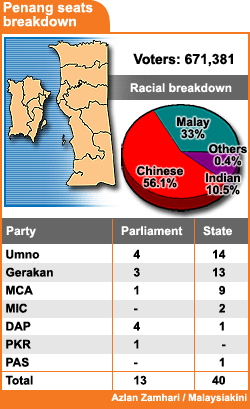 The widely anticipated Chinese swing against the BN will be accentuated in Penang, which is the only Chinese-majority state in Malaysia with 56% of Chinese voters.
Furthermore, for the first time in recent memory, the Indian vote, once solidly behind the BN, cannot be taken for granted in the aftermath of the Hindraf protests.
With the allocation of seats among the opposition largely settled in Penang, the uncertainty surrounding the identity of the new chief minister and the fielding of a credible list of opposition candidates, this cocktail of additional factors makes the contest in Penang one to watch.
DAP’s secretary-general, Lim Guan Eng will likely contest in the Bukit Gelugor parliamentary seat and the party will likely field a set of fresh faces notably Jeff Ooi, a prominent blogger, Prof P Ramasamy, a well-known academic and Liew Chin Tong, a political analyst.
PKR will also field new candidates, though not as well-known as DAP’s. Yusmadi Yussoff, a lawyer, activist and former Humphrey scholar will likely contest in the Balik Pulau parliamentary seat. Sim Sze Tzin, Anwar Ibrahim’s political secretary, and one of the two parties involved in revealing the Lingam video tapes, will also be a candidate in Penang.
Who will be new CM?
The choosing of the new Penang chief minister to replace Koh Tsu Koon has led to some uncertainty within Gerakan and opened the doors for this issue to be exploited among the opposition.
The two front runners for the position are Dr Teng Hock Nan, currently a state exco member and Chia Kwang Chye, deputy minister of information as well as Gerakan secretary-general with Lee Kah Choon, currently a parliamentary secretary, seen as a dark horse. The opposition has accused Gerakan of letting Umno decide who the next chief minister because of the delay in this decision.
This is not to say that the opposition can expect a smooth ride to the polls. Many local DAP leaders and members are unhappy with the ‘parachute’ candidates such as Liew and Ramasamy who do not hail from Penang. In addition, the decision to move Karpal from Bukit Gelugor to contest in the Bagan parliamentary seat has angered some of the supporters of Lim Hock Seng, the incumbent DAP MP in Bagan.
At the same time, Gerakan leaders will campaign that a vote against the party is a vote that might take away the position of the chief minister away from them, something which most Chinese voters do not want to see happen.
Split-ticket voting
What do these factors mean in regards to the number of seats that the opposition could win in Penang?
Expectations are that the opposition would pick up more seats at the state level compared to the parliamentary level. Penang voters, especially among the Chinese, are well-known for their split-ticket voting patterns whereby they will cast their vote for the opposition at the parliamentary level but for the BN at the state level.
As such, the opposition currently holds five parliamentary seats in Penang but only two state seats. A swing against the BN would thus be felt more at the state level this time since the opposition vote at the parliamentary level is already significant.
For example, using the 2004 results as a baseline, the BN might lose an additional seven to 10 state seats and one to two parliamentary seats if the swing against the BN among the Malays, Chinese and Indian voters were 4%, 8% and 3% respectively.
In addition to Sungai Puyu , which is currently a DAP-held state seat and Permatang Pasir , which is currently a PAS-held state seat, the BN might lose the state seats of Penanti , Padang Lalang , Perai , Bukit Tambun , Air Putih , Batu Lancang , Paya Terubong and possibly Bagan Dalam , Padang Kota and Pengkalan Kota .
In addition to Bagan, Bukit Gelugor, Tanjong , Bukit Mertajam and Permatang Pauh , which are currently opposition held parliamentary seats, the seats of Batu Kawan and Jelutong might also be at risk.
DAP the key beneficiary
The one thing that all these seats have in common is that they are non-Malay majority seats that are currently held by Gerakan, MCA or MIC. Even if one might not expect as high a swing as 4% among Malay voters, it is not inconceivable that a swing of greater than 3% among Indian voters will occur which means that all these seats are still at risk, perhaps more so than in the previous scenario.
The main beneficiaries from this swing is likely to be the DAP and to a lesser extent, the PKR, since the DAP is expected to contest in the bulk of these ‘at risk’ seats.
But estimating results from a statewide swing is notoriously inaccurate. Other factors on the ground, such as the strength and popularity of the respective BN and opposition candidate, the salience of particular local issues, the extent of opposition and BN in-fighting, all come into play, especially in close contests.
But what is certain is this – do not look for the BN to repeat its 2004 performance at the state level where it won 38 out of 40 state seats.
ONG KIAN MING is a PhD candidate in political science at Duke University specialising in electoral and ethnic politics.


