
Private medical group slams RM10 consultation fee floor
Federation of Private Medical Practitioners Associations Malaysia (FPMPAM) president Dr Shanmuganathan Ganeson pointed to the consultation fee floor kept at RM10 as a cause of the issue.
“While the government may have acted on advice from health economists seeking to preserve affordability...
A doctors’ group is urging the government to stop third-party administrators (TPAs) and managed care organisations (MCOs) from sticking to the legal minimum for reimbursement rates.
Federation of Private Medical Practitioners Associations Malaysia (FPMPAM) president Dr Shanmuganathan Ganeson pointed to the consultation fee floor kept at RM10 as a cause of the issue.
“While the government may have acted on advice from health economists seeking to preserve affordability by maintaining a lower floor price, this logic fails completely in a TPA-dominated market.
“The RM10 ‘floor’ immediately becomes a corporate anchor for reimbursement, handing MCOs and TPAs a ready-made tool to suppress fees and dictate terms - undercutting consultation time, continuity, and patient safety,” he said in a statement today.
Yesterday, while tabling Budget 2026 in Parliament, Prime Minister Anwar Ibrahim said the government agreed to revise the range of consultation fees from RM10-RM35 to RM10-RM80.
He said the government had considered the fact that the rate was last revised in 2006, as well as the need to maintain affordability for the people.
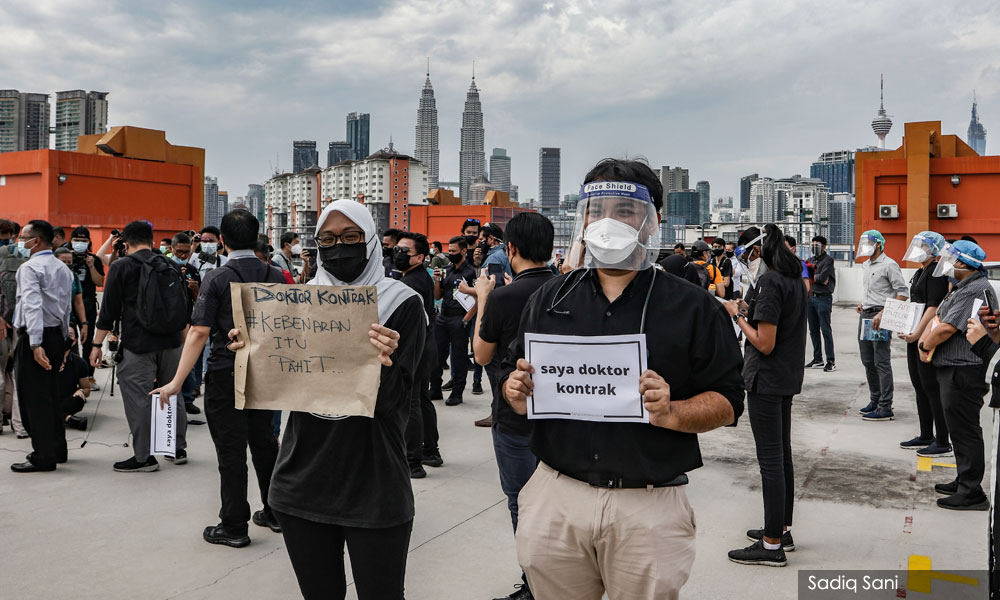
In May, private doctors joined a protest organised by the Malaysian Medical Association (MMA), where several were seen carrying placards questioning the ceiling for GP consultation fees remaining at RM35, compared to plumbers and locksmiths who charge RM150 and RM200, respectively.
MMA former president Dr Azizan Abdul Aziz previously pointed out that “the majority of private GPs rely on TPAs for the network of clientele they provide”.
This leaves clinics little choice but to accept contracts where “TPAs take a percentage from the total bill charged to patients”, a practice she described as unethical and unsustainable.
Commenting further, Shanmuganathan said there will be consequences for what he termed the government’s prioritisation of TPA interests.
He said this includes the closing down of family clinics, increased waiting times, and shrinking treatment choices.
Decades of archaic fees
To remedy this, he called on the government to bring Schedule 7 fees in the Private Healthcare Facilities and Services Act (PHFSA) 1998 in line with Schedule 13 fees in the same Act.
Schedule 7 contains the fees that GPs practising in clinics can charge, while Schedule 13 contains the fees that those working in hospitals can charge.
“For over three decades, GPs have been shackled by an archaic Schedule 7 fee schedule that ignores inflation, regulatory compliance costs, staff wages, and medical indemnity.
“The new range is not even comparable to Schedule 13, which has had a ceiling of RM125 since December 2013.
“This decision - made despite repeated representations to the Health Ministry, parliamentary select committees, and even direct memoranda to the prime minister - shows that economic modelling has overtaken practical healthcare realities,” Shanmuganathan said.
He further urged the government to align community GP fees with Schedule 13 to eliminate the two-tier disparity between private clinics and hospitals.
Besides that, he announced that the FPMPAM will call for the deregulation of all consultation fees.
He said his organisation will advise GPs to unbundle charges for transparent costing while advising medical practitioners to reject TPA instructions or guarantee letters that restrict or compromise patient care.
The FPMPAM will also publish a list of TPAs that violate the PHFSA or Malaysian Medical Council Code of Professional Conduct, he added.