
KINIGUIDE | On the appointment of judges and how PM has a role
KINIGUIDE | Chief Justice Tengku Maimun Tuan Mat served her final day as Malaysia’s top judge today, before reaching mandatory retirement age, sparking debates about whether her time in office should be extended.
This has highlighted questions about how superior court judges are chosen in Malaysia and the prime minister’s role in the process.
Malaysiakini looks at the existing processes and what the implications are.
What does the Constitution say?
The general principle for the appointment of judges as per Article 122B of the Federal Constitution is that judges to superior courts - meaning the High, Appeals, and Federal courts - are made by the Yang di-Pertuan Agong, on the advice of the prime minister.
The Constitution also provides that for the appointments of the Court of Appeal president, chief judge of Malaya, chief judge of Sabah and Sarawak, and Federal Court judges, input from the chief justice is required.
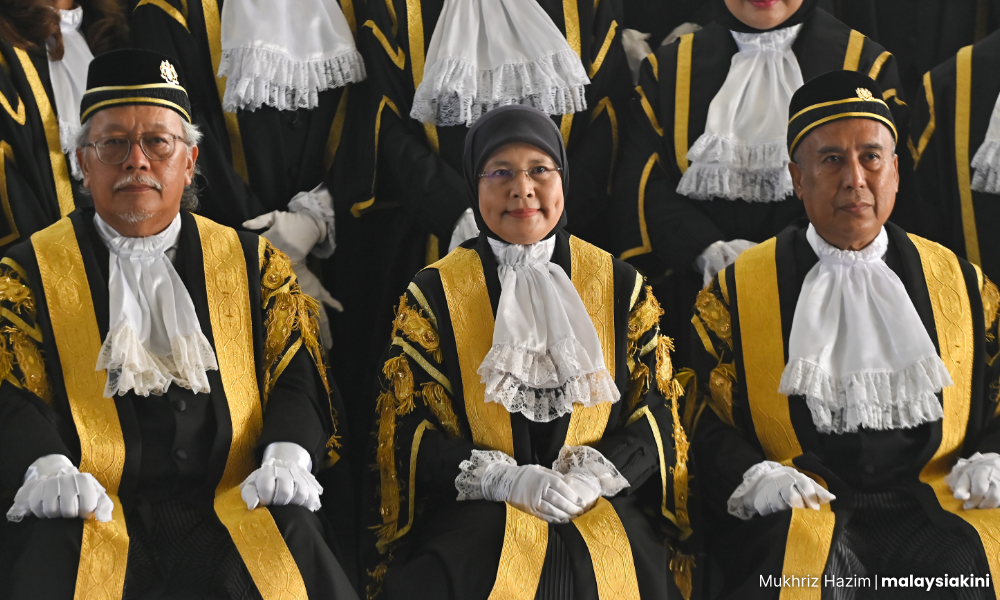
Likewise, the Court of Appeal president’s input is required for appointments of appellate court judges.
Meanwhile, Article 123 stipulates that judges must be Malaysian and have at least 10 years of experience in the legal system in one form or another, but no other criteria are mentioned.
However, since 2009, the vetting of candidates has first been done by the Judicial Appointments Commission (JAC).
Why the JAC?
Prior to 2009, the appointment of judges only followed the constitutional provisions, with the prime minister essentially picking judges after consultation with the head of the judiciary, at least in theory.
However, in 2007, a leaked video clip caught former senior lawyer VK Lingam purportedly discussing the brokering of judicial appointments and promotions, igniting furore.
The JAC was then proposed by the Malaysian Bar, which was endorsed by a Royal Commission of Inquiry that was set up to probe Lingam’s judicial brokering scandal.

The JAC, which officially came into formation on Feb 2, 2009, now acts as a gatekeeper to vet judicial candidates.
With the formation of the JAC came additional criteria for a person to be a judge, including their integrity, competence, objectivity, writing skills, and moral character, among others.
When candidates are up for consideration, the JAC conducts a secret ballot to decide whether to approve a candidate for the prime minister to submit to the Agong.
While the system effectively ends the direct-hire power of the government, the prime minister still holds a lot of influence on how judges are picked.
What power does the PM wield?
To understand this, we must first understand the structure of the JAC.
There are nine members in the JAC - four of them automatically appointed by virtue of their positions in the judiciary.
They are the chief justice - who is also the commission’s chairperson - the Court of Appeal president, and the two chief judges representing East and West Malaysia.
The rest of the members are appointed by the prime minister.
This includes one federal court judge and four eminent persons who are not members of the executive or other public service.
The selection of the four non-judges is supposed to be done in consultation with the Bar Council, the Sabah Law Association, the Advocates Association of Sarawak, the Attorney-General of the Federation, and the attorney-general of a state legal service, or any other relevant body.
Since the prime minister’s five appointees hold a majority on the nine-member JAC, those he selects have the decisive vote in recommending who becomes a judge.
This concentration of power raises serious concerns about judicial independence, especially since judicial candidates approved by the prime minister’s JAC appointees can hold key positions in the judiciary.
What about the tenure of judges?
Under the Federal Constitution, unless they retire or are removed due to disciplinary breaches, all superior court judges must retire at 66.
However, Article 125(1) stipulates that a judge’s tenure can be extended by a maximum of six months past retirement, with the approval of the Agong.
But here, the prime minister holds influence as well, thanks to the constitutional principle that the King acts on the premier’s advice.
Should the PM be removed from this process?
This is something that many legal practitioners are advocating for.
In her speech at the 24th Commonwealth Law Conference in Malta in April, Tengku Maimun voiced support for the call to remove the role of the prime minister in the appointment of judges.
“Of late, there have been proposals to amend the Judicial Appointments Commission Act 2009 and the Federal Constitution to remove the role of the prime minister in the appointment of judges.
“Such changes, in my view, would reinforce the impartiality of the selection process, ensuring that judicial appointments remain firmly grounded on merit and free from any perception of political influence,” she said.
Prior to that, in November 2022, the Yang di-Pertuan Besar of Negeri Sembilan, Tuanku Muhriz Tuanku Munawir, had also called for the removal of the prime minister’s power to appoint JAC members.
However, while the current prime minister, Anwar Ibrahim, has pledged non-interference in the judiciary, there has been no significant movement as of yet to make these recommendations a reality.
Related articles
Bar to hold EGM over judicial vacancies as CJ's term ends
On CJ's final day, DAP backs extension amid silence from Putrajaya
KINIGUIDE | On the appointment of judges and how PM has a role
COMMENT | Call for judges' tenure extension nothing to do with lobby
COMMENT | Anwar's Umno state of mind
COMMENT | Danger signs of public confidence erosion in our systems