




COMMENT | Public caning will not deter crime and sin
COMMENT | My wife and I don’t subscribe to corporal punishment for our kids. We don’t cane, slap, pinch, twist, spank or hit them in any way if they do anything wrong.
The reason why I’m doing this is because I am continuing the practice that my parents did when raising me. My parents also did not believe in hitting as a form of punishment for me and my siblings. They never laid a finger on us.
The problem with corporal punishment and hitting is that it only works to create fear in the child, the fear of getting caught. They fear the punishment that comes from getting caught and not necessarily the wrongfulness in whatever it is they did that resulted in the punishment. It would probably motivate them to not be caught rather than not do the wrong thing.
Another obvious fact is that corporal punishment and hitting are the easy way when it comes to disciplining children. Parents don’t really need to think so much because all they need to do is hit the child rather than teach them any reason. If a child does something wrong, just smack him or her. Simple, easy and not much of a hassle as compared to talking or discussing.
Hence, I am lucky to have the kind of parents I have.
COMMENT | My wife and I don’t subscribe to corporal punishment for our kids. We don’t cane, slap, pinch, twist, spank or hit them in any way if they do anything wrong.
The reason why I’m doing this is because I am continuing the practice that my parents did when raising me. My parents also did not believe in hitting as a form of punishment for me and my siblings. They never laid a finger on us.
The problem with corporal punishment and hitting is that it only works to create fear in the child, the fear of getting caught. They fear the punishment that comes from getting caught and not necessarily the wrongfulness in whatever it is they did that resulted in the punishment. It would probably motivate them to not be caught rather than not do the wrong thing.
Another obvious fact is that corporal punishment and hitting are the easy way when it comes to disciplining children. Parents don’t really need to think so much because all they need to do is hit the child rather than teach them any reason.
If a child does something wrong, just smack him or her. Simple, easy and not much of a hassle as compared to talking or discussing.
Hence, I am lucky to have the kind of parents I have. They always tried to explain things to us rather than hit us. It may have taken a longer time to make us realise right and wrong, but once the realisation sets in, it sticks with us forever.
Basically, we learn something. We don’t do the bad things we are not supposed to do because we know it’s wrong and not because we are scared of a beating.
So that is my opinion when it comes to the law and punishment in society as well, which means I am also against corporal punishment in the bigger scheme of things.
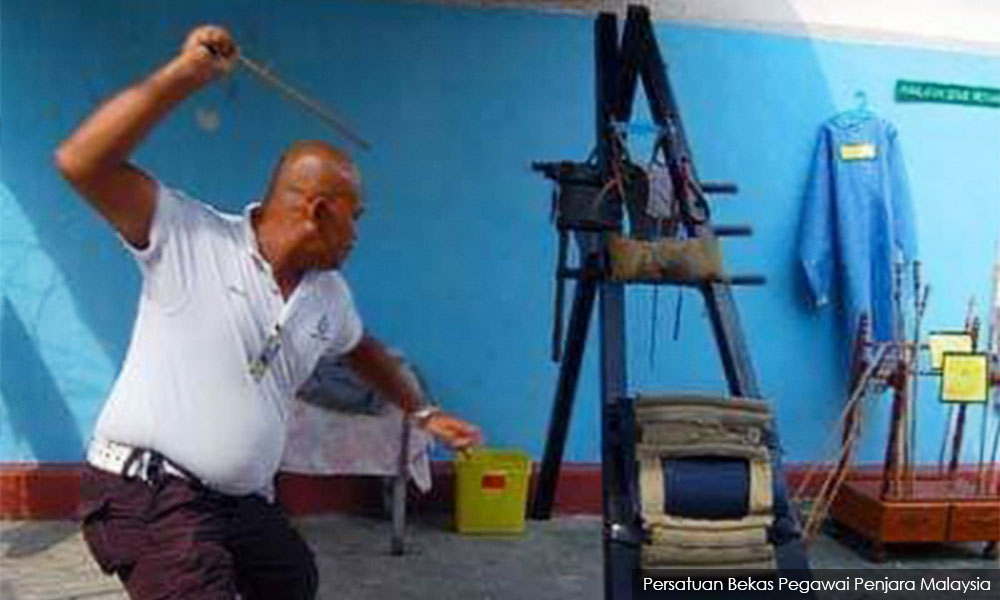
For example, I do not believe that the recent case in Terengganu where an individual was caned in public at a mosque for being caught in close proximity (khalwat) with a girl was the right thing to do.
First of all, this person has committed khalwat twice before this, and although he was only fined, he continued to do it for the third time. He was then sentenced to six strokes of the rotan. It is obvious that this individual didn’t think he was going to get caught. But like what the Malays say, “As clever as a squirrel jumps, it will eventually fall to the ground.”
We can probably assume that this individual probably isn’t that smart because he has already been caught so many times, and I guess he will continue to do it again in the future.
The only difference would be that he would find ways to not be caught. However, looking at his track record, he will probably be caught again if he were to commit khalwat again.
Never a good deterrent
Now we go back to my original point of not believing in corporal punishment. I still believe that fear will not make people do good things. It only teaches them to find ways to do wrong things and not get caught. But proponents of corporal punishment use that very wrong fact as their argument as to why it is a good idea to cane people - the fact that corporal punishment will deter people from doing wrong.
So how is the deterrent coming along? Have we managed to eliminate khalwat, or any other crimes that have corporal or capital punishment? I don’t think so. Khalwat still happens and so does murder, rape and drug trafficking.
In fact, countries that do not have corporal or capital punishment tend to lower crime rates of this sort as compared to Malaysia. One good example is the Scandinavian countries.
I understand that the case in Terengganu falls under the Syariah Court. Yet, I still do not agree. I believe that Islam is a religion that is suitable for all times and as time progresses, so does the maturity and knowledge of human society. Many psychology and behavioural studies have shown how corporal and capital punishments are never a good deterrent for crime.

Before all the religious zealots in Malaysia start screaming bloody murder and accusing me of questioning the religion, do take heed that the punishment meted out to the individual in Terengganu falls under “takzir” matters, which means discretionary. This means that the punishment is a choice made by the authorities and hence, it may be right or wrong.
Since it could be right or wrong, proper discourse and debate about it should be allowed. There needs to be a spirit of “shura”, or the practice of making decisions through collective discussion, when it comes to “takzir” matters. Only then can society progress and grow positively. Therefore, I think it is important that we highlight issues like this and encourage public discourse.
Base our decisions on science and research that have been done and see if any outdated and archaic practices can be abolished and done differently. We should not be living in a backward society and instead, strive to develop as better human beings and improve our society.
ZAN AZLEE is a writer, documentary filmmaker, journalist and academic. Visit fatbidin.com to view his work.
The views expressed here are those of the author/contributor and do not necessarily represent the views of Malaysiakini.









To me caning children and caning criminals are two worlds apart. The first caning is for the children to become good human beings in the future. I had a friend who has seven brothers. Now raising seven boys is not easy. My friend said his brothers were very naughty. Luckily they had a very strict father who use the all powerful rotan to teach and discipline the boys. Now grown up, my friend was always grateful to the father. He said it made him “human”. If the father did not be strict, he could have been a thief, a killer, a rapist or worst a drug addict. For me, it was a strict teacher. He too had the all powerful rotan by his side. I got a taste of the rotan too. I am no angel back in the day. But now, I became human. For that, I am grateful to my teachers. Nowadays, kids are very pampered. They cannot stand pressure. I had one graduate working in my company. I did not scold him. I did not throw file at him. I did not use foul language at him. All I did was told him, he has to meet a client at cameron highlands once a month, for which I guided him for the first month. The resigned 24 hours the following day. Kids today are soft, too soft. No caning? No rotan? Its the kids loss, never the parents or the teachers.