
COMMENT | 5G: Spectrum value, the Singapore link, and other issues
That model was agreed upon, signed, and sealed earlier in March 2021 but cavalierly abandoned in May 2023. U Mobile’s award was announced 17 months later on Nov 1, 2024.
The varying of the contract to include other parties - CelcomDigi and Maxis - is only a partial solution and will come with major risks to the roll-out of the 5G network and danger to the government-owned sole network operator, Digital Nasional Bhd (DNB).
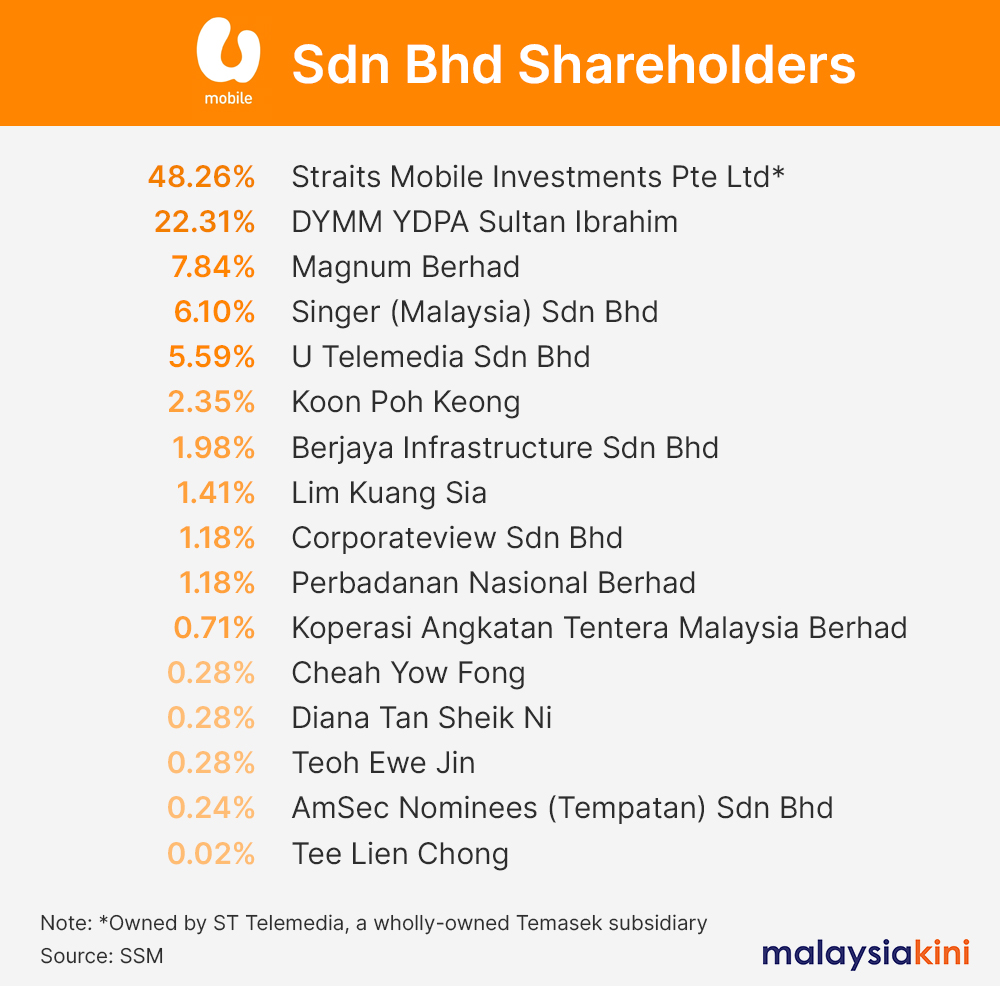
On top of that, things get rather complicated with U Mobile’s major and controlling shareholder - the Singapore government through Temasek Holdings owns a 48.3 percent stake in U Mobile via a wholly-owned subsidiary. This throws up key questions of valuation and disposal as we shall see.
Ever wondered why telecommunication companies fought tooth and nail against establishing a single network provider for 5G services and lobbied strongly against DNB as the sole provider of such services?
Spectrum, the magic word
The magic word is spectrum, the frequency band for transmission which...
COMMENT | Appointing U Mobile as the second operator of the 5G network in Malaysia has raised a plethora of problems that can only be solved with a return to the “one service provider” model.
That model was agreed upon, signed, and sealed earlier in March 2021 but cavalierly abandoned in May 2023. U Mobile’s award was announced 17 months later on Nov 1, 2024.
The varying of the contract to include other parties - CelcomDigi and Maxis - is only a partial solution and will come with major risks to the roll-out of the 5G network and danger to the government-owned sole network operator, Digital Nasional Bhd (DNB).
On top of that, things get rather complicated with U Mobile’s major and controlling shareholder - the Singapore government through Temasek Holdings owns a 48.3 percent stake in U Mobile via a wholly-owned subsidiary. This throws up key questions of valuation and disposal as we shall see.
Ever wondered why telecommunication companies fought tooth and nail against establishing a single network provider for 5G services and lobbied strongly against DNB as the sole provider of such services?
Spectrum, the magic word

The magic word is spectrum, the frequency band for transmission which in Malaysia is given totally free of charge to the telcos. These are worth billions and because they are given free, telcos can make quite a bundle from them.
In the US, telcos paid US$81 billion for 5G spectrum in 2021, yes a whopping RM356 billion, but here in Malaysia, we are giving it away for free- for free! In Malaysia, a former minister estimated it could be worth between RM6 billion and RM15 billion!
That’s why a single wholesale network was proposed as the model for Malaysia so that 5G costs to the consumer were the lowest possible. DNB got the contract and was to roll out the services for all. And yes, it got the spectrum for free.
The reason it was set up was because the telcos were taking their time to roll out 5G under a company they were to have set up. DNB has done a good job so far, raised financing on its own, was planning to get listed, and has met all major milestone targets, including coverage of 80 percent of populated areas.
According to Ookla in a report in September last year, DNB’s speed test ranking went up 45 places to 41st, eclipsing countries such as Indonesia, Thailand, Philippines, and Vietnam, as well as some developed markets, including the United Kingdom, Japan, and Germany.
After the Madani government came to power, DNB was still chugging along nicely. However, the government introduced considerable uncertainty by proposing a new entrant in the 5G space and threatening progress made by DNB.
The least qualified
On top of that, the least qualified of the three contenders for 5G has been chosen. The award of the right to 5G is done via a beauty contest, with no auction for the valuable spectrum. It’s hard to see how U Mobile qualifies as the table shows.
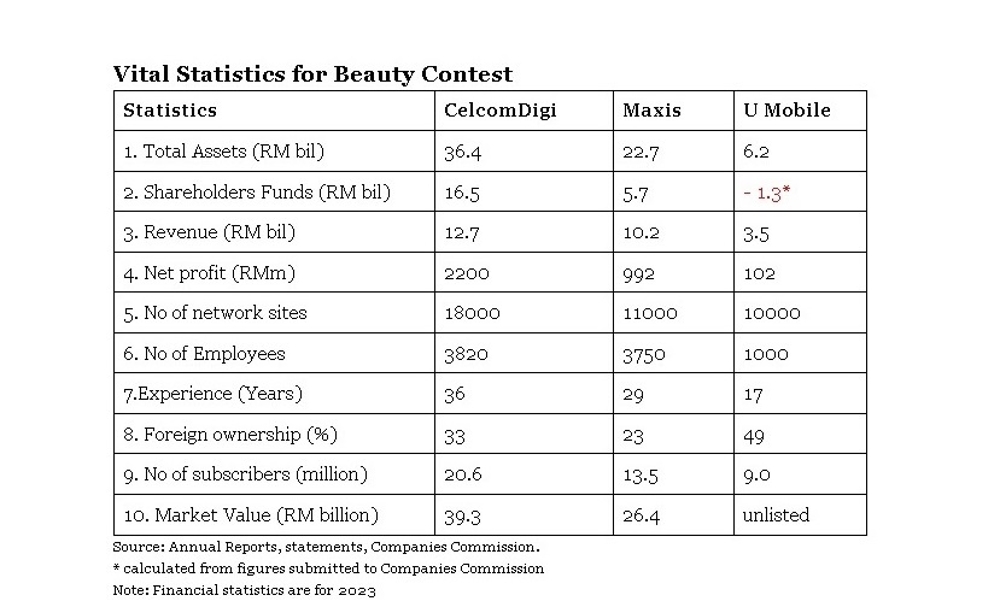
On every count, U Mobile is far inferior to the other two. In addition, there are three areas where the situation is particularly concerning - shareholders’ funds, profits, and foreign ownership.
U Mobile has not quite turned the corner as far as profitability is concerned. Companies Commission figures show its shareholders’ funds in deficit by RM1.3 billion with accumulated losses of RM3.9 billion exceeding the share capital of RM2.6 billion.
If it were listed, it would be a Practice Note 17 company under Bursa Malaysia’s listing requirements and would require a regularisation programme to return it to full main board status. It is unthinkable that an award of 5G has been made to such a company.
While it made a net profit of RM102 million in 2023, it is minuscule compared to CelcomDigi’s RM2.2 billion and Maxis’ RM992 million. A clear profit track record has not been established despite 17 years of operations. That’s rather worrying.
Singapore govt in control
The current major and controlling shareholder is ultimately the Singapore government through Temasek with 48.3 percent. As mentioned earlier, the 5G spectrum for Malaysia is valued at between RM6 billion and RM15 billion.
If we take the top end of this valuation of RM15 billion and allocate half to U Mobile, since DNB was allocated its share earlier, the value of this spectrum allocation alone is RM7.5 billion. Nearly half of this value or a huge RM3.75 billion will accrue to its major shareholder, ultimately Singapore.
Surely it would be more proper to allocate this to a company where there is much more Malaysian ownership and control for security and other reasons. CelcomDigi is currently 65 percent Malaysian while Maxis is 77 percent.
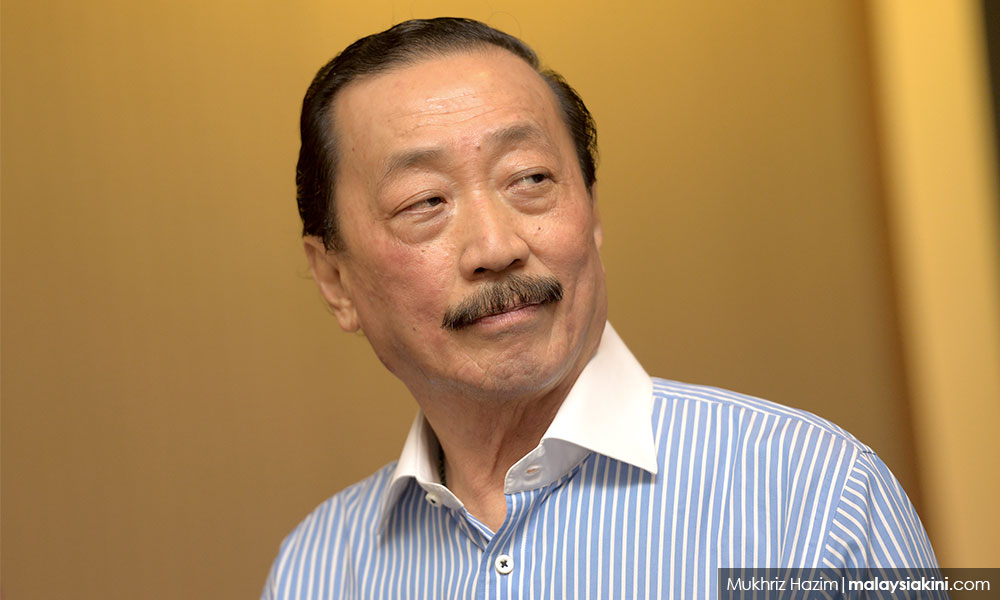
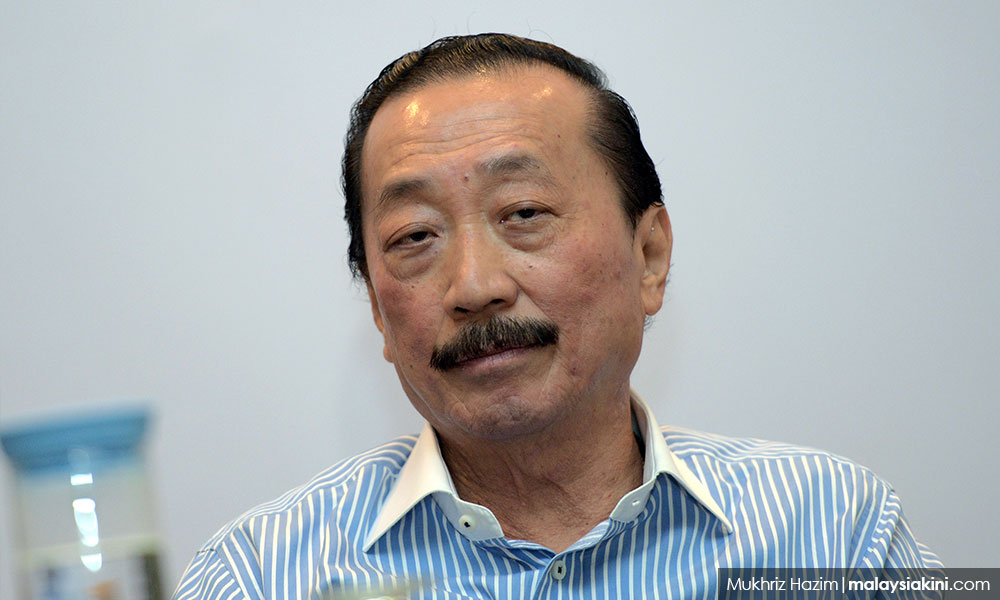
Yes, U Mobile chairperson Vincent Tan has said the Singapore shareholders will reduce their stake to 20 percent but the value at which they will reduce the stake will include the value of the 5G spectrum.
If the spectrum value is RM7.5 billion, that is the value that will be added to U Mobile. If the Singaporeans cash out now, they are cashing out on the 5G spectrum with no addition of value - a handout, in other words.
Renong deal was denied
In 2000, a deal to sell minority interests by the troubled Renong group in telecommunications companies Time Engineering and Time dotCom to SingTel, the government-owned Singaporean telecommunications company, for RM2.2 billion was jettisoned because of security and other considerations.
But now, the Singapore government is the major beneficiary of a deal to award 5G to the least qualified of the three telcos in contention, and is in a position to benefit from a cashout. This is unacceptable.
There are three options the government has in terms of this 5G contract.
Retract the award and give DNB back its due
This is the best deal for all parties, especially the general public. DNB has already rolled out 5G. Let it continue its job under the agreed parameters where other telcos will take a stake and have board representation to minimise conflict of interests and ensure equal 5G access to all parties at the same price. Competition will be at the front end.
Technically, there is already built-in duplication to avoid a simultaneous breakdown of the entire network. The transition to 5G under this will have the least risk and the most benefit to customers in terms of lower fees because 5G spectrum costs are free to DNB and this has been taken into account in pricing.
Revise the new award of 5G to a consortium
The consortium can include the two other main telcos, CelcomDigi and Maxis. To avoid duplication, they can be given the 20 percent not already covered by DNB and run that part independently. A less palatable alternative is to force DNB to give up part of its coverage, thereby handicapping it and reducing its value - unacceptable.
Another even less desirable option is to have open competition with DNB throughout Malaysia. The only way that can happen is if one of the players, probably CelcomDigi, takes the alternative 5G network because of its 50 percent market share. Presumably then the other two will go with DNB and there will be competition.
This costs more money and is a high risk - one or both of the 5G operators can get into trouble or they may join together anyway and set prices cartel-like.
Keep the status quo
This is the lousiest alternative but if it is chosen, there must be stringent conditions attached. The first is current shareholders must not be permitted to sell down their stakes. Yes, you read that right.
The reason is because of that value of as much as RM7.5 billion for the spectrum which we discussed earlier. The major shareholders must be required to stay in and make the project work, there must be a moratorium on sale for at least five years so they do not cash out.
Clearly, the best option is the first one. If only this government had the guts and gumption to do what is right and not pander to the demands of other people, crony or otherwise.
National interests take precedence over everything else.
P GUNASEGARAM says we absolutely need to get the 5G thing correct if we are to avoid billions in terms of wasted money and much more in terms of poor communications infrastructure. Let’s do what is right.
The views expressed here are those of the author/contributor and do not necessarily represent the views of Malaysiakini.