




Leopard tortoises going home to Tanzania
Sixty leopard tortoises smuggled into Malaysia last June will soon be re-shipped to their native Tanzania after it was announced on Sunday the East African government is ready to bear the cost of the repatriation exercise.
Sixty leopard tortoises smuggled into Malaysia last June will soon be re-shipped to their native Tanzania after it was announced on Sunday the East African government is ready to bear the cost of the repatriation exercise.
Tanzania's Permanent Secretary in the Ministry of Natural Resources and Tourism Donatius Kamamba said the government was only waiting to be informed by Malaysia of the estimated costs of the repatriation exercise, reported the African nation's Sunday News.
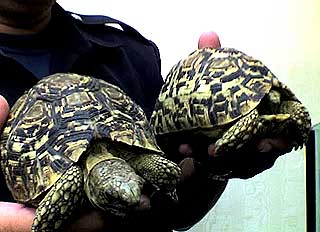 Kamamba quoted Article VII of the Convention on International Trade in Endangered Species of Wild Fauna and Flora (Cites), which stipulated that the country of origin of confiscated specimens which are to be repatriated is obliged to bear the cost.
The announcement puts an end to almost three months of haggling between Malaysia and Tanzania about details of the handover. The tortoises are currently held by the Department of Wildlife and National Parks in Kuala Lumpur.
At least 13 were reported to have died from the original 76 since they were seized on June 12 by Pos Malaysia officials at the Kuala Lumpur International Airport (KLIA).
'Criminal gangs'
The officials were suspicious of the parcels - bearing the description 'claypots' - that originated from Tanzania.
Leopard tortoises come under the Cites appendix II - species of which can be traded though under strictly-controlled provisions.
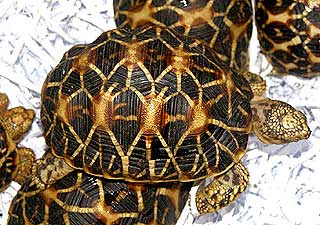 Less than a month before their seizure, 404 Indian Star Tortoises were
confiscated
by KLIA officials from an Indian national who was hand-carrying the reptiles in cloth bags.
Less than a month before their seizure, 404 Indian Star Tortoises were
confiscated
by KLIA officials from an Indian national who was hand-carrying the reptiles in cloth bags.
The 385 who remained alive were sent back to India - which has banned the export of its Star Tortoises since 2001 - in mid June.
Criminal gangs are said to be using Malaysia as a hub for exporting millions of dollars worth of wildlife for the Chinese market.


