




Politics-free education needed
No matter what spin the Education Ministry, and the politicians put on it, the unpalatable fact is that the teaching of science in the English language as with the earlier myopic Bahasa Malaysia only policy - in the primary and lower secondary schools, has been an unmitigated disaster.
Meanwhile, the standard of Chinese as well, continues to go to the dogs although the same cannot be said to be entirely true of Tamil.
No people, except perhaps for the French, love their language as much as the Tamils. There are few statistics available on Punjabi, Iban and Kadazandusun. Bajau is just beginning to be taught under an entirely private initiative by a community association.
Don't the politicians simply love to experiment with the education of our children? And they often wonder why so many people cite the education of their children as the main reason for literally fleeing the country.
No matter what spin the Education Ministry, and the politicians put on it, the unpalatable fact is that the teaching of science in the English language as with the earlier myopic Bahasa Malaysia only policy - in the primary and lower secondary schools, has been an unmitigated disaster.
Meanwhile, the standard of Chinese as well, continues to go to the dogs although the same cannot be said to be entirely true of Tamil.
No people, except perhaps for the French, love their language as much as the Tamils. There are few statistics available on Punjabi, Iban and Kadazandusun. Bajau is just beginning to be taught under an entirely private initiative by a community association.
Don't the politicians simply love to experiment with the education of our children? And they often wonder why so many people cite the education of their children as the main reason for literally fleeing the country.
That does not mean that the local children of other countries are doing well in education either in fact, most local kids in the west, for example, don't stand a ghost of a chance against children from Asian countries but at least they are not bogged down by a system run by semi-literate politicians.
In recent years, we have been forced to plead with those who left the country to come back and put the oomph back in the local scene.
The democratisation of education and catering to the lowest common denominator does not mean we must forget where to draw the line.
 On balance, the teaching of mathematics in English appears to have been an unqualified success and has no doubt contributed in no small measure to increasing proficiency in the English language.
The same cannot be said for maths standards since our students, like our people in general, are loathe to think or ask too many questions in class, if any.
Maths is the easiest subject to score, and teach, but unfortunately our teachers are lagging behind partly through no fault of their own.
The Bahasa Malaysia factor
Five years later, there are accusations that the English only policy in science and maths has relegated Bahasa Malaysia a sometimes not so careful blend of Bahasa Melayu, local and Nusantara dialects and English to the backwaters in education and imperiled its status as a still emerging modern language of communication, science and technology.
The fact that September 2007 has been declared Bahasa Malaysia month is a telling factor.
Bahasa Malaysia has now become increasingly irrelevant in the era of globalisation and all the hard work on science terminology, undertaken by a diehard core of nationalists and patriots in Dewan Bahasa dan Pustaka over the last half century, consigned ingloriously at the stroke of a pen to the dustbins of history.
To be fair, BM was irrelevant as well in the pre-globalisation era when all teaching, except for the vernacular, was done in that language only.
 Now, we are getting into semantics over the terms Bahasa Malaysia and Bahasa Melayu, the latter a beautiful but long dead language a fact still unacknowledged, when the dropping standards of education in the country, by extension synonymous with the politicisation of education, remains perhaps the single most serious issue that haunts our future.
Education and lifelong learning will make or break our collective national efforts to eradicate poverty, bridge the growing gap between the haves and have-nots and keep us productive and competitive as a nation and still relevant in an increasingly globalised world economy.
The old ways no longer work and we are yet to find new ways for a brave, new world.
Anyone who has stepped into our schools would know that the great majority of our students hardly know 10 percent of the English words used in the science books or, for that matter, in their English language textbooks and workbooks.
This is not a contradiction in terms considering the success with English for maths. All this makes us really wonder what the teachers are doing during English language lessons.
It's amazing when thousands of children can go through years of schooling and yet be unable to even read at the end of it.
Matters are not made any easier in Bahasa Malaysia either, especially among the non-Muslim Bumiputera communities in Sabah and Sarawak. Anything in Bahasa Malaysia sounds like ancient Greek to these communities.
It must be remembered that Bahasa Malaysia has borrowed heavily from English over the last fifty years and when one is weak in English, the result logically is weakness in Bahasa Malaysia too.
Even native speakers find Bahasa Malaysia difficult to master, unlike in the old days, when the Malay community stamped their dominance in the Malay language and had an edge over the non-Malays at least in this one area.
Increasingly, our best students in Bahasa Malaysia are non-Malays, generally Indians and Chinese who, unlike native speakers, don't take the language for granted.
Meanwhile, Malay artistes are happily murdering the language with bad grammar and singing in an unplaceable "Mat Salleh" slang which makes the hairs stand and leaves one cringing in embarrassment especially when native English-speaking foreigners are around.
Hence, the cycle has come full circle.
A total revamp necessary
Generally, language standards in Malaysia are low although, unlike the English who can't manage even their next door French, Malaysians can rightfully pride themselves on their ability to speak several languages and dialects.
Many Chinese students themselves fare poorly in the Chinese language under the present vernacular education set-up in Malaysia.
The politicians have been quick to attribute this state of affairs to the teaching of science and mathematics in English but the records show that most Chinese students in Malaysia have never done well in their mother tongue for a variety of reasons.
Malaysia is yet to produce even one novelist of repute in Chinese. The Tamils have done better with their language. Malaysian Tamils can still wax lyrical over their language.
Why the sudden turnaround from doggedly teaching science and maths in Bahasa Malaysia for many years 'Bahasa Malaysia will be only dropped over my dead body and that of Tun Razak too,' thundered Education Minister Abdul Rahman Yakub and bring back the English language as a medium of instruction for all science subjects and mathematics in schools and in tertiary education?
Many stories are making the rounds, some very humourous, not all entirely true but certainly very entertaining on rainy nights when faced with endless re-runs on Astro.
If education is to make any sense at all in Malaysia, and enhance its reputation as a global centre of excellence in education, there's a dire need to depoliticize the sector. An obvious first step should be the abolishment of the Education Ministries there are two and their replacement by a National Education Commission appointed by Parliament and the King, and, at the lower levels, state education boards and district education committees.
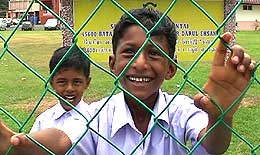 This would mean that a Bidayuh child, for example, will have the right to a state education in his mother tongue, a universal right, during the nursery, pre-school and primary school years and not in Bahasa Malaysia or English which would just be language subjects.
Even so, maths is best taught in English from the nursery school level to improve English language standards in the country.
In lower secondary, the Bidayuh child would learn the Bidayuh language and literature, maths in English, the science subjects in two languages i. e. Bahasa Malaysia and English, the English language and literature, Bahasa Malaysia and sastera, and other subjects in two languages i. e. Bahasa Malaysia and Bidayuh.
Identifying the deserving students
In upper secondary and Form 6, the Bidayuh student would learn the Bidayuh language and literature, maths in English, the science subjects in English only, English language and literature, Bahasa Malaysia and sastera, and other subjects in Bahasa Malaysia only.
The universities should use both Bahasa Malaysia and English as the medium of instruction, not English only, and students should be allowed to answer in either of the languages, or if they so wished, in any of the other languages taught in Malaysian schools.
This is of course easier said than done since science teaching would be easier done in the English language only but the idea is not to compartmentalise too much or set up artificial barriers.
Private schools should be allowed in any medium of instruction and encouraged. This would facilitate the opening of English medium only schools as well and attract a greater number of foreign students.
The market will decide which ones survive. Scholarships, state and private, should be given to deserving students who cannot afford to attend such schools.
 Also, the role of the Dewan Bahasa dan Pustaka should rightly be expanded beyond Bahasa Malaysia to include English, Tamil, Punjabi, the Orang Asli languages and dialects, the native languages and dialects of Sabah, Sarawak and Labuan, and Mandarin.
Education Minister Hishammuddin Hussein announced this week that the results on the review of the teaching of science and maths in English in primary schools will be announced some time this year and not in 2008 as it had earlier been decided.
This looks more and more like a political decision under pressure from MIC and MCA and with national polls around the corner.
Otherwise, this would be a good time to have a good, long, hard look at education in Malaysia. Politics should definitely be kept out.
JOE FERNANDEZ @ Fernz is an educationist and former newspaper editor who feels compelled to put pen to paper when something doesn't quite jell with his weltanschauung (worldview). Otherwise, he's happily working on a semi-autobiographical travelogue, his first and long overdue, and teaching English privately.


