
COMMENT | Being rational about the ringgit
The answer to both questions is a resounding no!
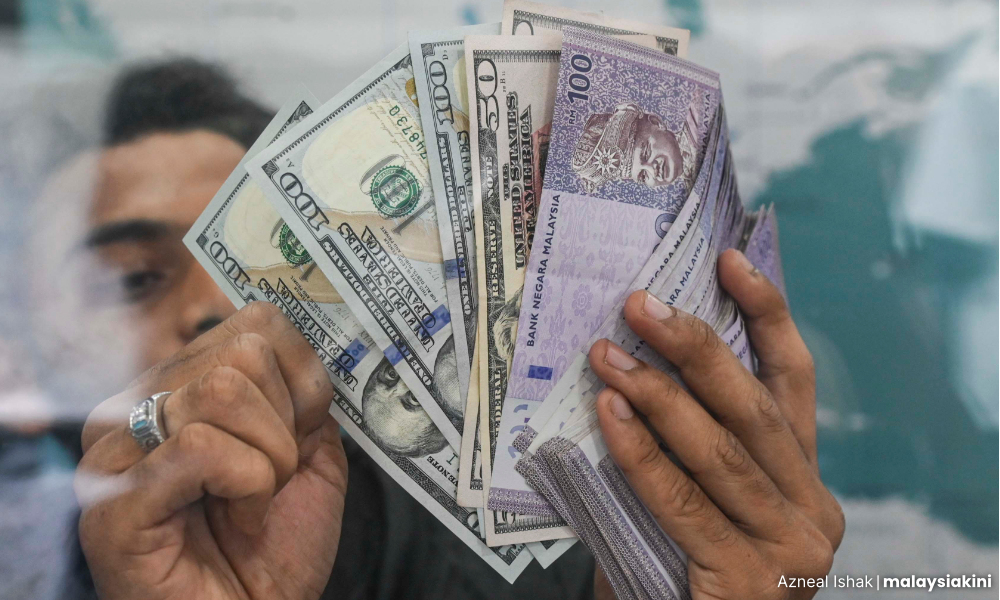
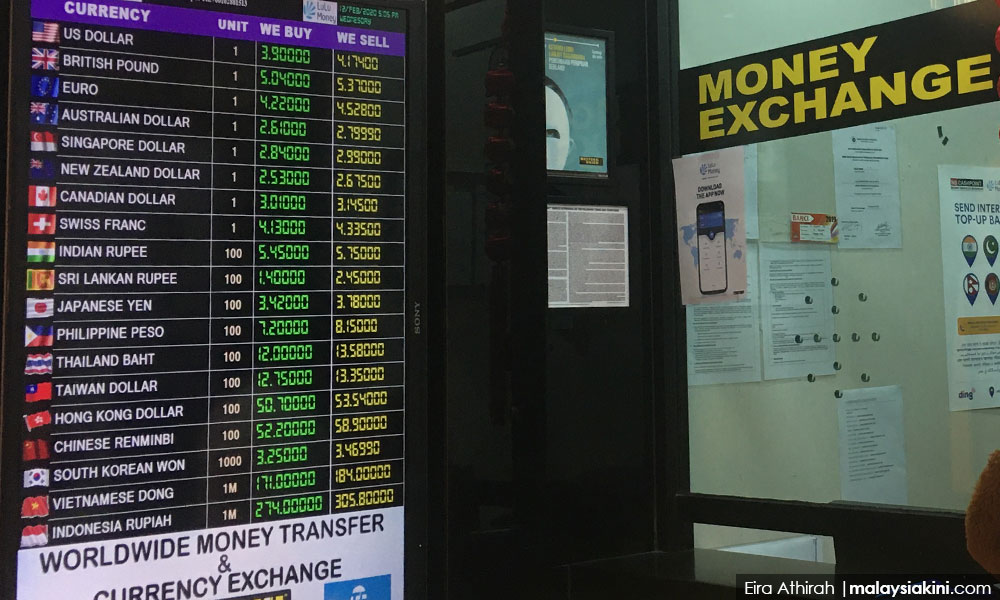
This Madani government cannot claim credit for short-term movements in the ringgit just as they are not to blame for the most recent decline of the ringgit from around 4.1 to the US dollar to the 4.3 mark and the decline earlier this year.
As anyone who knows foreign exchange markets and any economist worth his salt will tell you, short-term movements in the ringgit are due almost entirely to immediate demand and supply for the currency.
Short-term demand can be affected by things such as delays in the remittance of US dollar earnings to Malaysia for various reasons and even converting US dollar loans to ringgit proceeds.
The former delays a demand for ringgit. The latter increases the short-term demand for the ringgit although the long-term effects may be deleterious if the loan taken is not wisely used to earn foreign exchange but is squandered instead.
Repayment in US dollars means outflows. Think 1MDB for instance.
The true test of whether economic policies are actually working to increase the ringgit’s value is...
COMMENT | Were Prime Minister Anwar Ibrahim and his Madani government responsible for turning the ringgit around? And were they responsible when the ringgit declined earlier this year?
The answer to both questions is a resounding no!
This Madani government cannot claim credit for short-term movements in the ringgit just as they are not to blame for the most recent decline of the ringgit from around 4.1 to the US dollar to the 4.3 mark and the decline earlier this year.
As anyone who knows foreign exchange markets and any economist worth his salt will tell you, short-term movements in the ringgit are due almost entirely to immediate demand and supply for the currency.
Short-term demand can be affected by things such as delays in the remittance of US dollar earnings to Malaysia for various reasons and even converting US dollar loans to ringgit proceeds.
The former delays a demand for ringgit. The latter increases the short-term demand for the ringgit although the long-term effects may be deleterious if the loan taken is not wisely used to earn foreign exchange but is squandered instead.
Repayment in US dollars means outflows. Think 1MDB for instance.
The true test of whether economic policies are actually working to increase the ringgit’s value is if there is sustained long-term strengthening of the currency over at least a year which can be traced back to policies and their implementation.
Then it might be possible, note I use the word “might”, to tie the strength of the ringgit to the strength of the economy.
The strength of the ringgit in the long term can only be supported by a continuous net inflow of foreign exchange into Malaysia over the period, resulting in greater demand for the ringgit and hence its revaluation upwards.
Comparison with Singapore dollar
It is instructive to look at how the ringgit has performed over the very long term and compare it with a country whose currency used to be on par with ours but is now more than three times ours - Singapore.
Let’s look at the two charts. If you want to get exact figures, go to this link.
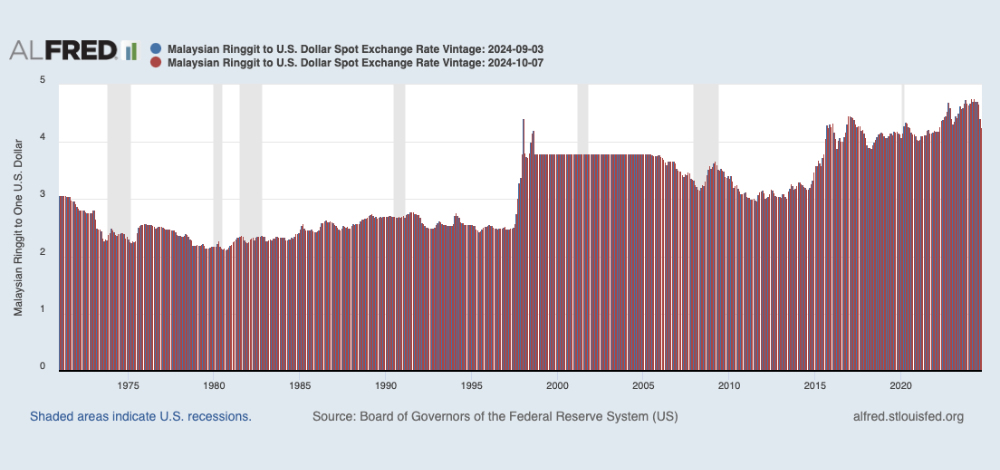
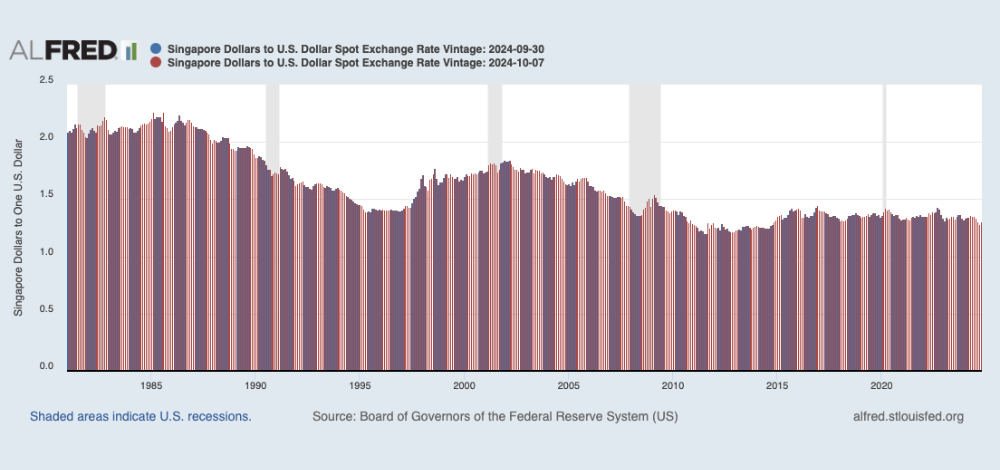
There are some important landmarks for the ringgit and the Singapore dollar. The first was in 1973 when the Bretton Woods arrangement of fixed currencies was fully abandoned and currencies began to float.
Before that, the ringgit was at RM3.06 to the US dollar (see Chart 1).
Note that exchangeability between the ringgit and the Singapore dollar was also abandoned in 1973 although they moved in tandem until around 1981, 16 years after the separation of Singapore from Malaysia in 1965.
In 1981, they both actually strengthened to a healthy 2.2 to the US dollar from 3.06 at the end of the Bretton Woods Arrangement in 1973. Since then, they started to diverge steadily.
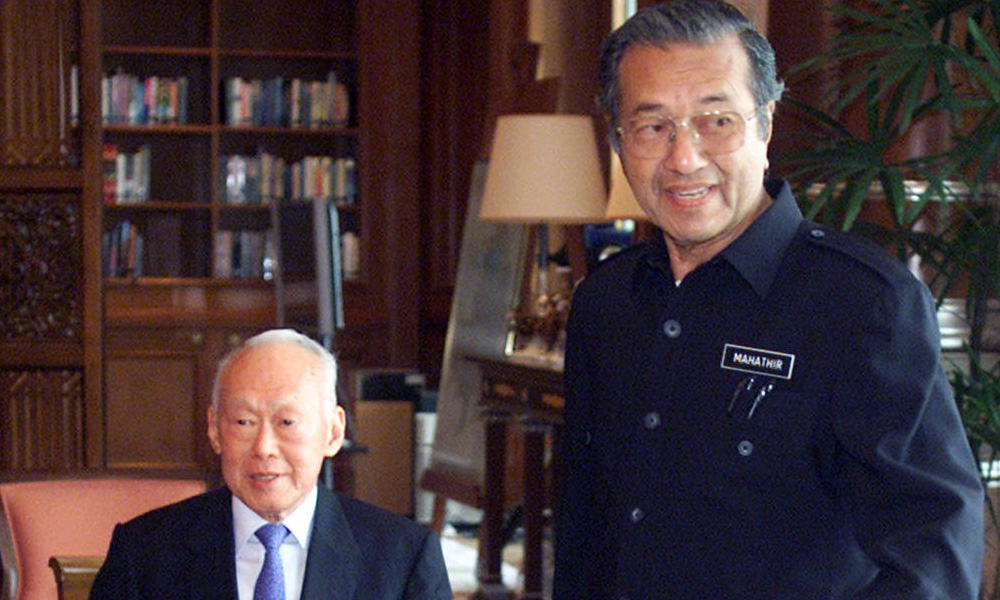
This coincided with Dr Mahathir Mohamad becoming prime minister of Malaysia in 1981. He experimented with moving into heavy industries and a low-wage environment, allowing large imports of migrant labour. There were many other wrong policies.
Before the onset of the Asian financial crisis of 1997, during which time Mahathir was still PM, the Malaysian ringgit was 2.6 to the US dollar in January 1996, and the Singapore dollar was 1.4. The gap had widened considerably over the 16 years since 1981.
Post the crisis, the ringgit was pegged at RM3.8 to the US dollar, and the Singapore dollar floated at 1.7.
Fast forward to the situation now, the ringgit is 4.3 to the US dollar - lower than the pegged rate of 3.8 post-crisis and not far off from its lowest monthly average during the crisis of 4.5 to the US dollar. That’s really an abysmal performance!
The Singapore dollar is now 1.3. Our currency is less than one-third of Singapore’s. Singapore is firmly back to its pre-1997 level, we are not. That’s a terrible record by any measure when compared to Singapore.
High productivity, excellent education
So, what’s the difference? What do we do to get the ringgit stronger and thereby increase the wealth of the nation by being able to buy more for the same amount of ringgit?
Foreign exchange inflow increases the value of the ringgit and sustains it. That means you need stability - politics, economic policies, and sustainable high growth. That will inspire confidence and help keep the money in and bring more in.
Next, we need to export more than we import. Importing millions of foreign workers is not the answer. Much of the cost of labour goes out in terms of remittances and rich owners of capital also keep their money overseas. That will not benefit local labour and citizens.
The answer is high productivity spearheaded by a highly trained workforce produced by an excellent education system.

This is the only way to get high-value-added industries to increase economic growth and export earnings, proven time and again in countries like Japan, South Korea, Taiwan and, yes, Singapore. They all require a range of policies and implementation.
Another is greater self-sufficiency in terms of food and services. You need to re-emphasise agriculture which Mahathir de-emphasised.
You need appropriate education and research. Instead, our agricultural university has become one of the many degree and PhD mills.
In short, we are where we are relative to Singapore because their government was and is much better, and their economic policies were well considered and implemented efficiently with no massive costs of corruption and patronage. And their education system was and is top-class.
When the Madani government starts addressing these problems meaningfully, the ringgit will strengthen, not overnight, but when results start to show, there is a continuing clear commitment to long-term sustainable change for the better.
Then and only then, after a few years of persistent strength in the ringgit, can this Madani government take credit for the strengthening of the currency. Lamentably, we have seen way too little in that direction so far.
P GUNASEGARAM says underachievers often claim credit for fortuitous events.
The views expressed here are those of the author/contributor and do not necessarily represent the views of Malaysiakini.