


/file/publisher-c1a3f893382d2b2f8a9aa22a654d9c97/2020/06/d2f3dd42cf46ee644ca94aa72ab81bf5.jpg)

COMMENT | Working with time to cultivate local films
COMMENT | In times of intense political debate, local filmmaking might not be the most urgent thing to discuss.
Then again, when do we not have intense political debates?
The state of our local moving image and filmmaking ecosystem is of concern, as seen through the occasional parliamentary questions, controversies around censorship, and the compassionate visits by top officials to sick and afflicted industry veterans in dire straits.
There needs to be an intentional discussion over how we can develop our film ecosystem...
COMMENT | In times of intense political debate, local filmmaking might not be the most urgent thing to discuss.
Then again, when do we not have intense political debates?
The state of our local moving image and filmmaking ecosystem is of concern, as seen through the occasional parliamentary questions, controversies around censorship, and the compassionate visits by top officials to sick and afflicted industry veterans in dire straits.
There needs to be an intentional discussion over how we can develop our film ecosystem across its commercial, independent, arthouse, and experimental forms to figure out what can be done to empower local practitioners, develop the ecosystem’s growth, and keep it sustainable.
Not quite different, not quite the same
Over the past few months, my collaborators and I spoke to film practitioners from different backgrounds in Malaysia and the UK, culminating in a week-long residency within the grounds of Slade Farm Organics in South Wales where we put together our responses and key learnings in the scenic coastal village of Southerndown.
These questions of sustainable development and regenerative growth for local film production were what my collaborators, Phoebe Davis, Fieldwork Studio, Wales, and UK-based film programmer and independent film producer Qila Gill, spent time exploring, with support from the British Council’s Connections Through Culture grant.
What I found interesting was how similar the experience was for practitioners. While there are differing levels and forms of restrictions and obstacles experienced, there are also similarities that can be seen in terms of access to resources, governmental and private sector preferences that influence the types of projects that get supported, lack of grassroots infrastructure and artistic support, as well as income precarity among practitioners.
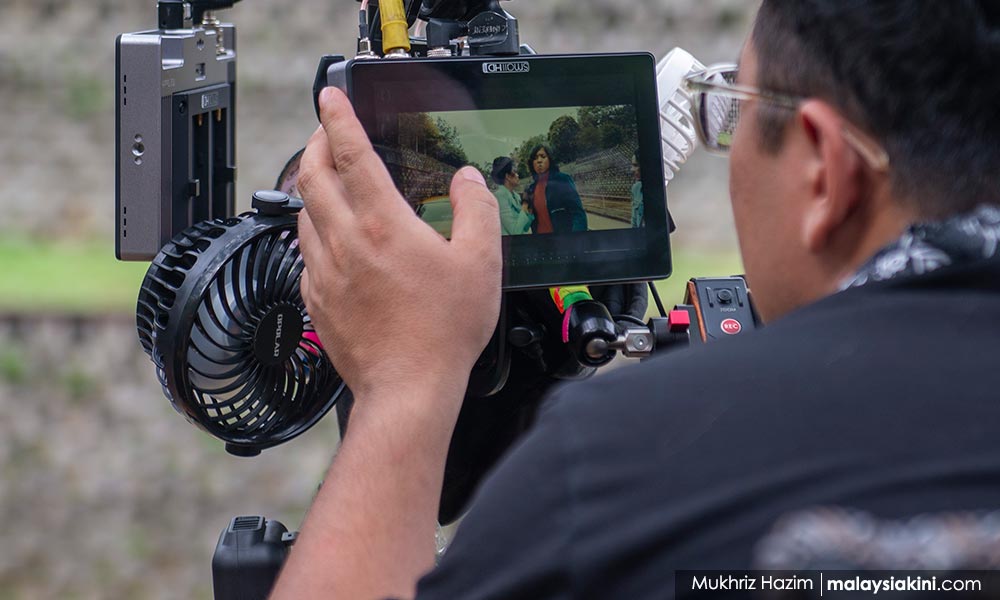
My conversations with moving image and film producers in Kuala Lumpur, Wales, and London on their struggles and challenges revealed that there is a great amount of shared experience despite operating in very different cultural, religious, and governmental regimes.
At some point during these exchanges, I felt a sense of déjà vu. It seemed that the same issues and concerns could be heard around the table at an Indian Muslim eatery in Bangsar, Kuala Lumpur more or less in the same way they were shared at our residency venue in South Wales.
There was also a shared interest in rediscovering alternative ways of film- and culture-making that do not solely revolve around mechanical production and resource exploitation. There is also a need to decouple from prescriptive forms of cultural policy (more formally expressed in Malaysia through the National Cultural Policy which sets very clear paradigms of “Malaysian” culture).
The term rediscovering is used here as it harks back to the period before digitisation and mass industrialisation, where forms of arts and culture were produced locally. Films as a relatively recent form of cultural production may not have direct historical examples, but there are analogues through the types of storytelling that existed within communities.
Conventional traditional Malaysian examples of this would be the epics of the wayang kulit and bangsawan troupes of yesteryears, but in more contemporary times we should also look at the “Kaki Step” scene emerging from Perak, the many different types of subcultures like the Mat Motor, punk and skinheads, and other scenes producing art in local idioms and languages (eg Kadazan, Kelantanese, etc).

Without formal support and guidance, distinct local cultures have managed to emerge - the question here is not how we can encourage their further growth and development, and prevent them from burning out.
What are the necessary principles that we can adopt and adapt to enrich our contemporary cultural practice, specifically for moving image and filmmaking?
Umbra of the obvious
To say that filmmaking is expensive and challenging is stating the obvious. There is no sure-win formula to making commercially successful films, even when producers set out to make titles as audience-friendly and conventionally attractive as possible.
It is also a very steep mountain to climb for makers of independent, arthouse, and experimental films where commercialisation sounds great in theory, but in practice is hard to obtain.

The expectation for all films to make money flattens the different types of moving image and filmmaking that exists and creates highly restrictive barriers for practitioners that affect the subject, depths of expression, and artistic innovation of their works.
The barriers become even higher for filmmakers who operate in regional areas and smaller towns and villages without the same level of resources and support available.
That would be a lost opportunity to encourage the growth and development of distinct talents and forms that emerge from within local cultural contexts, where the gaze comes from and is fixed on concerns that would have been lost in the larger national or global culture-making machine.
Digital tools and platforms that break the monopoly of resources and access have given us a glimpse of a wide expanse of talents and stories that remain to be told, and occasionally we are able to discover them through inclusive platforms like the Freedom Film Network, or labours of love like Wayang Budiman, and to a certain extent the locally sensitive algorithms of social media platforms.
Yet at the same time, this culture of local filmmaking, and by extension the wider rubric of locally responsive culture-making and innovation, needs to be embedded deeper within the community’s consciousness.
It is not easily accomplished. The same forces of digital disruptions that have made it possible for anyone to make and distribute a film have also impaired the film industry’s ability as a whole to generate income.
The combined effects of digital innovation (including piracy, the commodification of content, and potentially generative AI) have forced a deep consolidation of media businesses to the point that today there are only a handful of large companies, domestically and globally, that produce the vast majority of films, TV programming, and other types of content.

Even then, margins are thin. Specifically for Malaysia (although not unique to the country), restraints via government policy either through explicit or implicit censorship regimes and limiting policies either in the form of permits for production, exhibition of works, or taxation and duties, dampen productive forces even more.
What this all means is that most industry (if we can still call it that) participants cannot expect straightforward market logic to function to enable them to continue making works and live dignified and comfortable lives.
Drawing lessons from nature
While these are two critical constraints that are often cited for the difficulties faced in motion picture production, they cannot be seen in isolation from the wider ecosystem of factors, participants, and logic that end up shaping filmmaking communities around the world.

Through our residency, we listened to the views and concerns that practitioners raised and at the same time drew heavily on the experiences of organic farming and permaculture to find an expression of principles that would allow local filmmaking to grow.
An organic farmer would have to patiently wait for the soil’s nutrition to come back into balance before the first seeds can be planted, and even then there needs to be further experimentation of what types of vegetables and produce would naturally thrive in a specific place.
Drawing inspiration from that, we wanted to understand what it would mean for moving image practitioners to work within a longer time scale and their locales.
How can we work with and channel naturally occurring resources around us, as well as improve the ecological health of the cultural space? At the same time, we cannot neglect the need to earn livelihoods and some profit to enable the continued growth of these spaces.
This is not a rejection of mass commercial production, but rather accepting it as one of many forms and purposes of production. It is recognising that the scale of production needs to be varied; commercial viability should not mean a one-size-fits-all national and global success. There needs to be an allowance for gradations of financial success that fits the different budget sizes and capacities of film works.
Similarly, the government ultimately is one component of a wider ecosystem that needs to be in sync and harmonious with the rhythms of growth.
The government is of course a critical and highly significant player due to the extent of its financial, legal, and political might, and it’s important that its actions nourish and empower organic cultural production rather than become the de facto enabling force for filmmaking and other forms of cultural production.
Government intervention, when necessary, must be responsive to the cycles of growth of the wider film community.
At this initial stage, education is a key part towards enabling an organic and sustainable film environment, which must extend beyond formal training and appreciation through schools and colleges.
The point of choosing to consume local and organic art without the polish and marketing power of media giants must be widely spread among the general public and viewed as a form of awareness and discernment not dissimilar to the choice to consume what is halal (permissible) and tayyib (good, ethical, and wholesome).

Works themselves must be accessible, whether formally or informally, to the curious public, in the dense urban areas and also in small towns and villages. Practitioner communities also play a role in offering mutual aid, advice and cross-pollination of ideas, including in the development as well as commercialisation of work.
As alluded to in the title of “working with time”, these are intentional and organic processes that would require patience and perseverance from practitioners, supporters, and the community at large, before the first fruits can be harvested. The choice is not binary between mass-produced and organically grown culture, but they exist side by side.
It is a choice to empower our own talents, raise our own voices, and share our own stories for the enrichment of our society, without rejecting or isolating ourselves from the world at large.
This is an invitation to ponder on these ideas to find ways we can contribute to building our moving image and film ecosystems.
LUTFI HAKIM ARIFF works at the intersection of media, policy, and politics. Currently on an education sojourn in the US.
The views expressed here are those of the author/contributor and do not necessarily represent the views of Malaysiakini.
/file/publisher-c1a3f893382d2b2f8a9aa22a654d9c97/2024/08/e6bc48cc07c218867c4cca5c4f0329f0.jpg)
/file/publisher-c1a3f893382d2b2f8a9aa22a654d9c97/2024/08/7b301faff9ab5b42a27b406dca0c0a98.jpg)
/file/publisher-c1a3f893382d2b2f8a9aa22a654d9c97/2024/07/aaf25c1873b36c3d07cfc2f4d2007190.jpg)
/file/publisher-c1a3f893382d2b2f8a9aa22a654d9c97/2024/07/23614ee4f93a6e7180b8665a337b1287.jpg)
/file/publisher-c1a3f893382d2b2f8a9aa22a654d9c97/2024/05/843d22b486eede21d25cc483fdac1027.jpg)


