


/file/publisher-c1a3f893382d2b2f8a9aa22a654d9c97/2024/08/0a5cabacff5002cef468f6d74c16624c.jpg)

OECD recommends govt implement GST, carbon emissions tax
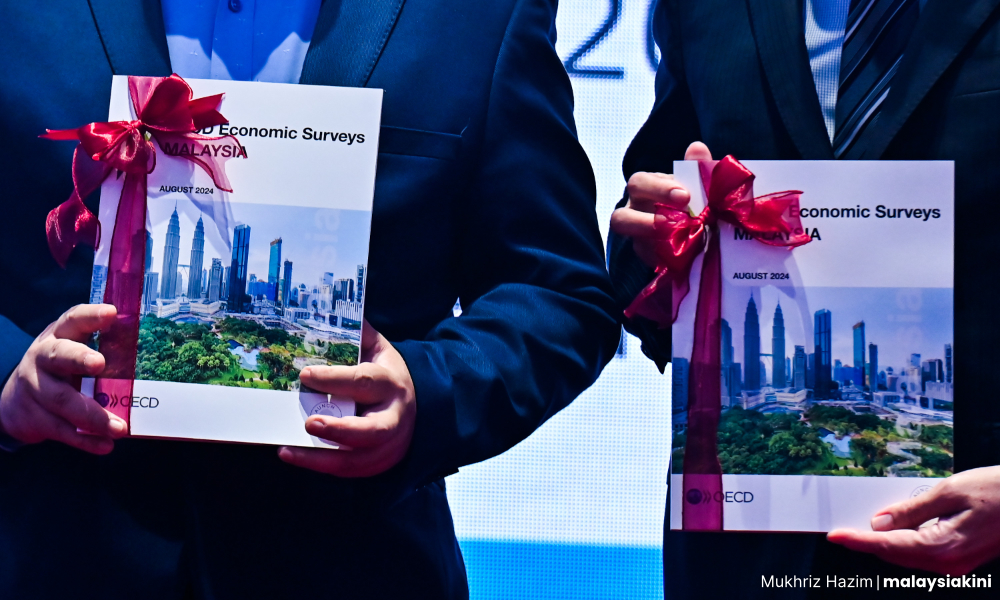
The OECD’s Malaysian economic survey for 2024 said this has to be done because the country needs to increase its revenue as tax receipts only account for 12 percent of the country’s gross domestic product (GDP).
“Most OECD countries have made...
The France-based Organisation for Economic Co-operation and Development (OECD) recommended that Malaysia reintroduce its goods and services tax (GST).
The OECD’s Malaysian economic survey for 2024 said this has to be done because the country needs to increase its revenue as tax receipts only account for 12 percent of the country’s gross domestic product (GDP).
“Most OECD countries have made value-added taxes a central pillar of their tax system because these taxes are friendly to economic growth and create very little distortions in the economy overall, and also because they are relatively simple to enforce and difficult to evade.
“Malaysia could follow this OECD best practice by reintroducing the GST, which was abolished in 2018,” said Luiz de Mello, country studies branch director of the OECD’s economics department.
Any possible regression could be offset via targeted aid to vulnerable households, he added.
He also suggested that the personal income tax group could be broadened.

In response, Economy Minister Rafizi Ramli neither confirmed nor denied the government’s plans to reintroduce the GST when asked by reporters.
“There are many ways to strengthen the fiscal (position), different groups have different views, and these matters will be discussed continuously at the government level,” he said.
In January, Rafizi said the government would explore all available approaches before reintroducing the GST.
Previously, in 2015, the government under then-prime minister Najib Abdul Razak introduced the GST amid massive public protests. It replaced the Sales and Services Tax (SST) and reportedly netted the government RM27.3 billion in its first year.
The government led by Dr Mahathir Mohamad in 2018 reduced the GST from six to zero percent, effectively abolishing the tax, and subsequently reintroduced the SST.
Carbon emission tax
Meanwhile, the OECD report also recommended a carbon emission tax, saying fuel subsidies were ineffective.
“Fuel subsidies create the wrong incentives for achieving carbon emission reductions, as they reduce the price of carbon emissions,” de Mello said.
Fuel and energy subsidies have seen a threefold increase over the last year when it was 3.5 percent of the country’s GDP, he added.
According to the report, Malaysia currently has no mandatory carbon pricing measures or fuel tax.
“A gradual introduction of carbon pricing through taxes or emission trading systems could be complemented by more stringent regulations, while targeted transfers could cushion their social impact and facilitate political support,” it added.
/file/publisher-c1a3f893382d2b2f8a9aa22a654d9c97/2024/03/26a981ef0d33fda7d524d86e6eabe10a.jpg)
/file/publisher-c1a3f893382d2b2f8a9aa22a654d9c97/2020/11/8239b6f2cc945c5624ce22f5a176768e.jpg)
/file/publisher-c1a3f893382d2b2f8a9aa22a654d9c97/2024/01/f482e56b94079110d26ffbe7a0505d11.jpg)


