




One for the money, two for the show
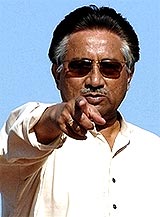
Pakistan is lurching towards implosion, and even the country's dictator president, General Pervez Musharraf - who has his party and the fractious military and security forces on his side, for now, but not the rest of the country - won't be able to stop the run to damnation. The day of judgment is the parliamentary elections planned for this November, although they could be easily scuttled by the wildly nervous and desperate Musharraf.
Worse for the embattled president, the anti-Musharraf momentum is quickly gathering pace. In the last two weeks at least 50 people were killed in anti-government protests. Unknown gunmen mowed down the protestors as Musharraf's security forces became mere spectators in Pakistan's newest blood sport - political murder by the regime. So much so it has Pakistan's chief patron, the United States, in quite a bind. For all of its spin about ridding the world of evil and spreading democracy, the Bush administration has created a fiend in Musharraf.
Pakistan is lurching towards implosion, and even the country's dictator president, General Pervez Musharraf - who has his party and the fractious military and security forces on his side, for now, but not the rest of the country - won't be able to stop the run to damnation. The day of judgment is the parliamentary elections planned for this November, although they could be easily scuttled by the wildly nervous and desperate Musharraf.
Worse for the embattled president, the anti-Musharraf momentum is quickly gathering pace. In the last two weeks at least 50 people were killed in anti-government protests. Unknown gunmen mowed down the protestors as Musharraf's security forces became mere spectators in Pakistan's newest blood sport - political murder by the regime. So much so it has Pakistan's chief patron, the United States, in quite a bind. For all of its spin about ridding the world of evil and spreading democracy, the Bush administration has created a fiend in Musharraf.
 There's more. To get his help in fighting a proxy war against Islamic terrorists, Washington has been making payments of roughly US$1 billion a year to Pakistan. But here's the best bit: the payments, what the US calls reimbursements to the country's military for counter-terrorism efforts along the border with Afghanistan, are still being given even though Musharraf unilaterally decided eight months ago to cut patrols through the area where al-Qaeda and Taliban fighters are most active.
That's not all. Typical of George W Bush's presidency, the monthly payments, called coalition support funds, are not widely advertised; they're buried in public budget numbers - Bush's honorific badge of concealment. Pakistan has received more than US$5.6 billion under the programme over five years, plus US$1.8 billion for security assistance, which mostly finances large weapons systems. That's more than half the total aid the US has sent to the country since the Sept 11 attacks. And that's not counting covert funds via America's various spy agencies.
Blood on his hands
Now, though, Musharraf has blood on his hands. Even his staunchest supporters in Washington are chanting ever louder the "damned if we do and damned if we don't" mantra about a Pakistani president who, like Zimbabwe's most vile dictator, the kleptomaniac, murderous and mirror image of Adolf Hitler, Robert Mugabe, has begun to govern the rapidly changing political landscape in a desperate bid to keep his power firmly in his hands. Far from being the peoples' president, Musharraf has become an political ogre - and a growing liability to the US-led war against Islamic terrorism in neighboring Afghanistan and elsewhere.
Since he grabbed power in a coup in 1999, and then promised Pakistanis in the same breath that he would return the country to civilian rule before his term was up, Musharraf has been under growing siege at home. He now wants a second term in power. But his opponents have other ideas. In particular, the so-called pro-democracy opponents, led by the usual suspects - former prime ministers Benazir Bhutto and Nawaz Shariff, both of whom fled in humiliation on charges of corruption - have been hitting out at Musharraf from the safety and rich comfort of their exile abroad. Not that the fundamentalist Islamic parties in Pakistan will ever give Bhutto or Shariff the light of day when they have not Musharraf.
If Bhutto and Shariff have labeled Musharraf an anti-democrat, Washington isn't too far off doing likewise. In fact it may just do so if the spineless European Union does so first. What has saved Musharraf's hide from being dragged over burning coal by Washington so far has been its dour relationship with mulishly pro-nuclear India. All that is about to change, though, with the US agreeing to supply nuclear fuel to India. But Musharraf's true saving grace came from being comprehensively rapped by the Americans came on the morning of the 9-11 attacks in America. Faster than Superman, Musharraf unstintingly signed up to Bush's John Wayne-like Calvary to hunt down and exterminate Islamic terrorists wherever they hid, including in Pakistan.
In signing up, however, Pakistan's militant Islamic political parties in double-quick time labeled him a Muslim traitor. By last month the siege of Musharraf's presidency began to further unravel. The sudden sacking in March of the influential, one-time pro-Musharraf Chief Justice, Iftikhar Chaudhrywho has been ordered to prove his innocence against a raft of misconduct charges in a closed kangaroo-court, charges without specificity, so rendering the entire politically conspired saga about as ridiculous as the government of Pakistan's robust claim to legitimacyhas only worsened Musharraf's own position. In mid May Chaudhry defiantly held a public anti-Musharraf rally in Karachi. That's when the regime's assassins spilled the blood of anti-government protestors on its streets.
And which is why, in the run up to the November elections - if Musharraf does not postpone or cancel them altogether - Benazir Bhutto has suddenly found the bravado from her hideout in Dubai to begin drumming up wider support in Pakistan for her return to national politics. Bhutto has vowed to campaign against Musharraf and oust him, in bitter-sweet revenge, after the president insisted he would never let her re-enter the country. That was after attempts to bed Musharraf and Bhutto in a political alliance collapsed hopelessly. "No matter what," Bhutto fumed, "I'm going back this year." Nawaz Shariff, who fled to London, said: "The iron is hot, but after a few weeks or months it will start melting and I will go when it starts melting."
Colorful language, certainly, but ultimately cowardly. It's smacks of gamesmanship, a show, by Bhutto and Shariff. It's June now. When, exactly, will Bhutto and Sharrif travel to Pakistan and begin political campaigns that will spread from east to west, north to south, in a country that is riddled with bloody deadly politics, corruption, terrorism, violent Islamic fundamentalism, plus a military that is so fractious that even Musharraf can not know if all of his generals and the young Turks are right behind him, and a police force that is so incompetent in bringing about social and political order from the chaos that their boss has been manufacturing while he is holed up in his presidential palace? More, would Musharraf not have Bhutto and Shariff arrested immediately on their arrival for corruption charges still pending against them?
How clever is he?
Musharraf is looking and acting decidedly like former Philippines dictator Ferdinand Marcos. Marcos manufactured political situations which he then used to legitimize imposing martial law. While Pakistan's economy is growing, surprisingly, at 6%-7%, it's not going to avert the ballooning political crisis. In fact, the more Musharraf manufactures political crises in a bid to cement his personal power base, the more he is likely to bring the economy to its knees. That'll be enough to drive Pakistan's middle class, who have been reaping the benefits of the economy over the last two to three years, to Musharraf's enemies - just as the Filipino middle class did against Marcos and again against, Joseph Estrada.
The best bits just keep coming. Here's one more. Federal minister for information and broadcasting, Senator Muhammad Ali Durrani, described the state of affairs in Pakistan as "normal" while calling the regime's dissidents' views of an imminent implosion as only a "crisis in their own kinds".
Go figure. Yet it explains why Durrani is Musharraf's spin merchant. Surely even he cannot believe his own twaddle, let alone his master's. Fact is, though, Musharraf is being cornered. Much of this is his own making. And no doubt, given the mule that he is, he will come out fighting - or with all guns blazing. He may also recall Field Marshall Ayub Khan, who ruled Pakistan by military diktat but was ousted by mass public protests in 1969. But this time is different. Pakistan is deeply, and dangerously, split between different rival political and tribal groups, and political and Islamic ideologies. It boils down to this: just how clever is Musharraf in manipulating these rifts to his long-term advantage?
MANJIT BHATIA, an Australian, is a university lecturer and writer who specializes in international economics and politics, with a focus on the Asia-Pacific. He has been published in The Wall Street Journal.


