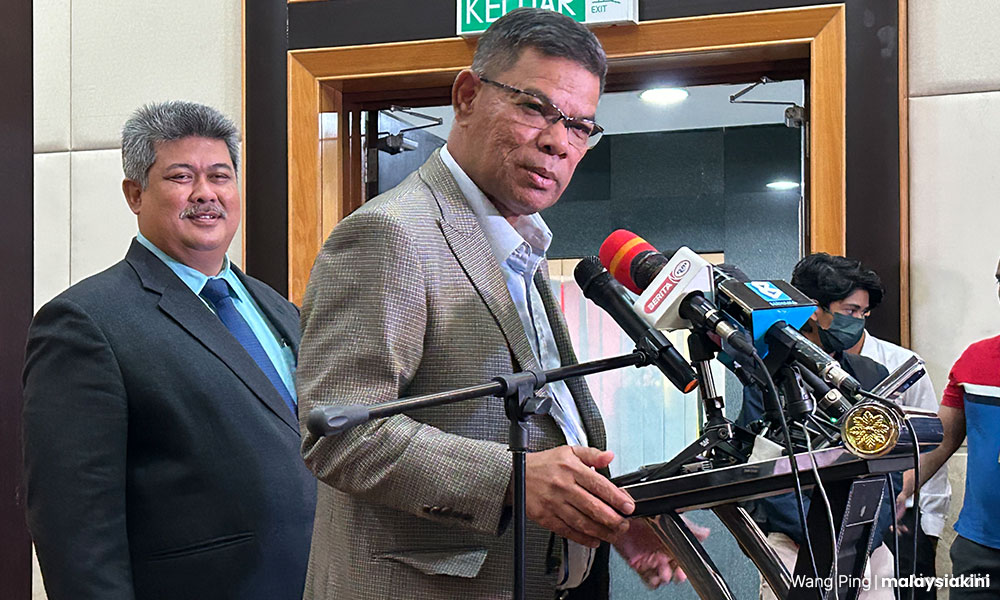
COMMENT | What's so confidential in govt agreements?
The cash payment, he said, was part of a total settlement of US$3.9 billion (RM16.63 billion) which the group had agreed to resolve over outstanding claims related to the three bond transactions that the Wall Street bank had structured and arranged for 1MDB.
The balance of US$1.4 billion (RM5.97 billion) will be paid...
COMMENT | In July 2020, then-finance minister Tengku Zafrul Abdul Aziz announced that Goldman Sachs Group Inc would hand over a cash payment of US$2.5 billion (RM10.66 billion) to the Malaysian government to resolve outstanding claims related to 1MDB in two months.
The cash payment, he said, was part of a total settlement of US$3.9 billion (RM16.63 billion) which the group agreed to resolve over outstanding claims related to the three bond transactions that the Wall Street bank structured and arranged for 1MDB.
The balance of US$1.4 billion (RM5.97 billion) will be paid after the assets related to the misappropriated proceeds from the transactions have been returned to the government.
In return, the government would drop all charges against Goldman Sachs subsidiaries and the bank’s former employees - Tim Leissner and Roger Ng.
Other details, or more the lack of them, prompted PKR MP Wong Chen, who was then in the opposition, to demand full disclosure in Parliament.
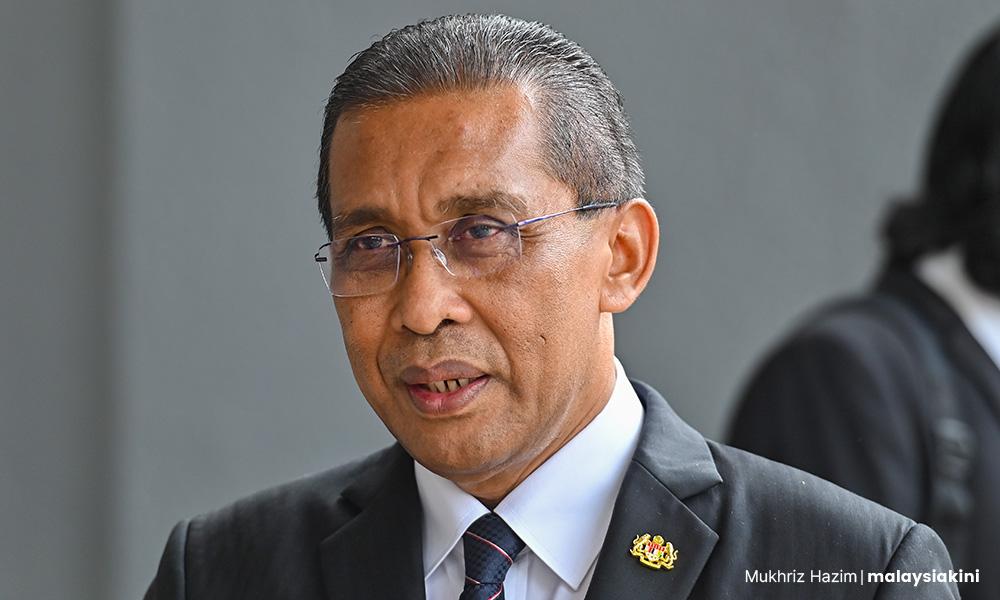
The then-de facto law minister Takiyuddin Hassan turned down the request, citing a clause requiring all terms and conditions stated in the agreement to be bound by a confidentiality clause, which was agreed upon by the parties.
“The confidentiality clause also applied to the (return of) US$1.4 billion in stolen assets as pledged by Goldman Sachs.
“As such, based on the confidentiality clause, the government is not able to give access to the details of the agreement, as requested, to prevent any legal action being taken (against Malaysia) due to a breach of the agreement,” Takiyuddin said.
At that time, civil societies questioned the clause stating that it involved misappropriation of public money.
A lot of water under the bridge had flowed and major disclosures were made in the trial of the bank’s former employee Roger Ng in a New York court.
Besides, some sketchy details were made known in the trial of former prime minister Najib Abdul Razak but the real issues related to the scandal and subsequent agreement remain a secret.
That was until last week when Goldman Sachs sued Malaysia in a UK court amid festering disagreement over a settlement tied to its role in the 1MDB scandal.
“We filed for arbitration against the government of Malaysia for violating its obligations to appropriately credit assets against the guarantee provided by Goldman Sachs in our settlement agreement and to recover other assets,” a spokesperson for the New York-based bank said.
What followed were salvos fired by the Attorney-General’s Chambers which claimed the allegations mischaracterised the government’s conduct.
The chairperson of the 1MDB task force (asset recovery) Johari Abdul Ghani said: “In light of recent events, the government will be preparing to respond to this matter and ensuring that this process is done diligently and in accordance with the established legal frameworks while ensuring that the interest of the Malaysian people is safeguarded.”
Now that the matter is before the London Court of International Arbitration, all the details will be laid bare and the confidentiality clause becomes irrelevant.
Both parties must file affidavits which will contain all the details of the discussions and the agreement.
As such, why still hang on to the clause when some of it is already in the public domain?
Only last month, the Special Cabinet Committee on National Governance agreed in principle to the enactment of a Freedom of Information Act to establish clear parameters and guidelines to give the public access to information from public bodies and the government.
“The government will continue to implement good governance empowerment efforts to support the development of the country in line with the desire to develop a civilised Malaysia,” Prime Minister Anwar Ibrahim said in a Facebook post.
Freedom of Information Act
The Prime Minister’s Office (PMO), in a statement, said in line with the meeting’s decision regarding the Freedom of Information Act, the Official Secrets Act 1972 (Act 88) will also be amended accordingly.
It said this step was taken to ensure that the delivery of public services can be improved and encourage the involvement of the people in the process of national policy formation.
This should include government-owned and government-linked companies, as well as state agencies and companies.
In the face of these developments, the confidentiality clause in government-related transactions or agreements is redundant and those involved must be directed to exclude such restrictive passages and vigorously oppose any such clause in public interest.
The government must walk the talk, and the first step is to declassify government contracts except for those related to the procurement of security or defence matters.
Land alienation and lop-sided joint venture agreements in the development of state land have been significant in the past - and there have been reports of the government not giving the appropriate share in the profits or the land being sold below market prices.
Although this involves states, a federal law will certainly compel everyone to keep transactions above board for fear of public scrutiny.
For heaven’s sake, the money belongs to taxpayers and ratepayers who must have a say or be informed on how their money is spent and to ensure it is spent prudently.
Just asking: What was the quantum paid for the lease of the Kuala Lumpur Tower and was it fair and equitable?
R NADESWARAN is a veteran journalist who writes on bread-and-butter issues. Comments: citizen.nades22@gmail.com
The views expressed here are those of the author/contributor and do not necessarily represent the views of Malaysiakini.