


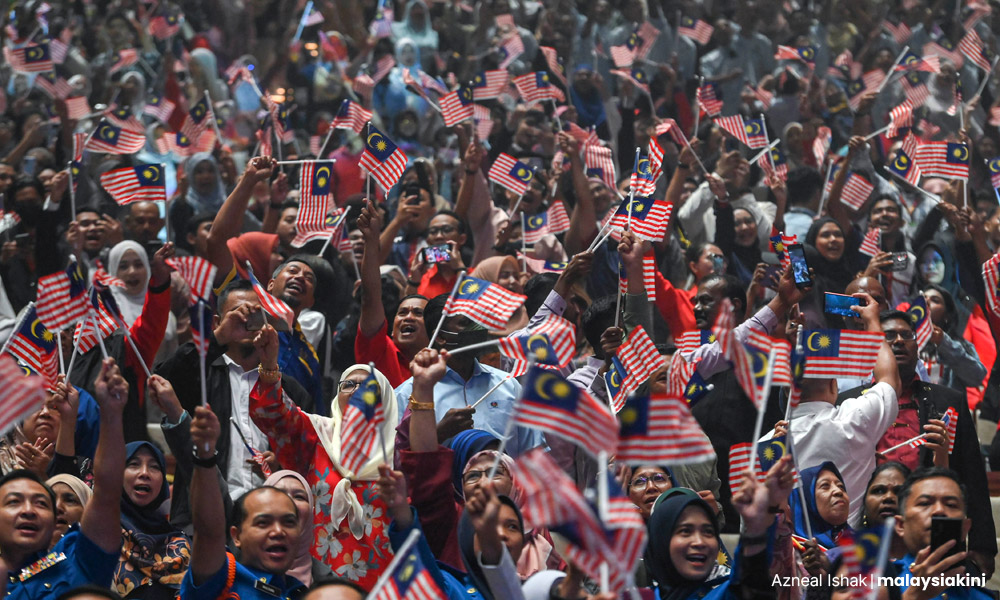

HISTORY | Knowing the Malays
HISTORY | The Malays are the largest ethnic group in Malaysia, forming about 58 percent of the nation’s population, with the vast majority of them residing in Peninsular Malaysia.
They form about 24 percent of the population in Sarawak and less than 10 percent in Sabah. Outside Malaysia, there are approximately nine million Malays in Indonesia (mainly Riau Archipelago and the coastal areas of Sumatra and Kalimantan), two million in southern Thailand, 600,000 in Singapore, and about 330,000 in Brunei.
The “Malay World”, on the one hand as propagated by some Malay scholars and activists, encompasses currently more than 350 million people inhabiting areas from Easter Island in the East to Madagascar in the West, to Taiwan in the North, and New Zealand in the South.
Such a broad categorisation includes virtually every group of inhabitants in the Malayo-Polynesian-speaking world.
In the words of Geoffrey Benjamin, a leading social anthropologist, this overly stretched description of the “Malay World” is “as misleading as it would be to refer to the Sinhalese as ‘European’ because they speak an Indo-European language, or to the Vietnamese as ‘Mons’ because they speak a Mon-Khmer language”.
On the other hand...


Ranjit, I concede that you mentioned the Constitution. Having said that, not every T, D and H can be Malay. The 1st and 2nd Prongs of Article 160(2) must be read together to determine Malay. JPN reads only the 1st Prong and hands out Malay birth certificate and MyKad to every T, D and H who is Muslim. This has happened in Malaya with converts after Merdeka and in Sabah and Sarawak. The Definition of Malay in Article 160(2) remains confined. It's only for Singapore and Malaya. The Malay Definition facilitates Article 153 -- read special position for reasonable proportion in four specific areas viz. intake into civil service, intake into training institutes owned by the gov't and training opportunities, scholarships, and opportunities from the gov't to do business -- on affirmative action programmes. Article 153, always observed in the breach and having become sapu bersih in practice, remains redundant. In law, Article 8, there can be no discrimination save as provided by law. There must be sunset clause. Article 153, originally, had 15 years sunset clause. That was done away after 13 May 1969. Article 153, although unconstitutional, remains unless the court rules on the matter. In jurisprudence and constitutional law and international law, no Constitution can go against itself. Article 153, as it stands after the 15 years sunset clause, implies the Constitution going against itself. If the Constitution goes against itself, it ceases to exist by the extent to which it goes against itself, court or no court declaration. Likewise, Article 152 on Bahasa Kebangsaan, has been rendered redundant. The 20K word Bahasa Melayu -- as habitually spoken in Johor, Rhio and Lingga -- has never been Bahasa Kebangsaan given the existence of vernacular schools from long before Merdeka. At best, it was unofficial official language until 1969. The 40K word Bahasa Malaysia, based on Bahasa Melayu and loanwords from English and local languages and dialects, came after 1969 as unofficial official language. Bahasa Malaysia may be becoming more English and less Bahasa. The 127K Bahasa Indonesia, based on Bahasa Melayu, is one quarter Dutch. It also has 95K loanwords from English and local languages and dialects. Bahasa Malaysia and Bahasa Indonesia are not synonymous with Bahasa Melayu. Bahasa Malaysia isn't synonymous with Bahasa Indonesia.