




Lina Joy and our sorrow
I want to move away from the obvious analysis of the soon-to-be psycho-semiotic phenomena of the Malay Christian convert named Lina Joy.
Where I live - 30 minutes' drive from New York City - a local newspaper has a story on the individual formerly known as Azalina Jailani. This paper normally would not carry stories of people wishing to delete designations/words they find meaningless in an identity card.
But because international news picks up 'anomalies of culture and/or religion' as creative elements and sensational items to help sell, Lina Joy is a newsworthy item.
I want to move away from the obvious analysis of the soon-to-be psycho-semiotic phenomena of the Malay Christian convert named Lina Joy.
Where I live - 30 minutes' drive from New York City - a local newspaper has a story on the individual formerly known as Azalina Jailani. This paper normally would not carry stories of people wishing to delete designations/words they find meaningless in an identity card.
But because international news picks up 'anomalies of culture and/or religion' as creative elements and sensational items to help sell, Lina Joy is a newsworthy item.
I want to use the lens suggested by renowned Russsian linguistic-philosopher/philologist Mikhail Bakhtin to speak about the conditions and motivations of Lina Joy. Perhaps when Malaysians or whoever interested in speaking about 'inner worlds' and 'outer projections' of the self in 'theological transitionary stages' are tired of the emotional analysis of 'apostasy', they may come back to this piece I have written.
My analysis will be quite disappointing as they will contain no judgment on the self of Lina nor the 'collective self' that constitutes society, as well as the 'documentaried material' self we call 'the Malaysian constitution'. This is just a plain analysis.
Lina will certainly be a subject of symbolic analysis of language as well as a focal point.
My interest is in this question: What would contemporary linguistic theorist such as Bakhtin say about the self and the meaning of being a 'self'? To me, those following the case and affected by the decision of the Federal court are not reading about Lina Joy the person, but actually reading about themselves as 'scripts of a social text'. What ails us as a nation and what then must we do? Is Lina Joy a mirror of our sorrow?
Post-modern self
Bakhtin's work "discovered and studied by American and British professors at renowned universities, emphasises the role of meaning in one's interpretation of phenomena be they in one's understanding of society or in one's conjuring up of grand theories to understand the structure of reality itself. This means that Bakhtin's work is a precursor to the idea of post-modernist interpretation of phenomena and the explanations of the way of the world".
Post-modern perspectives on a range of topics such as the nature of the self, of language and thought, of social analysis and organisation, and of the relationship of and between the subject and the object are all drawn from the idea of multiplicity in the way phenomena is observed and explanations structured. In the case of Lina Joy, we are in a post-modern condition - we do not know who is the subject and who is the object of the "fragmented self".
If we take for example the post-modernist idea of the self in the (Jacques) Lacanian concept of the self as fragmented by nature and that the existence of the self is contingent upon the idea of how language shapes thoughts and determines the nature of reality that the self creates, then we are perhaps subscribing to Bakhtin's notion of the "dialogical self".
He proposed the idea that since society and culture is "text" then the individual interacts with the texts and makes meaning out of his/her interpretation of the textual information presented. The individual is then in constant dialogue with society and hence the self is a "dialogical self". In Lina Joy, we see her in dialogue with society that has become complicated.
And because the individual is a dialogical self who interprets the meaning of this "social text" and because there is perpetual interpretation of the text, creativity is a central dimension of the life of the individual. Lina Joys' challenging the conventions of her culture is indeed an example of radical form of creativity.
 Herein lies the post-modernity of Bakhtin's work if we look at it from the lens of how post-modernism is interpreted. For Bakhtin, the individual will look at society not as a fixed phenomena but rather an arena of construction of reality in which contestations, interpretations, resistance, controversy, etc happen. It is as if the individual exists as a central element in a novel (of various sub-plots perhaps) of which there are personal meanings to be derived from and decisions to be made in the central character's existence in the novel. Lina Joy is inviting us to "reconstruct and re-invent reality" as how we want it to be.
In this sense of society as text and the individual as postscripts and agents of change in this grand novel called existence, there is in Bakhtin's scheme a wide spectrum of creativity in the way perspectives on one's location in society is seen. This, I believe is an existential notion of the self in the most progressive form, i.e, rather than look at the human condition as hopeless and conditioned by society, there is in the Bakhtinian view a sense of "human agency" or the idea of "human as makers and participants in social textualising and historicising." Lina Joy did not wish to see her condition as hopeless.
There is the notion of the human condition central to the obsession of post-modernist thought on the relationship between the individual and the society. This is what Lina Joy is demonstrating to us - a human being or a human agency that has a choice through her own realisation of existential selfhood.
Joy and sorrow
We produced Lina Joy out of our own shortcomings in our education system. Had our system taught our children how explore the beauty of each religious tradition and find universal themes of peace and justice in each, we would not have denied Lina Joy her fundamental rights to carry her religious designation as how she would prefer. Names are a powerful signs and symbols of ones own existence, as any scholar in biosemiotics would agree.
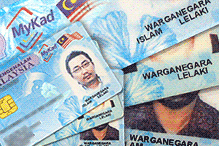 If I no longer wish to carry a Mykad with the designation 'pagan' as my religion, it is my fundamental rights to change it, as I will be carrying 'paganism' as my religion. If I do not wish to sign the fascistic
Surat Akujanji
of Universiti Utara Malaysia and pledge loyalty to something I do not believe in, it is my fundamental right to not sign it, since I will be carrying something throughout my career that will tell me that I will be discriminated against by those who has abused power.
If I no longer wish to carry a Mykad with the designation 'pagan' as my religion, it is my fundamental rights to change it, as I will be carrying 'paganism' as my religion. If I do not wish to sign the fascistic
Surat Akujanji
of Universiti Utara Malaysia and pledge loyalty to something I do not believe in, it is my fundamental right to not sign it, since I will be carrying something throughout my career that will tell me that I will be discriminated against by those who has abused power.
There are different levels of understanding of God and religion in each and every human being who have chosen to be religious. For many who profess themselves as Muslims, Christians, Catholics, Hindus, Buddhists, Sikhs, etc. there are different levels of spirituality.
In the history of Islam, its beloved Prophet Muhammad (Peace be Upon Him) had an uncle Abu Talib who never converted to Islam. All the same the Prophet of peace loved him and prayed that he would be blessed and given the righteous place in Paradise.
Why did we do as such to Lina Joy? Why criminalise her and make her path to wisdom difficult? Has not Islam evolved to become a religion that tolerates the understanding of other people's believe and be able to learn from the different levels of understanding about the Universal Creator?
To Lina Joy, removing the word 'Islam' from her Mykad is meaningful and something deeply personal. That's her name, that's her identity card. She does not believe that a Malay must necessarily be associated with a Muslim.
Personal experience
I have been teaching a semester-long course 'Islamic Scriptures' in a college in the United States, amongst one of my 'signature courses' I have been asked to teach every semester. Student in my class come from all over the world - from Algeria to Kazakhstan, from Zimbabwe to Czechoslovakia. Many are Muslims - young ones eager to learn or relearn about Islam.
There will always be non-Muslims - Jews, Christians, Catholics, Buddhists, Hindus, atheists, etc. - who wish to learn about Islam. This is the American attitude towards knowledge, always eager to expand the horizon of learning.
 The challenge for me is to present the teachings of the Prophet of Islam as objectively and passionately as possible without alienating those new to the religion and without having Muslim students devalue the opinion of others. This has been an art of presenting I have acquired over the years, even if I am lecturing on Hinduism, Buddhism, Sikhism, Catholicism, Judaism, traditional American Indian philosophies or even L Ron Hibbard's Dianetics of the Church of Scientology (of which John Travolta and Tom Cruise are its most famous followers).
There is no room for criticism of any religion, I remind my students at each introductory lecture. I would generate the most conducive atmosphere of interfaith dialogue throughout the semester, presenting the true message of Islam that has not been tainted by the media or any other sources of knowledge that are framed around sophisticated systems of prejudice. I would begin by saying that "Like other religion, Islam believes in the universal message of peace, social justice, and salvation. Each one of us evolve differently according to the level of consciousness we possess as evolutionary beings".
Let us advocate a peaceful resolution to this issue, fundamentally through education for peace. The way to lift the veil of ignorance is through knowledge and the deep engagement and exploration of it.
Religion must be approached from a philosophical standpoint in order to draw out the best of what it can offer to help humanity understand multiple ways of knowing the Creator - the Universal God that reveals itself in the consciousness of Humanity by many names.
For, unto God we shall return.


