KINIGUIDE | A refresher on the controversial Sedition Act
KINIGUIDE | The controversial Sedition Act is once again under public scrutiny after recent uses of the law have provoked alarm from civil societies and politicians.
In this KiniGuide, Malaysiakini runs through the act’s history and issues with it since its introduction in 1948.
What is the Sedition Act 1948?
The Sedition Act is a colonial-era law that criminalises speech with “seditious tendency”.
Among the definitions of seditious tendency in the act include a tendency to bring into hatred or contempt against any ruler, government, or the administration of justice, to promote feelings of ill will and hostility between different races or classes, and to question any privileges reserved for...
KINIGUIDE | The controversial Sedition Act is once again under public scrutiny after recent uses of the law have provoked alarm from civil societies and politicians.
In this KiniGuide, Malaysiakini runs through the act’s history and issues with it since its introduction in 1948.
What is the Sedition Act 1948?
The Sedition Act is a colonial-era law that criminalises speech with “seditious tendency”.
Among the definitions of seditious tendency in the act include a tendency to bring into hatred or contempt against any ruler, government, or the administration of justice, to promote feelings of ill will and hostility between different races or classes, and to question any privileges reserved for the Malays, natives, and royalty.
The act was first introduced by the British in 1948 and was later amended after the May 13, 1969 riots to expand the scope of limitations on freedom of speech.
The new restrictions also overrode parliamentary immunity.
The law was again amended in 2015 to impose a minimum jail term of three years and allow the government to block online media deemed to be seditious.
Why has it been described as a “draconian law”? What is wrong with the Sedition Act?
The Sedition Act has long faced protests from civil societies and opposition politicians for its restrictions on freedom of speech.
Critics say the law is antithetical to the concept of modern democracy and has often been used to silence or punish dissent against the government.
They also say the act is so broad and vague that it is unclear what speech can be criminalised, which opens it up to abuse from the authorities.
A number of activists, journalists, and politicians have been arrested or charged under the Sedition Act over the years, including activist Hishamuddin Rais, graphic artist Fahmi Reza, cartoonist Zunar, The Edge publisher Ho Kay Tat, DAP national chairperson Lim Guan Eng, PKR deputy president Rafizi Ramli, and many others.

It was reported in February this year that 367 individuals have been investigated under the Sedition Act between 2018 and 2022.
Civil societies have also pointed out that many countries that had some form of law against sedition have long repealed it or had fallen into disuse.
This includes the UK itself, the US, New Zealand and Australia. In 2021, Singapore also repealed its sedition law.
What has been done about the Sedition Act in Malaysia in the past?
Aside from amendments, there have been efforts to repeal the Sedition Act in this country.
Former prime minister Najib Abdul Razak famously promised to repeal the law during his first term in power.
However, he did not follow through on this promise and instead, strengthened the law with the 2015 amendments.
Pakatan Harapan, which first came into power in 2018 for a 22-month stint as the government, had also vowed to repeal the Sedition Act in its electoral manifesto for the 14th general election, as part of its efforts to abolish “oppressive laws”.

The Harapan government briefly imposed a moratorium on sedition cases in October 2018 but lifted it soon after.
The Perikatan Nasional administration in 2020 also stated that it was “committed to improving security laws including… the Sedition Act”, but no efforts were made pursuant to that.
In 2022, the Harapan coalition again made a similar promise in its electoral manifesto for the 15th general election in 2022 to repeal the law.
What is the current government’s stance on this law?
The current government, which is an amalgamation of Harapan, BN, Gabungan Parti Sarawak, and Gabungan Rakyat Sabah, has said it has agreed in principle to study amendments to the Sedition Act to ensure the legislation is only used to protect the royal institutions from acts of provocation.

Minister in the Prime Minister’s Department (Law and Institutional Reform) Azalina Othman Said also said the government is mulling a new law to impose civil penalties on those who play up 3R (race, religion, and royalty) sentiments.
She said at present, any offence involving the 3R issue was investigated under the Sedition Act, whereby the act was more geared towards elements of criminal offences, causing prosecution to take a long time due to legal procedures.
However, the government does not appear to be making any efforts to repeal the Sedition Act.
On the contrary, government authorities have invoked the Sedition Act in several high-profile cases recently.
What are these recent high-profile Sedition Act cases?
The most recent high-profile case of the usage of the Sedition Act was the charging of Kedah Menteri Besar Muhammad Sanusi Md Nor.
The PAS leader was charged under the Sedition Act in July over a speech he made at a PN rally where he was alleged to have uttered words that could incite disloyalty towards the rulers.
Sanusi has accused the federal administration of using enforcement agencies to silence him, especially as he was charged a few weeks before the six state elections.
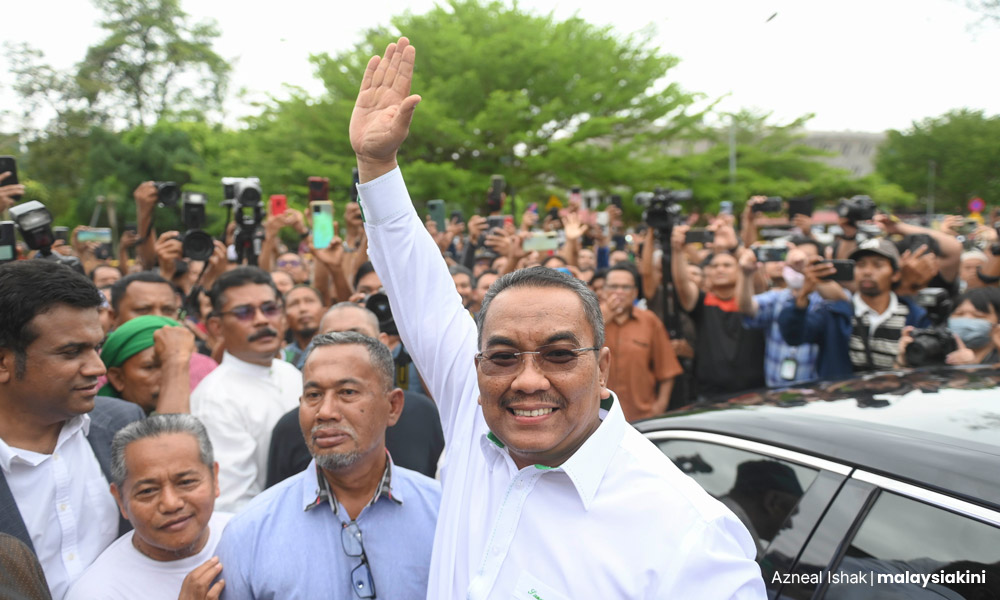
In responding to Sanusi’s sedition case, Prime Minister Anwar Ibrahim said the government would avoid using the act except when it touches on the position of the rulers.
Most recently, preacher Wan Ji Wan Hussin yesterday began serving nine months in prison over a 2014 sedition case linked to the Selangor sultan.
The Court of Appeal allowed his appeal to reduce his sentence but did not allow his appeal to quash the conviction.
The appellate court also earlier dismissed his application to refer constitutional issues of his sedition charges to the Federal Court.