




Dont court controversy, say Muslim groups
While immensely relieved with the Federal Court's decision in the Lina Joy case, Muslim groups and individuals urged for such issues to be resolved in future without recourse to courts of law and before they reach the level of public controversy.
While immensely relieved with the Federal Court's decision in the Lina Joy case, Muslim groups and individuals urged for such issues to be resolved in future without recourse to courts of law and before they reach the level of public controversy.
Such 'stress points' can easily boil over into social unrest and should be avoided by resolving them either through communal dialogue or by the governmental authorities and agencies, they said.
 Jemaah Islah Malaysia president Zaid Kamaruddin said cases with potential for communal conflict should be addressed primarily through discussions among and between the racial and religious communities.
Such discussions can then move forward in the form 'evolving' a framework of legislation based on mutual consultation and agreement, he said.
"We don't want communities to be put through such stress points again, which can become very easily politicised," said Zaid when contacted today.
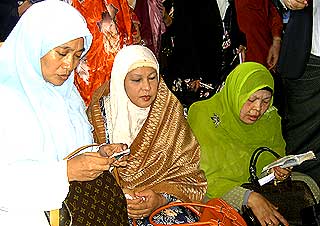 The case of Joy - born Azlina Jailani and who has waited almost 10 years for the courts to declare her as non-Muslim - comes at a time of heightened religious and racial tensions.
Some rights groups and lawyers pose the issue to be one of religious freedom and the increasing suppression of the religious minorities amidst a resurgent Islam.
Many Muslim groups, however, believe the issue to be 'yet another' attack on their religion and an effort to 'encourage' apostasy - one of the gravest sins in Islam.
 At one point, court cases involving conversions into and out of Islam were punctuated with a
death threat
to lawyer Malik Imtiaz Sarwar, who held a watching brief for the Bar Council during Lina's appeal.
At one point, court cases involving conversions into and out of Islam were punctuated with a
death threat
to lawyer Malik Imtiaz Sarwar, who held a watching brief for the Bar Council during Lina's appeal.
Opinions on judgment
While the Federal Court judgment serves as a defining decision in clarifying the jurisdiction of the civil and Syariah courts, it comes at a cost to social cohesion, said International Islamic University law lecturer Shamrahayu Abdul Aziz.
"I would guess there was no way to avoid such a decision being made. It's good in the legal sense because Muslims can be certain as to what are the limits, or lack, of their rights in Malaysia. There was a lack of clarity in the legal provisions. In social terms, however, it's not so good," she added.
 Islamic opposition party PAS women's wing leader Dr Siti Maria Mahmud was more blunt: "The damage is done. Ultimately, I don't think there was a victory for either side."
Muslim Youth Movement of Malaysia (Abim) president Yusri Mohamad said the ruling was in effect a rejection of attempts to "de-construct and radically revamp" the social and legal framework of civil and syariah laws.
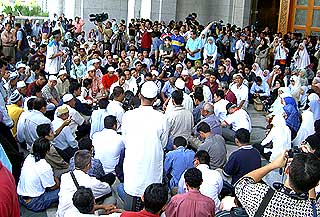 Yusri welcomed the decision as affirming the existing arrangement relating to Islam and the syariah courts and the position of Islam in the laws and the Federal Constitution.
He urged those seeking a revamp of the framework to go about it in a way that does not risk jeopardising social relations.
"We believe the court procedure is an unhealthy one because such issues should be avoided (at the courts) as all confrontational approaches should be shunned," he said when contacted.
At a press conference in Putrajaya later following the court ruling, Yusri urged anyone who is "aggrieved in any way" with any part of the existing arrangement to "choose other, less confrontational and controversial approach towards change and reform".
 "We also plead that those hoping for an opposite outcome to reconsider their position and to consider modifying their expectations to suit what is good and more sustainable considering our realities."
The decision, he added, should not be a perceived as a victory for Muslims and a loss for non-Muslims, but one that is "more justified and fair in that broader and higher sense" in light of the legal, historical, and social realities.
He also called on parties or individuals who feel aggrieved by the perceived injustice to approach the Islamic groups for assistance.
"It is our belief that it is wrong for us as Muslims and Muslim associations to tolerate any injustice in the name of Islam," said Yusri, who also heads the loose coalition of Islamic groups Pembela.
The state religious authorities and agencies, he added, must improve to ensure its personnel become more diligent, efficient, and professional when discharging their duties so that the good name of the religion does not suffer due to mistakes in implementation.


