


/file/publisher-c1a3f893382d2b2f8a9aa22a654d9c97/2023/08/576b8040f59f7d66fe59d7ee63653f51.jpg)

COMMENT | Why aren’t journalists asking hard questions?
COMMENT | Looks like the Home Ministry is on a banning binge. Will Apple's Pride Edition Smartwatches be next? Or Starbucks, Amazon, and Microsoft - all known for their support of LGBT pride.
Will the ministry and its affiliate the Malaysian Islamic Development Department (Jakim) clamp down on local NGOs advocating for LGBT welfare?
(Going by the Home Ministry’s thinking, the more than 200 rainbow steps to the Hindu deities at Batu Caves may also need a new coat of paint. Indeed, stupidity knows no bounds).
It’s a slippery slope - from the bans on LGBT artefacts to two innocuous books...
COMMENT | Looks like the Home Ministry is on a banning binge. Will Apple's Pride Edition Smartwatches be next? Or Starbucks, Amazon, and Microsoft - all known for their support of LGBT pride.
Will the ministry and its affiliate the Malaysian Islamic Development Department (Jakim) clamp down on local NGOs advocating for LGBT welfare?
(Going by the Home Ministry’s thinking, the more than 200 rainbow steps to the Hindu deities at Batu Caves may also need a new coat of paint. Indeed, stupidity knows no bounds).
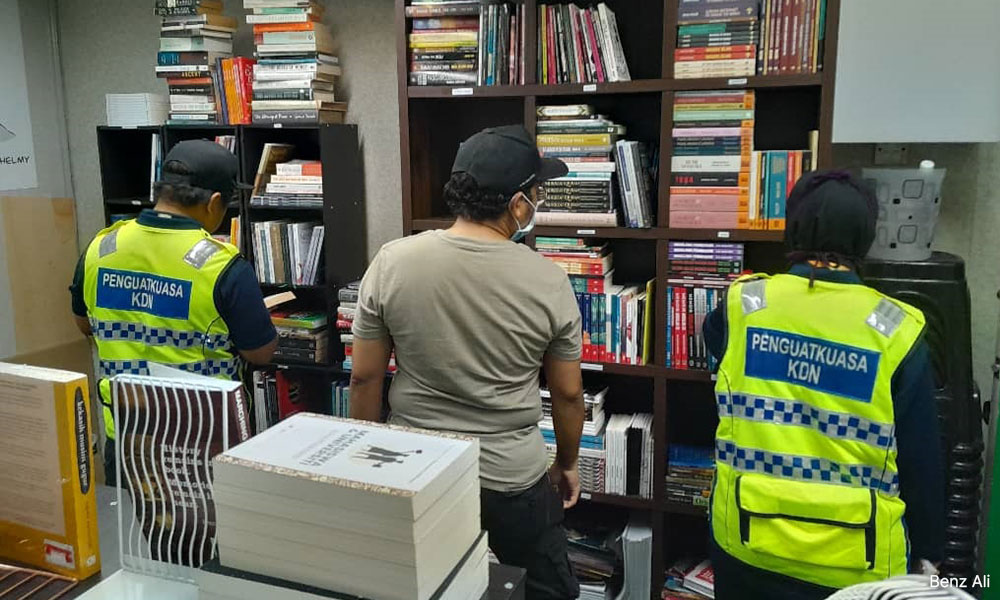
It’s a slippery slope - from the bans on LGBT artefacts to two innocuous books: ‘Marx the Revolutionary Educator’ (Marx Sang Pendidik Revolusioner) written by education philosopher Robin Small; and ‘Masturbation Poetry Collection’ (Koleksi Puisi Masturbasi) written by Benz Ali, owner of Toko Buku Rakyat.
First up, Benz’s collection of “puisi masturbasi”– obviously titled to titillate. But its translated Bahasa Malaysia synopsis reads: “Masturbation in this book does not refer to a physical act but only a connotation that mocks intellectual discussions that do not lead to any change.
“Poems collected since 2011 express feelings in limited words and try to escape from the norm of ordinary poetry. It speaks about sins that have been considered normal (norma), touching on the themes of poverty, stupidity, hypocrisy (catakserukin) and waste.”
In a self-critique of his book, Benz wrote in part (translated by Google) that the poems are “recordings of what happened before 2016 … a struggle expressing frustration and the deepest sense of rebellion against what cannot be done. That's why the poems … always end with a prayer, God, submission to destiny, a sign of how weak the person (that is, me) is”.
Next is Karl Marx. In a critique of Small’s book, a reviewer quoted the author as saying: “Marx is an educator for us. He challenges us to develop our capacity to think critically about our own society.”
Another reviewer says the book introduces Marx (1818–1883) as a radical educational thinker. It examines “Marx’s own schooling and education” and “how his interest in educational issues was informed by his own experience”.
“Educational themes in Marx’s thinking are identified: the role of education within capitalist society, the contribution of education to human development and the character of education in a future society. These are placed in a historical setting by the author (Small) and related to public debates over educational policy.”
Small’s book, published in 2014, underscores what Malaysian educators should, indeed, ask what we could learn from Marx’s revolutionary thoughts “now that education has become the principal legitimator of social inequality and a prime means of social control over prolonged youth”.
‘Woke’ culture
The ministry’s reactive clampdown on books and LGBT-associated literature underscores a dire need for its censorship board to be more educated on how to review controversial titles and understand the context of the contents, the author’s profile, and objectives before taking a torch to the publication.
Will the ministry now instruct universities to forbid doctoral students from researching and publishing Marxist theories of education and economic development? Or Marx’s ‘The Communist Manifesto’ be confiscated from university libraries?
Banning books, however, is not exclusive to Malaysia. We are catching up with the United States, where book bans in public schools had “increased by 28 percent in the first half of the 2022-2023 academic year”.
Likewise, ‘woke culture’ has infiltrated Australian children's literature taking political correctness and inclusive sexuality to unbelievable extremes.
This brings me to how Malaysian journalists can better serve their readers by looking at the bigger picture and researching the background of what led to the event than simply reporting on the dramatic raids on a bookstore and Swatch outlets.
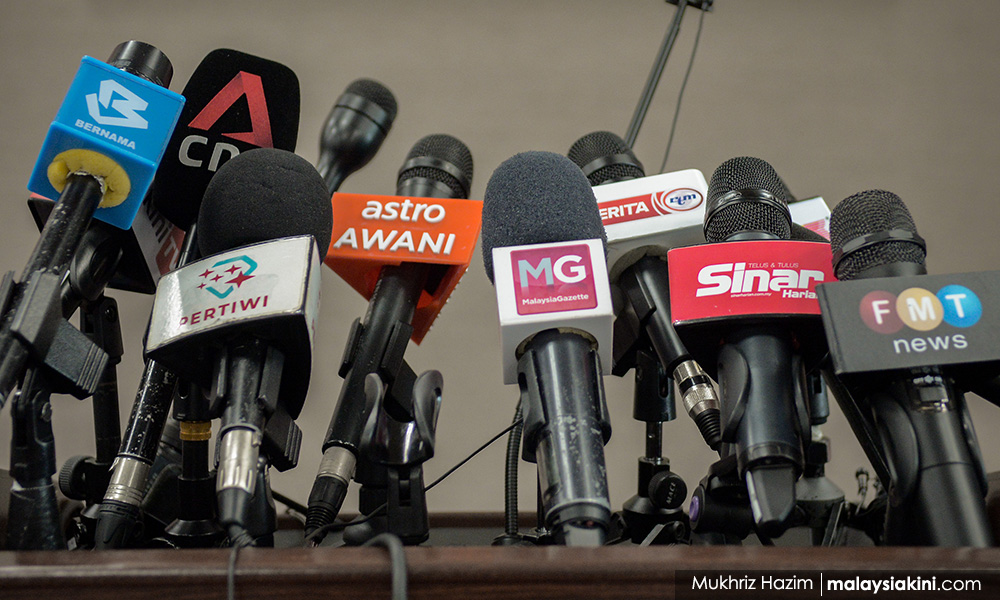
The internet has changed how information is sourced, contextualised, framed, and packaged. Our journalism methods and deliberation need to change accordingly.
Reporting what happened and why no longer suffices. Context and background matter. Interpretation based on in-depth research and critical questioning of politicians matters even more in today’s digital environment.
The supposedly reformist party in 2018 has unfortunately turned. The current leadership has not shaken off the religious and ideological dust of the past. We still see shades of political and structural continuities from the BN era.
Journalists are well aware of the hypocrisy of our ministers, and the discrepancy between what they said when they were in opposition and what they are doing now while in government.
Readers’ comments show utter frustration with the ‘incomplete’ picture in the news. Why are journalists refraining from asking the hard questions?
ERIC LOO is a former journalist and educator in Australia and a journalism trainer in parts of Asia.
The views expressed here are those of the author/contributor and do not necessarily represent the views of Malaysiakini.
/file/publisher-c1a3f893382d2b2f8a9aa22a654d9c97/2023/05/723ad32e339a31bc2592fa8be4caac0a.jpg)
/file/publisher-c1a3f893382d2b2f8a9aa22a654d9c97/2023/08/fdd364c426a22e67d5622893cf4bf7fb.jpg)
/file/publisher-c1a3f893382d2b2f8a9aa22a654d9c97/2019/07/8db3fe093f113d771b38f59d5eb362f5.jpg)


