
KINIGUIDE | Jill Ireland, Dr M-era bungles and 'Allah' for non-Muslims
KINIGUIDE | The Anwar Ibrahim administration’s decision to withdraw its appeal on the Jill Ireland “Allah” case has been a wild roller coaster ride.
Statements by the prime minister, home minister and others have caused much confusion over the matter, and provoked both Muslims and non-Muslims alike.
However, the Madani government’s handling of the case and its fallout is just the latest in bureaucratic bungles that date back all the way to the 1980s - when Dr Mahathir Mohamad was in power.
Meanwhile, overlapping court cases on Christians petitioning to use the word “Allah” in the past 15 years has also added to confusion on how the judiciary has ruled on the matter.
In this edition of KiniGuide, Malaysiakini takes a look at the facts to set the record straight.
What is Jill Ireland’s case about?
Jill Ireland is a Melanau Sarawakian Christian who had eight CDs - bearing titles with the word “Allah” - seized by the Customs Department when she flew back to Malaysia from Indonesia on May 11, 2008.
In August of the same year, Ireland filed a legal challenge to get back the CDs as well as a court declaration on her constitutional rights involving equality before the law and religious freedom - including the right to use the word “Allah”.
This started a legal battle that would last more than a decade.
The latest court ruling came from Judge Nor Bee Ariffin in March 2021, which ruled in favour of Ireland.
The issue came under the spotlight again when it was revealed that the government decided to withdraw its appeal against the 2021 High Court decision on April 18, 2023.
So, is it about getting back Christian CDs that had the word “Allah”, or about a Christian’s right to use the word “Allah”?
The short answer is, both.
But the declarations Ireland sought under Article 8 (equality before the law) and Article 11 (freedom of religion) of the Federal Constitution are not so straightforward.
When she initiated her case at the Kuala Lumpur High Court, she sought seven declarations of which two are on her right to use the word “Allah” and to own material bearing the word.
However, while the High Court in 2014 quashed the Home Ministry’s seizure of her CDs and ordered for them to be returned - it did not rule on the declarations of her constitutional rights.
Ireland appealed to this lack of ruling on constitutional issues in the Court of Appeal, while the government appealed against the High Court’s decision that the ministry was wrong to seize her CDs.
What did the Court of Appeal decide?
In 2015, the Court of Appeal ruled that the eight CDs must be returned to Ireland and ordered the High Court to hear Ireland’s case again, on just two of the seven constitutional declarations sought.
They were on whether Ireland had a constitutional right to import the seized CDs for her religious practice and education, and whether the Federal Constitution protected her from discrimination by law.
The two declarations specifically on her right to use the word “Allah” were not sent back to the High Court for a rehearing.
Justice Tengku Maimun Tuan Mat - who is now the Chief Justice of Malaysia - led the three-person Court of Appeal bench that heard the case.
The CDs were returned to Ireland in September 2015.
What happened during the 2017 rehearing of Ireland’s case at the High Court?
The High Court heard Ireland’s case on two declarations sought - that her constitutional right to practise her religion was violated and the use of federal laws to seize the CDs infringed on her constitutional right to equality.
The laws used were the Publication and Printing Presses Act (PPPA) 1984 and the Customs Act 1967.
During the rehearing, Ireland’s legal team discovered that the root problem was a Home Ministry’s directive dated Dec 5, 1986, which completely banned the use of “Allah”, “Kaabah”, “Baitullah”, and “Solat” by non-Muslims.
As such, she sought an additional declaration that the directive was unlawful and went against her constitutional rights to profess and practise her freedom of religion.
Although the rehearing began in 2017, due to several attempts to settle the matter out-of-court, the decision was only delivered on March 10, 2021.
Judge Nor Bee Ariffin ruled that the Home Ministry’s directive - issued under the PPPA and used to seize Ireland’s CDs - has no statutory backing and is, therefore, illegal and irrational.
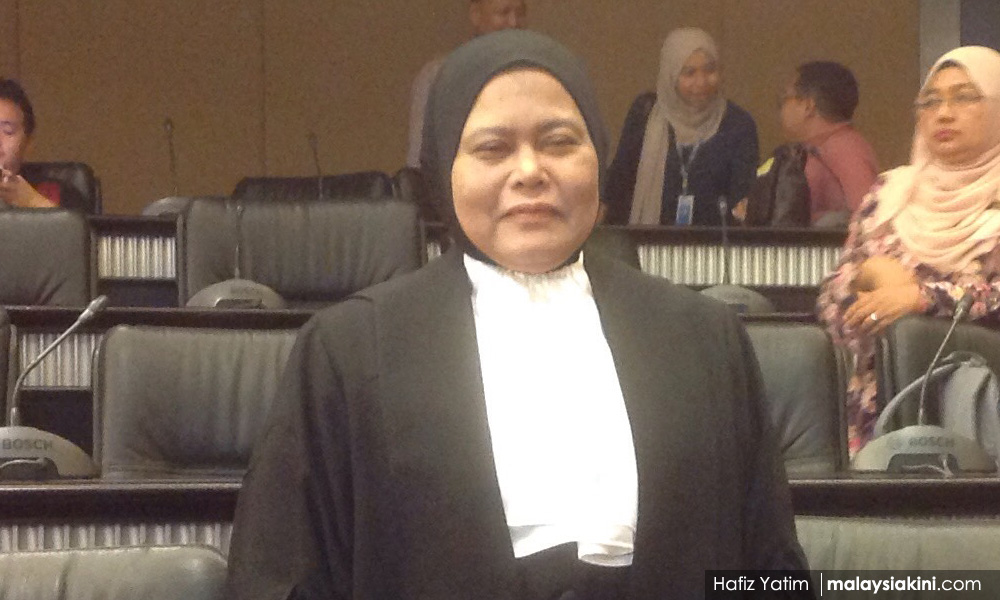
Nor Bee, a Court of Appeal judge who sat as a High Court judge when delivering her decision, said the December 1986 directive went above and beyond the cabinet’s intention, in a memorandum on the matter dated May 16, 1986.
The contradicting 1986 cabinet stand and Home Ministry’s directive - and how it decided the case
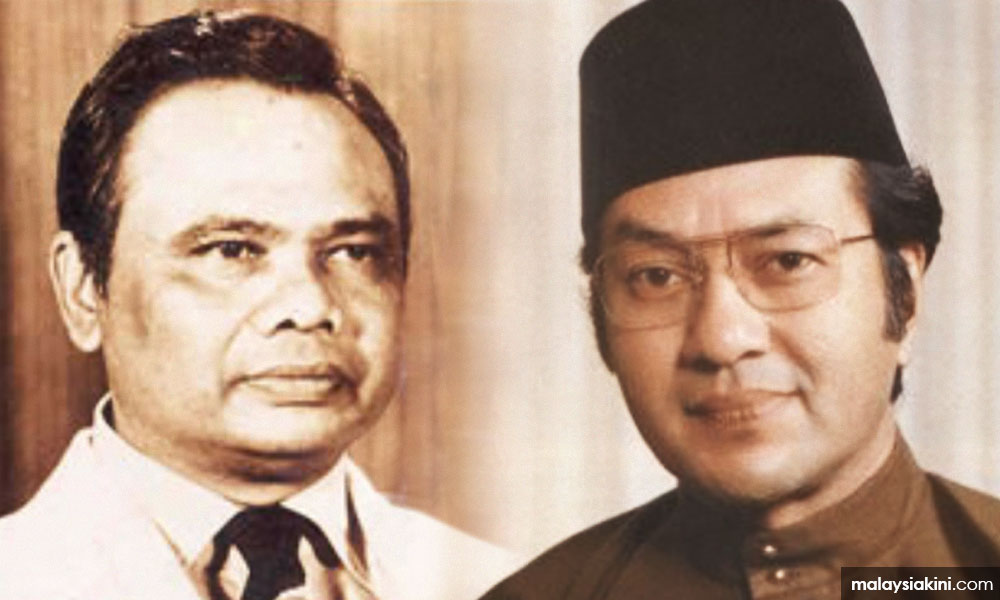
On May 19, 1986, then-prime minister Mahathir affirmed that he assigned his deputy, the late Ghafar Baba, to determine what words can be used and what can’t in the Christian religion.
The letter was submitted to the court in Ireland’s case.
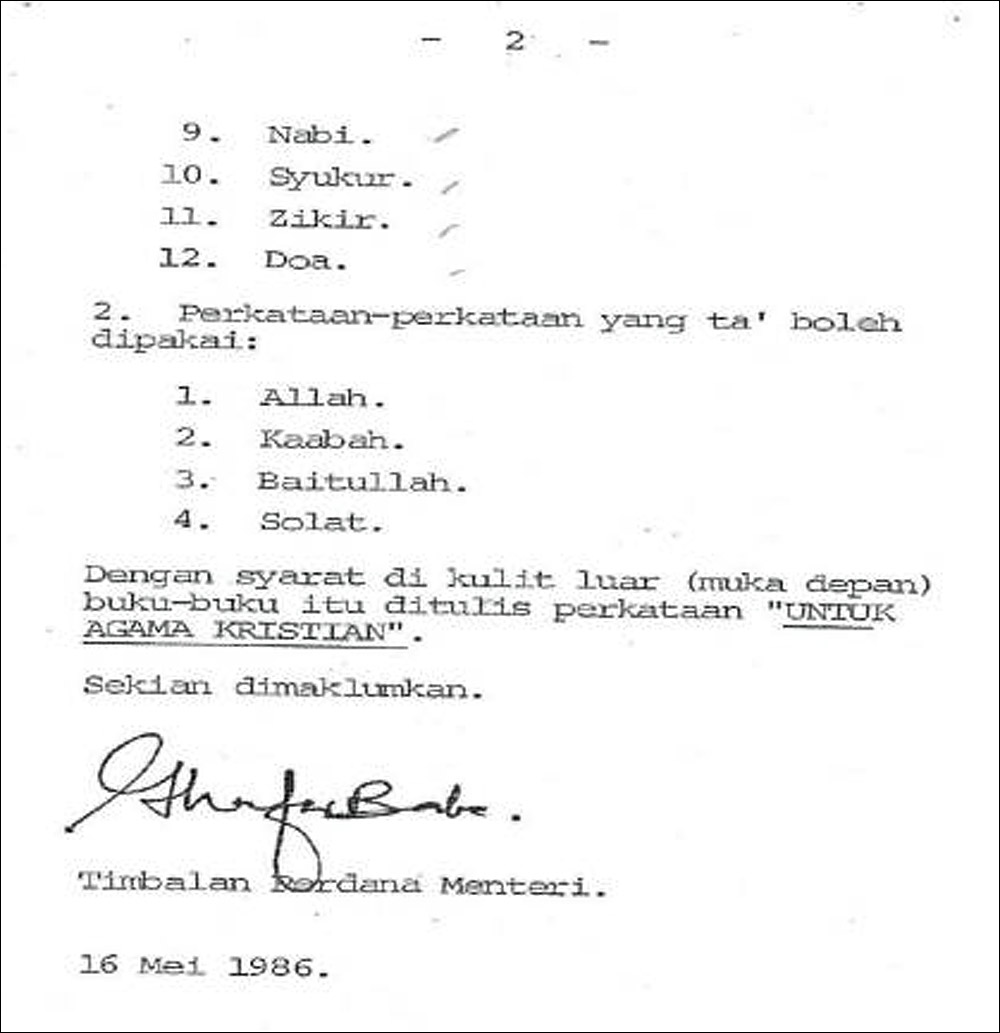
Attached to that letter was a note from Ghafar dated May 16, 1986, titled “Islamic terms/words in the AlKitab which cannot be used”.
The AlKitab refers to the Bible published in the Malay and Indonesian languages.
The note identified 12 words which were allowed and four words – “Allah”, “Kaabah”, “Baitullah”, and “Solat” - which were not.
However, under the four disallowed words, the note read: “On condition, the book cover (front page) has the words “Untuk Agama Kristian” (for the Christian religion)”.
Seven months later, on Dec 5, 1986, a directive was issued by the Home Ministry, containing the list of the same 12 permitted words and four prohibited words - but this time - for all Christian publications and not just the AlKitab.
Additionally, Ghafar’s condition - that the book covers include the words “For the Christian religion” - was placed under the 12 permitted words instead of the prohibited words as was written in Ghafar’s note.
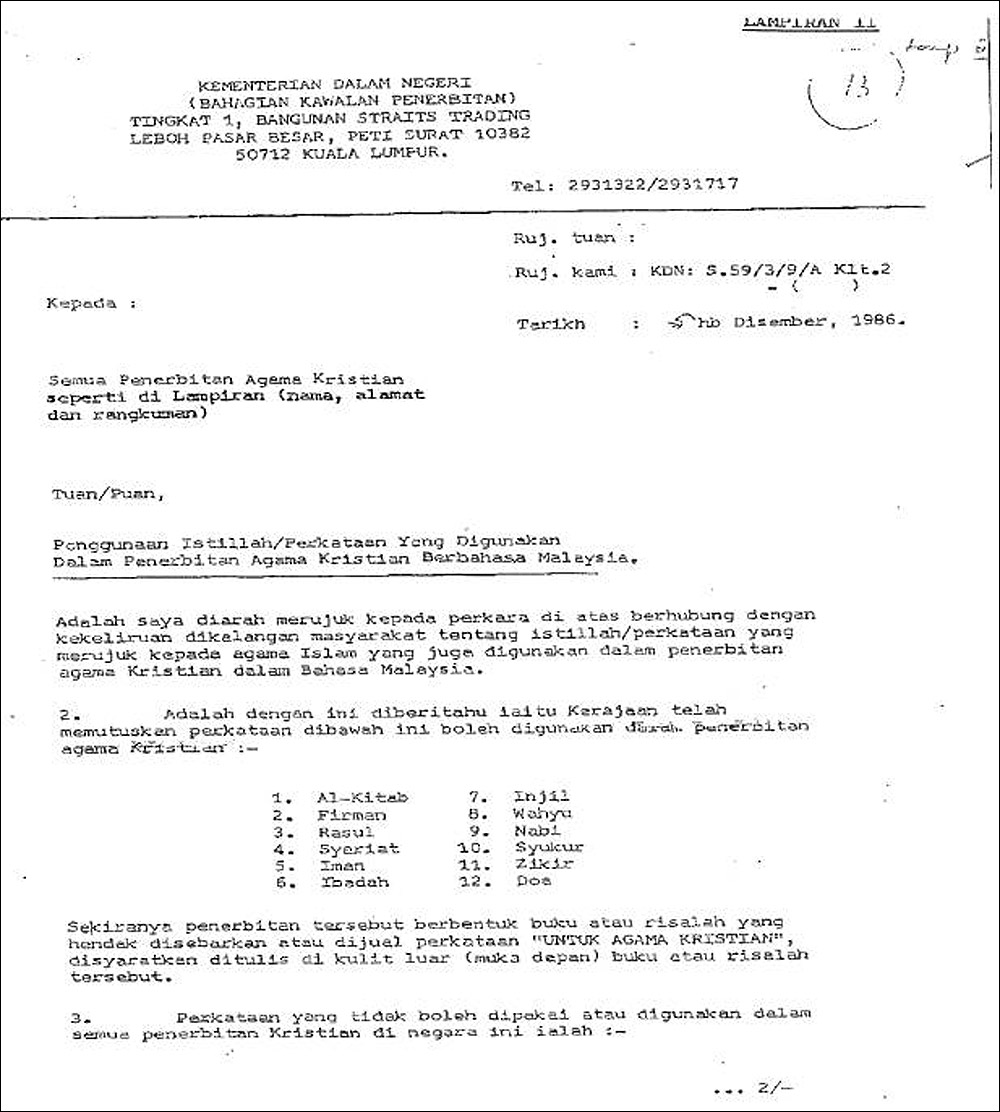
Nor Bee ruled that this showed a contradiction between the directive and what was set out in Ghafar’s note.
She said the note clearly stated that the 12 words can be used unconditionally - whereas the four words could only be used subject to the condition that the front cover of the publication must contain the words “For the Christian religion”.
At the same time, Nor Bee said the cabinet could not have meant to impose a total ban on the four words because that decision would contradict a government order gazetted four years before that, on March 22, 1982.
The 1982 order - issued under the now defunct Internal Security Act (ISA) - permitted the AlKitab, which carried the word “Allah”, to be used within the confines of Christian churches throughout the country.
If the cabinet wanted to ban those words for Christian publications, it would repeal the 1982 order, but this was not done, the judge said.
As such, Nor Bee ruled that the Home Ministry’s directive was illegal, unlawful, and that it was devoid of any legal effect whatsoever from its inception.
Current Home Minister Saifuddin Nasution Ismail said the contradictions as highlighted by the judge were the reason behind the government’s decision to withdraw its appeal in the Ireland case.

So did the judge say Christians can use the word “Allah”?
It’s complicated.
Although Ireland sought declarations specific to her right to use the word “Allah”, this was not one of the two declarations that the Court of Appeal ordered the High Court to hear.
This means it was never adjudicated, and there is no ruling specifically for this.
The rulings were only on whether the CD seizures breached her constitutional rights to practise her religion without discrimination.
To do so, Judge Nor Bee ruled on the legality of the directive used to seize those CDs - i.e. the ban on the use of the four words in Christian publications.
This means that the judge was not making a ruling on whether Christians had the right to use the word “Allah” in general, but whether Christian publications can use the word “Allah” and that Christians can own such material.
However, she did note that Bahasa Malaysia had been the lingua franca for the native people of Sabah and Sarawak and that the Christian communities of those states have used the word “Allah” to refer to God for generations when practising their Christian faith.
“The uncontroverted historical evidence that the use of the word ‘Allah’ by the applicant (Ireland) and her Christian community in Sarawak was over 400 years, since the year 1629, cannot be ignored,” she said.
She ruled this also negates the government’s argument that the directive is needed to curb public unrest.
Wait, what about a Federal Court decision the government claims supersedes this ruling?
In deflecting brickbats for withdrawing its appeal against the Nor Bee ruling, Putrajaya has several times referred to a 2014 Federal Court ruling which it said remains in force.
While the government has not been specific, this most likely refers to the Federal Court rejecting leave for a Catholic publication, the Herald, to appeal a Court of Appeal decision not allowing them to use the word “Allah”.
The Federal Court - in a 4-3 decision - found that the appellate court had applied an objective test when arriving at its decision, among others.
However, the Federal Court also ruled that remarks by the Court of Appeal bench on theological aspects were mere “obiter” - a passing remark that does not bind the court.
This was believed to be in regard to the Court of Appeal saying that the word “Allah” was not integral to the Christian faith.
READ MORE: CJ: 'Allah' ban not based on theological issues
Also to note, the government’s position at the time was that the Court of Appeal and Federal Court decisions on the use of “Allah” were specific only to the Herald - and not to Christians in Malaysia as a whole.
However, the Court of Appeal’s decision did have an impact on a similar case filed by Sidang Injil Borneo (SIB).
What’s the SIB case then?
Like Ireland’s case, the SIB case began after the Home Ministry seized Christian religious books containing the word “Allah” in 2007.
The group won its case to get the books back in 2008 but continued to seek a court declaration that it had the right to use the word “Allah” in publications and for educational purposes.
However, the Kuala Lumpur High Court in 2014 rejected the application, saying it was bound by the decision of the Court of Appeal in the Herald case.
SIB discontinued its 14-year legal battle to challenge this decision last month in the interest of “national harmony”.
Which court ruling takes precedent on whether Christians can use the word “Allah”?
Lawyers have opined that the Ireland case takes precedent on the use of the word “Allah” by Christians for religious and educational purposes.
This is because the rulings in the Herald’s case should be deemed specific to the Catholic publication, as was the Najib Abdul Razak administration’s position at the time.
In 2013, several ministers - including then home minister Ahmad Zahid Hamidi - also held the position that the Court of Appeal ruling on the Herald did not apply to the AlKitab, which could continue using the word “Allah”.
This is consistent with the 1982 government order, referred to by Judge Nor Bee, in the Ireland case.
READ MORE: Gov't insists 'Allah' ban only for 'The Herald'
Does a ban on non-Muslim use of the word have Islamic precedence?
The use of “Allah”, as the Arabic word for God by non-Muslims, is common practice among Christians and Jews in Arabic-speaking countries.
This was attested to by Perlis Mufti Mohd Asri Zainul Abidin in a 2021 opinion piece where he argued that Islam and the Quran do not prohibit non-Muslims from using the word “Allah” - as this is the name of God.

Instead, he said what is prohibited is the misuse of the word “Allah” - such as using it to describe idols, inanimate objects or humans.
PM said ruling only applicable in East M’sia. Is this true?
In an attempt to quell dissent over the government’s decision to withdraw its appeal on the Ireland case, Prime Minister Anwar Ibrahim said the court ruling is only applicable to East Malaysia.
However, this position does not appear to have solid footing, with former home minister Hamzah Zainudin and others pointing out that Judge Nor Bee’s ruling was not confined to East Malaysia.
Others also pointed out that the decision was delivered in the Kuala Lumpur High Court.
Likewise, after the 2014 Federal Court ruling, then minister in the Prime Minister’s Department Idris Jala said the cabinet’s position that Christians can use the word “Allah” also applied to copies of the AlKitab in Peninsular Malaysia.
Idris is the architect of the Najib administration’s 10-point solution which allowed the printing of Malay-language bibles.
READ MORE: Gov't lifts ban on printing of Malay Bibles
What about state Syariah laws barring non-Muslims from using the word “Allah”?
In theory, the Federal Constitution states that when federal law and state laws clash, then federal law takes precedence.
However, besides constitutional provisions safeguarding freedom of religion, there is no specific Act or article in the Federal Constitution on non-Muslim use of the word “Allah”.
In contrast, several Peninsular Malaysia states such as Selangor have state enactments that prohibit non-Muslims from using “Islamic words” such as “Allah”.
READ MORE: MB: Non-Muslims in Selangor still barred from using the word 'Allah'
This has led to situations such as the Selangor Islamic Department seizing Malay-language bibles in 2014, despite the then Najib administration’s 10-point plan allowing Christians on the peninsula to use the AlKitab.
This contradiction remains unresolved.
One peninsula state that does not prohibit non-Muslims from using the word “Allah” is Perlis.
So what’s next?
The Anwar administration has said that it plans to amend laws that leave room for contradictions on the “Allah” issue so that the matter can no longer be challenged in court.
The government also plans to limit the use of the word by non-Muslims to those in Sabah and Sarawak only.
How this might affect the use of the AlKitab and Christian worship by Bahasa Malaysia-speaking East Malaysian congregants in the peninsula remains to be seen.