




Dr M: Im all for press freedom but...
Former premier Dr Mahathir Mohamad said today that he supports press freedom but argued the media should also be responsible.
Former premier Dr Mahathir Mohamad said today that he supports press freedom but argued the media should also be responsible.
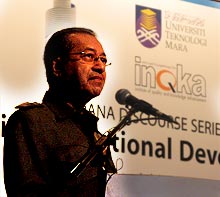 "I'm all for press freedom but the press must be responsible," he said at the 6th Perdana Discourse Series entitled 'Media and National Development', organised by Perdana Leadership Foundation in Putrajaya.
Mahathir conceded that his pro-press freedom stand has put him in a "difficult position".
"Others said, 'But in your time (as prime minister), you're worse," he quipped.
Nevertheless, Mahathir argued that there cannot be absolute press freedom and media control laws are necessary to ensure that racial hatred does not see the light of day.
He said that the media is like a knife - it could be used to carve the most beautiful things or to stab someone. The problem, said Mahathir, is not the knife but the person using it.
"Media needs to be licenced. (The law) is there for a very good reason because of the possible abuses of the media. We don't want that.
"(I) feel that the media can play a very big role, but in this country there's a need to supervise them to ensure the media does not become irresponsible," he said.
At the same time, he argued that the media must also do its job in creating an informed society.
"A responsible media must report so that people can make a reasoned choice when they go to elections."
Gov't abuse of laws
In his keynote speech in front of more than 250 people, the veteran politician however warned that national development would be stunted if media laws were abused by the government.
"The provision ensures that the media is responsible but when the government becomes irresponsible and abuses the power that it has by stifling opposition [...] to prevent people from speaking the truth then the country would not do well at all.
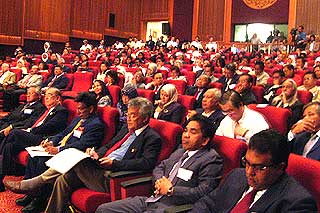 "The law can be used for the good of the country or be abused to perpetrate certain things," he said.
Last year, Mahathir accused the government for trying to discredit him through the media and decried that a media blackout by local newspapers has forced him to use the Internet, including giving interviews to online news portal malaysiakini , to express his views.
Mahathir noted that his detractors have accused him of abusing the laws to stifle dissent.
"I don't know when I was prime minister whether I abused such authority to stay as PM. I'm quite sure many people are convinced that I did. But my conscience is clear," he declared.
Stick to the truth
The former premier also spoke approvingly of bloggers but urged them to be truthful.
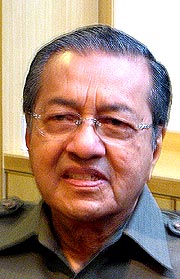 "The main thing (that bloggers should do) is stick to the truth. Don't embellish it (news) or exaggerate it.
"(They should) not give info that is deliberately wrong [...] and then claim the role in correcting misinformation coming from other sources," he said.
Later at a press conference, he was asked to comment on Energy, Water and Communications Deputy Minister Shaziman Abu Mansor's idea to register bloggers in the country.
Mahathir said such registration was not necessary.
"It is like licencing of the media - if it is something that is necessary then it's okay but if you register (bloggers) in order to threaten them, that I would think that is very bad," he said.
Mahathir said that press freedom in Malaysia today is worse than during his time as prime minister.
He lamented that reports which supported his criticism of the government were not published by the government-controlled media.
Editor rebuts Mahathir
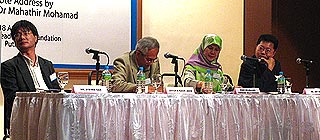 In the four-member panel discussion, which was held after Mahathir gave his one-hour speech,
malaysiakini
editor-in-chief Steven Gan said he was surprised to be invited to speak at the function.
In the four-member panel discussion, which was held after Mahathir gave his one-hour speech,
malaysiakini
editor-in-chief Steven Gan said he was surprised to be invited to speak at the function.
"I wished that forums such as this were held when Mahathir was prime minister," he said.
Gan then rebutted a number of points raised earlier by Mahathir, whom he described as a man of "great contradictions".
"I'd like to address two fallacies. One - that journalists, unlike politicians, are not elected. True, they are not. But while politicians have to account for their actions every four or five years, journalists hve to account for theirs every single report they write - every day. A wrong report and we lose our credibility. The same cannot be said of politicians, even when they lie - time and again - they continue to be elected.
"And the second fallacy - that journalists demand for absolute freedom of speech. There's no such thing as absolute freedom. Freedom comes with responsibility.
"There is a code of ethics which journalists need to abide to - the dos and don'ts of journalism, so to speak. This include getting the facts right, in exercising discipline in the verification process, in not peddling hearsay as news. All we ask is the freedom to do our job."
Gan also addressed the fear that press freedom would result in racial riots on the streets.
"The people who whip up racial and religious sentiments are politicians, not journalists," he said.
Watch the 20-minute video below. Part 2 to follow.


