
KINIGUIDE | What’s up with the bivalent vaccine?
KINIGUIDE | Amid fears of a resurgent Covid-19 wave, attention has turned to newer versions of Covid-19 vaccines that have been adapted to provide improved protection against the Omicron variant.
However, despite earlier assurances, no such vaccine will be available in Malaysia until at least late this month. The government has instead urged people not to wait for the new vaccines and come forward for their booster shots.
In this edition of KiniGuide, we revisit what these newer vaccines are and how they fit into the current situation.
Why is a newer vaccine made in the first place?
To recap, vaccines work by “teaching the body” what a potential “invader” might look like, so it can mount a swift and robust immune response if it encounters the same - or a similar - pathogen in the future.
This means a better chance of stopping the infection before it can cause too much damage.
However, the virus that causes Covid-19 can circumvent these defences by simply changing how it appears to our immune system. The more people it infects, the more opportunities to perfect its methods.
While there may be immunity, protection grows weaker and wanes more rapidly when challenged by ever-evolving variants. This applies to immunity acquired through vaccination, infection, or both.
The “holy grail” of Covid-19 vaccine development is a new generation of vaccines that can offer long-lasting protection against severe disease and death no matter what form the virus takes.
This could leverage the discovery of “super antibodies” that can neutralise not just the virus that causes Covid-19 but other types of coronaviruses as well.
This bivalent vaccine, unfortunately, is no such game-changer.
Rather, it is a tweak to an existing tool just to keep it relevant against an evolving threat, in lieu of better ways to keep the disease under control.
Why is the new vaccine called a “bivalent” vaccine and how is it different?
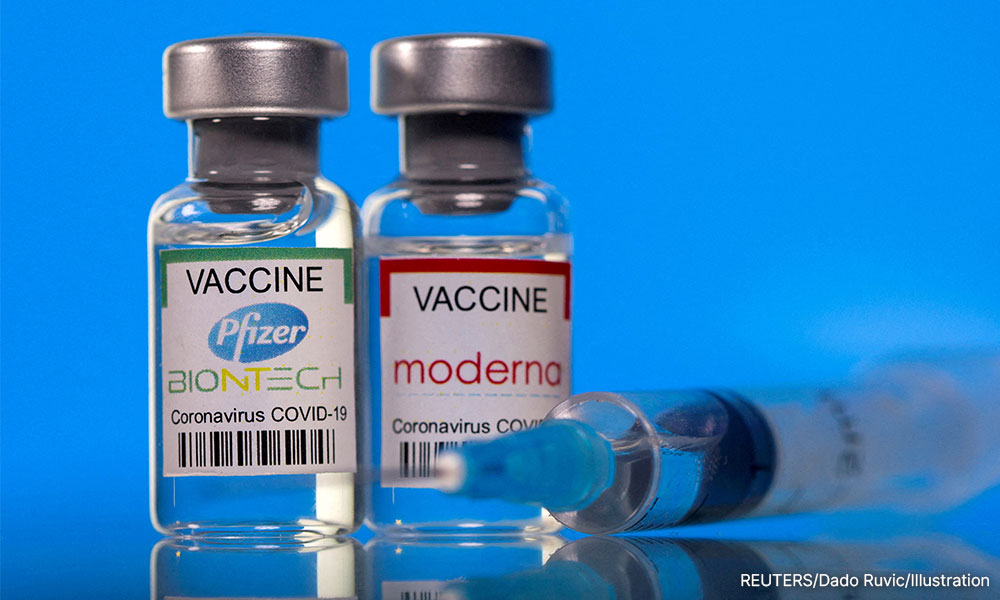
“Bivalent” refers to the fact that the vaccine has two active components that each target a different strain of the virus that causes Covid-19.
One component targets the Omicron strain. This usually means the BA.4 and BA.5 subvariants including the one in Malaysia, but some countries like the UK and Australia have opted for a different version of the bivalent vaccine that targets the older BA.1 subvariant instead.
The other component is the same as the earlier monovalent vaccines. It targets the original Covid-19 strain which first appeared in Wuhan, China in 2019.
The US Food and Drug Administration (FDA) website explains that the Wuhan strain is included to ensure broad protection against various Covid-19 strains, while the Omicron component improves its protection against the Omicron variant more specifically.
Targeting multiple strains of the same pathogen with a single vaccine dose is a common public health strategy.
For example, an annual flu shot typically targets four influenza virus strains at once. Its formula is updated twice a year (once for the northern hemisphere flu season, another for the southern hemisphere flu season) based on predictions of which strain would become prevalent in the respective hemisphere’s winter months.
US health officials believe that Covid-19 vaccination will become an annual affair in the future. Studies are already underway to test the possibility of combining Covid-19 vaccines with influenza vaccines.
How well does the vaccine perform?
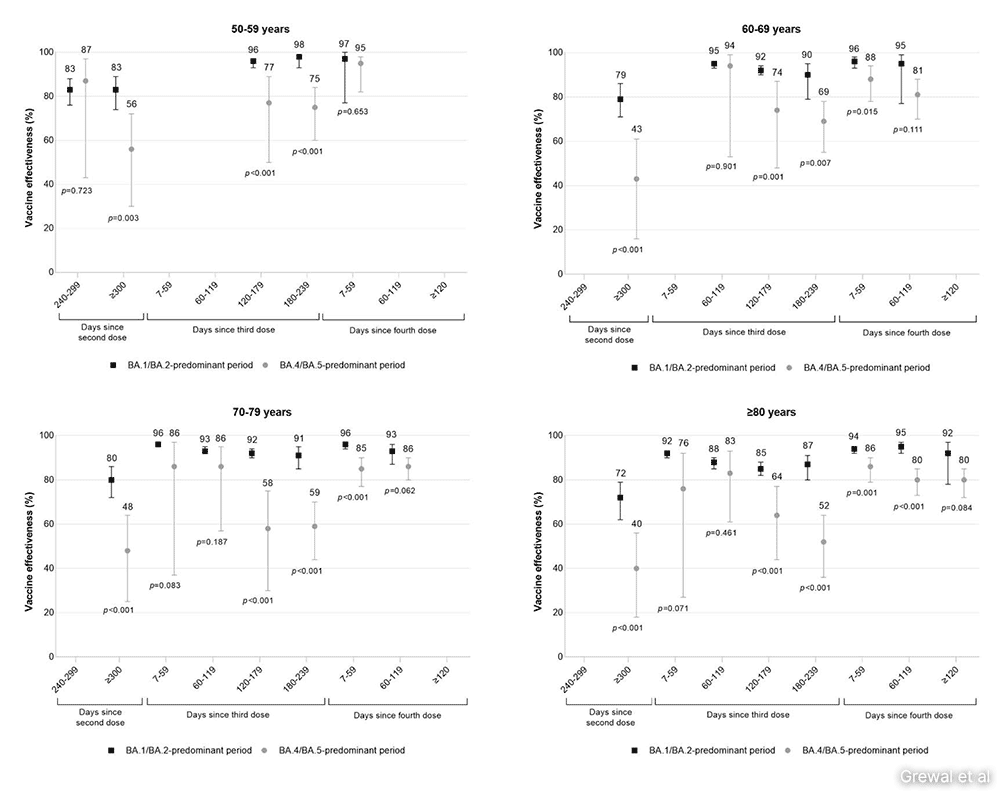
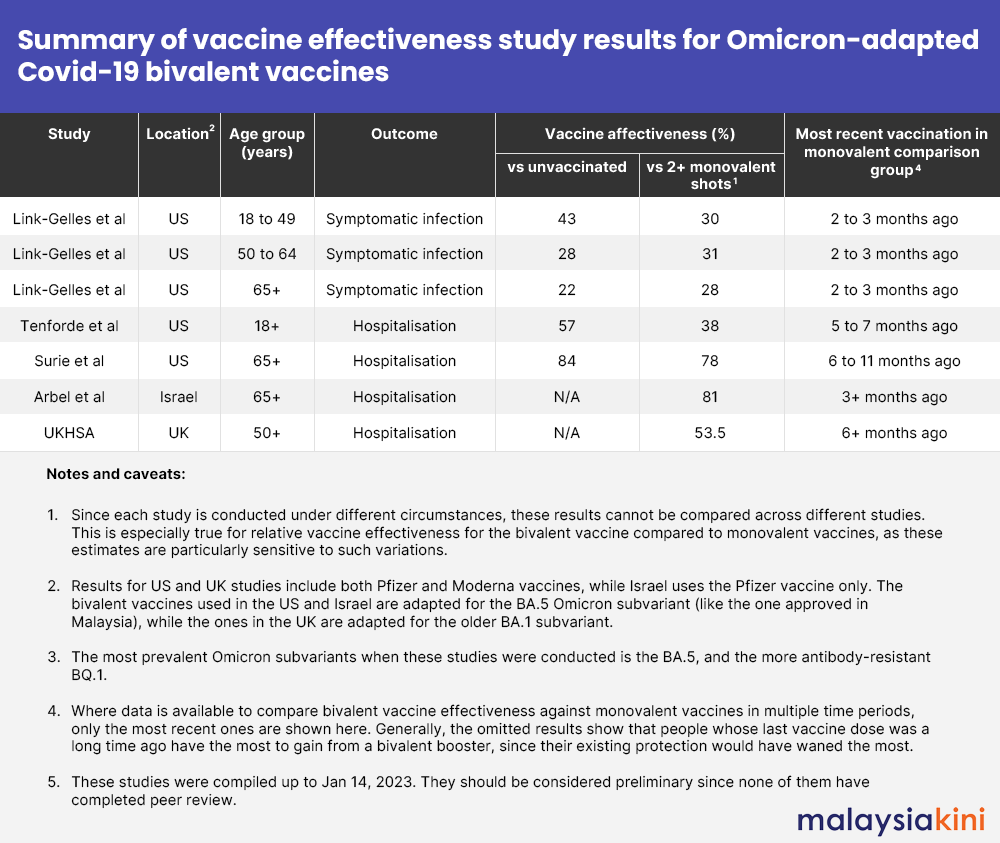
It is still early in the vaccines’ rollout to know with certainty, but the preliminary results so far (summarised in the table below) point towards at least a modest improvement in preventing Covid-19 hospitalisation, even when compared to those who had a monovalent booster just a couple of months earlier.
This holds true even in the UK despite having used a bivalent booster that targets the older BA.1 subvariant, which was nearly extinct and long been superseded by the more antibody-resistant BA.5 variant by the time the bivalent booster became available.
People who are most at risk of a severe bout of Covid-19 seem to have the most to gain from the bivalent booster. This means the elderly and those whose immunity has already waned due to the passage of time.
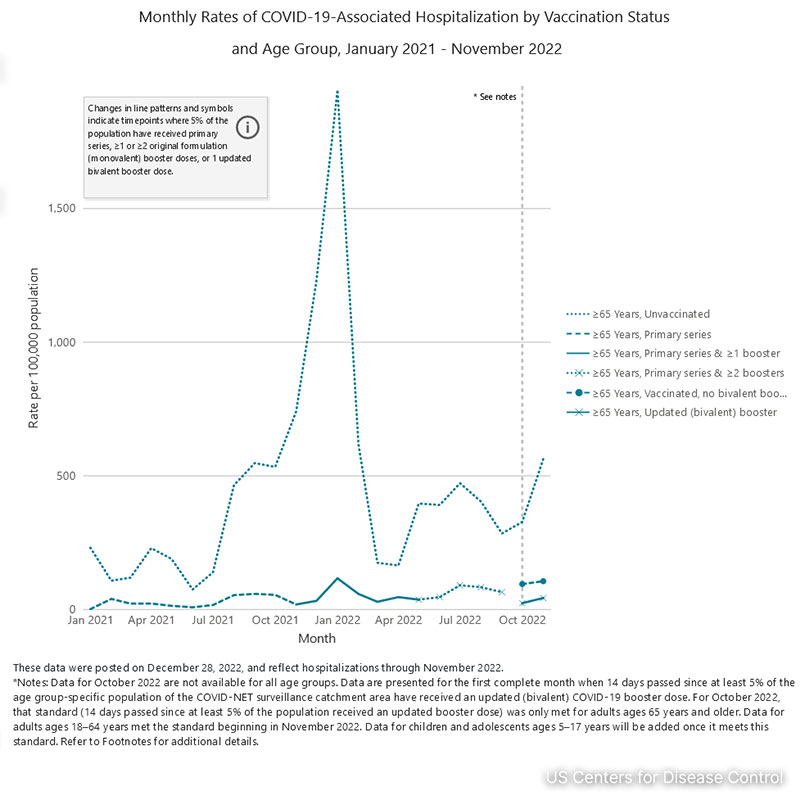
The US Centers for Disease Control (CDC) surmised that in November 2022, vaccinated people above the age of 65 without the updated booster are 2.5 times more likely to be hospitalised for Covid-19 than those who received the bivalent vaccine.
For unvaccinated people, the risk is 13.5 times higher.
Younger age groups also benefited. Among those aged 18 to 49 years, bivalent vaccine recipients were 29.9 times less likely to be hospitalised for Covid-19 compared to their unvaccinated counterparts, and 3.2 times compared to those who only had the older vaccine.
There are a few things we still don’t know about the bivalent boosters’ performance.
For example, one of the studies shown above attempted to investigate its effectiveness in preventing Covid-19 deaths. Since there were too few such deaths among the study’s participants, the estimate was too imprecise to be useful.
Unfortunately, for those wondering whether to get a monovalent booster now or wait for the bivalent booster, there are no head-to-head comparisons where participants were given one or the other vaccine during the same period.
According to one of the papers listed above, the reason is that the monovalent booster was discontinued when the bivalent version was rolled out, so no direct comparison can be made. Comparisons can only be made with those who had the monovalent vaccine months ago.
We also don’t know how well it can block Covid-19 transmission or prevent Long Covid. We don’t know how long its protection will last especially against newer variants like XBB.1.5 and whatever might come afterwards.
There are positive signs from test tube studies (i.e. neutralisation assays) suggesting that antibodies produced by bivalent vaccine recipients are more adapted to neutralise the XBB subvariant than their monovalent counterparts, but how that plays out in the real world remains to be seen.
For context, XBB is the variant that has been dominant in Malaysia since late last year and is considered one of the most antibody-resistant, while XBB.1.5 is its highly transmissible descendent that has been spreading rapidly in the US.
What about its side effects?
The known side effects of the bivalent booster are generally the same as the previous Pfizer/BioNTech vaccine.
Most people may have symptoms such as injection site pain as well as swelling, fever, and fatigue that should subside in a day or two.
It is inadvisable to drive or operate heavy machinery during this period. If symptoms persist, go see a doctor.
There is also the possibility of myocarditis (inflammation of the heart muscle) based on experience with the previous vaccine, but so far, the CDC says no such cases have been reported.
Instead, the CDC and FDA said one of their many vaccine safety monitoring systems has picked up a “safety signal” that could indicate an increased risk of ischaemic stroke 21 days after receiving the Pfizer/BioNTech bivalent vaccine.
This triggered a further investigation to see whether this was a spurious signal or represented a genuine risk. So far, no other vaccine surveillance system whether inside or outside the US has reported similar signals.
Who can get the bivalent booster?
According to the consumer medication information leaflet for the new vaccine, which is available from the Malaysian National Pharmaceutical Regulatory Agency’s (NPRA) website, there are several criteria to be met.
The vaccine is approved for those above the age of 12 who have completed their primary Covid-19 vaccination (i.e. the first two doses) using the earlier Covid-19 vaccines from Pfizer/BioNTech, Moderna, Johnson & Johnson, or AstraZeneca.
At least three months must have elapsed since the last vaccine dose was taken (including boosters).
This means the NPRA has not approved the bivalent booster for those who had Sinovac, CanSino Biologics, or Sinopharm’s vaccines for their first two shots.
However, that does not preclude the possibility that the Health Ministry might allow the vaccine to be administered anyway on an “off-label” basis.
So far, the Health Ministry has yet to announce who can get the bivalent vaccine once it becomes available or whether it plans to give it to those who took the China-developed vaccines. It is likely the elderly and those with certain medical conditions will be prioritised, as before.
Meanwhile, women who are pregnant or nursing are advised to inform their doctors before receiving the vaccines. The leaflet cautions that the available safety data for these populations is limited, but also notes that experience with the earlier version of the vaccine did not reveal any harmful effects on the pregnancy or the infant.
Those who have known allergies to any of the vaccine’s components (listed near the end of the leaflet) should not get the vaccine.
Should I get my booster now, or wait for the bivalent vaccine?
To date, only 2.2 percent of Malaysia’s population has gotten their second monovalent booster. Citing the Covid-19 situation in China, the Malaysian government has urged more people to come forward for their booster shots now rather than wait for the bivalent vaccine.
“The ministry urges the public that has received their first booster more than six months ago to receive a second dose without waiting for the bivalent vaccine,” said Health Minister Dr Zaliha Mustafa on Jan 2.
The bivalent booster was supposed to arrive in the third or fourth week of November, but this has been delayed to late January.
The basis for the government’s advisory is that the existing monovalent vaccines are still effective in preventing Covid-19 serious illness and death. This statement has remained true despite the emergence of new variants, even though the duration of that protection is increasingly short-lived.
Nevertheless, whether and when you decide to get a booster shot remains a personal decision. If you have reservations, consider consulting a medical professional – ideally one who is familiar with your medical history and circumstances.
There is also an additional factor you might want to consider: Whenever you decide to take your vaccine, it will take a week or two for the vaccine to reach optimum performance.
So, if you are taking the vaccine because you have upcoming gatherings or travel plans, it may be prudent to plan ahead and not leave your vaccination to the last minute.
Where can I get my booster shots?
The list of government vaccination centres can be found on the Health Ministry’s Covid-19 website.
In addition, ProtectHealth has a database of private healthcare providers offering Covid-19 vaccines as part of the government’s vaccination programme.