




Bumi equity: Asli report will be vindicated
Dr Lim Teck Ghee, the man who was at the centre of the bumiputera equity controversy last year, has reasons to feel vindicated.
Dr Lim Teck Ghee, the man who was at the centre of the bumiputera equity controversy last year, has reasons to feel vindicated.
Yesterday, Prime Minister Abdullah Ahmad Badawi told Parliament that the government hopes to achieve the 30 percent bumiputera corporate equity target in three years.
 Lim had earlier suggested that the government had already exceeded the 30 percent bumiputera share in corporate equity, and argued this could be as high as 45 percent - more than double the government's estimates.
However, the government has strenuously denied this. According to official statistics, the bumiputera share in the corporate sector is around 18.9 percent.
In his written reply yesterday in Parliament, Abdullah did not explain how the government would be able to make up the shortfall in three short years.
The prime minister also did not say whether the government's preferential treatment for the country's bumiputeras will continue after 2010.
Lim, a former World Bank official, argued that the target can indeed be reached much sooner than 2010.
"When that target achievement announcement is made, I am sure that the findings of the Asli report on corporate equity distribution will be vindicated," he said, referring to the Asian Strategy and Leadership Institute report which sparked the bumiputera equity debate a few months ago.
Statistical spin-masters
At the height of the controversy, Lim quit his post in Asli when the think-tank retracted the controversial report after coming under intense pressure.
Lim said that the prime minister's announcement "sets the stage now for the civil service statistical spin-masters to work towards a clear date for that target to be achieved."
"I am optimistic in light of the recent brouhaha that this milestone will finally and definitively be reached soon."
However, he said there were several other concerns Abdullah should now address.
"One is to ensure that during the remaining three year life span of that condition, it is the bumiputera poor that will become the beneficiaries of the quota condition, and not the politically connected and already wealthy."
Lim said that this would require greater transparency and disclosure by the government in pursuing the target, especially in its New Economic Policy (NEP).
"The other is that the corporate equity condition is a small part of a large system of racially privileged entitlement. That larger system needs to be dismantled if the country is to go forward as a united and cohesive nation."
A gift to young Malaysians
The NEP was enacted in the 1970 as part of a bold blueprint to reduce income disparity among different ethnic groups. This include a wide range of measures including the 30 percent bumiputera equity target.
It was given a shelf life of 20 years but the policy continued after 1990 under a different name - the New Development Policy - to be implemented up to 2000.
The National Vision Policy was set to be implemented between 2001 and 2010. However, the government in the Ninth Malaysia Plan unveiled last year, revived the NEP targets.
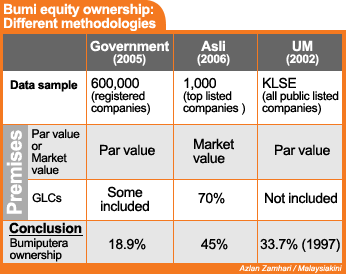 Debate over the NEP target became heated after two studies - the Asli report and a
University Malaya research
- showed that the target had been reached.
Debate over the NEP target became heated after two studies - the Asli report and a
University Malaya research
- showed that the target had been reached.
The government, maintaining that the figure was 18.9 percent as at end 2004, said the NEP policy will continue until 2020.
"The best gift Pak Lah can give to young Malaysians on the eve of the 50th anniversary of Merdeka is to define a new and historic direction for the country in which all Malaysians, regardless of race, religion, political affiliation, class and region, will be treated equally; and the poor and vulnerable are provided resources and special attention to help them improve their lives." said Lim.


