




A court within a camp
"Two months, two whips!" Another foreigner walks into Malaysia's overcrowded prison with bloody marks on his back. Thanks to the efficiency of the Semenyih Special Immigration Court, even the prison system could not cope with the speed in which cases are solved with the whip.
Being a lawyer working on cases involving migrant workers, most of whom were forced to overstay because of rogue agents, or because of some Rela members' lucky day of getting an extra RM80.
"Two months, two whips!" Another foreigner walks into Malaysia's overcrowded prison with bloody marks on his back. Thanks to the efficiency of the Semenyih Special Immigration Court, even the prison system could not cope with the speed in which cases are solved with the whip.
Being a lawyer working on cases involving migrant workers, most of whom were forced to overstay because of rogue agents, or because of some Rela members' lucky day of getting an extra RM80.
Yes, it is RM80 reward for each migrant worker nabbed by Rela members. And it no longer falls under the definition of pocket money when you have more than two million migrants walking about freely on the streets, at least now, until the equally efficient police chief fulfils his dream of zero-migrant workers on the streets. Never mind whether he or she is documented or not that's not their job. The special court at Semenyih has been set up to exactly decide on this. After all, nobody walks out of this special court without getting their backs whipped, prison-style.
Meanwhile, welcome to Semenyih, where the other side of Visit Malaysia Year 2007 resides. These foreigners do not don black expensive burqa or shop for perfumes, neither do they carry a hotel key-card while loitering in Bukit Bintang's sleazy areas. Semenyih is Malaysia's answer to Auschwitz and Shatilla, minus the chambers and the Israeli guns.
Making dirty money
The 'criminals' here did not snatch handbags or cheated a bank of millions; in contrast, they are dispossessed of all their belongings, left (sometimes for good) their families thousands of miles away, only to be nabbed on the street while on their way to the factories that employ them to work in places no Malaysian would ever want to even go, let alone work. Their arrestors are none other than youths, not dissimilar to countryside thugs, who themselves impoverished by unemployment, had joined the voluntary organisation once famed for fighting crimes in neighbourhoods and kampungs and therefore ridding the country of all the social ills we now hear of. This generation of Rela people religiously iron their uniforms every night bearing the Rela logo, to make some dirty money on a poor worker's plight.
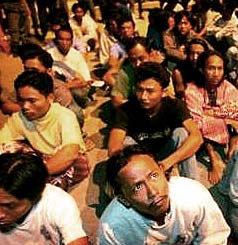 Nobody can point out Semenyih in a road map. Why is a court set up in such a remote area, when it 'hears' (if one may be polite enough to describe the court's activity thus) cases from Seremban, Sungai Buloh and as far away as Langkap and Juru? Or has the familiar refrain that "justice should not only be seen" taken an all new meaning by the administrators of this court, a court whose judge basks in the glory of seeing victims of poverty and human trade, transforming into chunks of meat to be flogged in the most dishumanely manner.
But then again, why not? After all, detainees are rarely represented by lawyers, and there is no need to have this court near a bank to prepare a bailout, especially when you have a judge who competes with award-winning comedians by asking such questions as "Why should I give bail to a foreigner?"
The scene at the court is like an auction of slaves, only that no slaves are actually traded. The end result is the same: marks of whipping are left on the poor migrant, not unlike the black slaves of old America who are hotstamped on their backs.
Mitigation takes an all new meaning in the court at Semenyih. A judge once retorted when told that a group of asylum seekers would like to prepare mitigation: "You can give me ten pages of mitigation, I will still whip them!"
If a detainee claims trial, he or she only invites further scorn from the judge. Understandable for someone whose sole pleasure is derived from the many whips he passes to the poor migrants. "Don't waste my time... how do you propose to prove your case?".
Finger pointed at Rela
I have seen how the judge, seeing that a detainee claims trial, would briefly stand down, during which the prosecution officer has a word or two with the detainee in the absence of his/her lawyer. Ten minutes later, the poor detainee would suddenly change his plea to 'guilty' and succumbing to punishments including whipping. The judge doesn't care even to ask, even for procedural sake, whether the detainee - who comes from a place where Coca-cola is unheard of, let alone the phrase 'right to a trial' knows the consequences of a guilty plea.
So what sort of miracles do happen if he indeed claims trial? Often,Rela members would throw away the valid documents when making an arrest. With RM80 per head, you can bet any country thug would! The prosecution himself had complained to the Judge the mistake was by the arresting Rela officer and produces records of valid entry and visa. The case is duly dismissed.... Not!
Remember, the court is set up to expedite sentencing, not solving cases, definitely not seeking justice. Decisions, decisions. What do they do now? The very raison d'etre of the court is being threatened by a genuine case. And decision.... The case is not thrown out. The DPP is to be referred. Meanwhile, he who misses the Whip shall be sent back to rot at the camp.
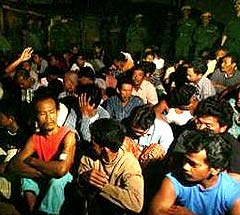 And you still ask, what if the detainees had been forced to overstay because their agents cheated them, and unable to find jobs, surrendered themselves to the authorities? The judge-cum-executioner won't let the day pass without her sadistic diet, and she remarks (and here's the part when one covers a child's eyes and ears during a horror movie):
Saya tak boleh bagi you pergi free jer... ok... dua bulan dan dua sebatan...
(I can't let you go just like that, ok... two whips and two months).
And you still ask, what if the detainees had been forced to overstay because their agents cheated them, and unable to find jobs, surrendered themselves to the authorities? The judge-cum-executioner won't let the day pass without her sadistic diet, and she remarks (and here's the part when one covers a child's eyes and ears during a horror movie):
Saya tak boleh bagi you pergi free jer... ok... dua bulan dan dua sebatan...
(I can't let you go just like that, ok... two whips and two months).
To be an asylum seeker, even with the backing of UNHCR, is like buying a ticket to seeing a tiger performing in a cage. The tiger in this case has its claws firmly on the gavel. Once, almost all asylum seekers were brought to court unrepresented (as usual) by any lawyers. A pupil doing migrant and refugee cases concerned had advised them to claim trial until a lawyer is found (before the matter started of course), for fear that they might be punished and whipped. When all of them claimed trial, the judge, standing down, threw a tantrum and even threatened her with a police report.
Driving philosophy
Sometimes, the judge confuses her role with that of a Jakim officer. Consider this: a girl from China, pregnant by the way, had pleaded guilty. Her lawyer asked for a more lenient sentence to avoid her giving birth in a prison. The judge responded by asking whether she was married and who had fathered her child.
Whether the detainee is a victim of circumstances, cheated by agents, first-time offender, or part of that strange and alien notion called "asylum seekers", is not relevant. In this court, there is no time for such civilised immigration jargons. A-whip-delayed-is-a-whip-denied seems to be the driving philosophy behind this court. It is set up solely to expedite backlog cases and a legally cruel solution to overcrowding at camps, thanks to the hundreds of eighty-ringgit envelopes finding their way into the nicely ironed Rela pockets.
The Semenyih detention camp has seen some of the worst cases of prisoner mistreatment by guards and which were documented not long ago. In it, witnesses have told of abuses most vile. Some were beaten, others forced to consume rotten food. Yet others were not so 'lucky'. I have personally seen how a PO slapped a detainee in full public view. They are shouted at, treated like convicted criminals. Their crime does not involve any victims. The only casualty here is the detainee's self respect, and the authorities' human semblance.
Thinking back, there is no greater symbolism than to have within the camp a court devoid of any justice.
LATHEEFA KOYA is a human rights lawyer


