




Johari denies taking bribes, raps police
Deputy Internal Security Minister Mohd Johari Bahrum today strongly denied he had taken bribes amounting to more than RM5 million to free detainees held under the Emergency Ordinance (EO), which allows detention without trial.
Deputy Internal Security Minister Mohd Johari Bahrum today strongly denied he had taken bribes amounting to more than RM5 million to free detainees held under the Emergency Ordinance (EO), which allows detention without trial.
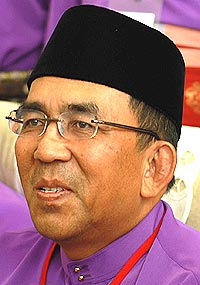 In defending himself, the embattled minister also took a swipe at the police, accusing the force of not taking action involving similar allegations made against other leaders.
He also accused the police of not following standard operating procedure (SOP) when carrying out investigations on EO cases, thus forcing him to release the detainees.
Johari, who expressed his willingness to be investigated by the Anti-Corruption Agency, said the allegations against him were made without any "basis or proof".
According to Johari, he too received numerous SMS (short messaging service) containing allegations and defamatory claims against other leaders - including the prime minister and deputy premier - of doing "immoral things".
"It is not fair that allegations on websites are turned into facts and used as a basis for something that a leader is accused of," he was quoted as saying by Bernama .
Johari was speaking to reporters today following a function in Kedah's Kubang Pasu - the Umno division in which he is chief.
The deputy minister also said there have been cases of inaction against identifiable senders of SMS making baseless allegations, resulting in many leaders to become subject of criticism by opposition parties.
"I have directed the police to be pro-active and not just act swiftly in cases (of allegations) involving only the police," he said.
He said that while the police could investigate the allegations against him, they should also take appropriate action to stem wild accusations being made as "it had gone on for a long time".
Three allegations
The 'freedom for sale' allegations against Johari first surfaced on the Internet - in a anonymous page hosted by free website, Freewebs.com. It accused him of being the "most powerful, but corrupted deputy minister."
The website cited three 'classic cases' in which Johari had allegedly abused his power and breached the trust of Prime Minister Abdullah Ahmad Badawi, who is his immediate boss in the Internal Security Ministry.
Johari was said to have ordered the release of triad kingpins and a suspect involved in vice activities this year upon receiving the bribes.
A news report quoted ACA director of investigations Mohd Shukri Abdul as saying that the agency is investigating the matter while inspector-general of police Musa Hassan said the force is assisting in the probe.
Meanwhile, Johari said that since he was appointed deputy internal security minister last year, he has deliberated on hundreds of cases, including the three mentioned in the website.
"I have to study the cases carefully based on reports from the police. If there is strong evidence and if I am satisfied, I will support the action (to detain them). Otherwise, the accused will be freed," he said.
He said the evaluation of such cases involved the calling of witnesses and the final decision - made after obtaining the advice from ministry officials and lawyers - is fair to everyone.
"Nobody is accused based on our whims and fancies because we do not want to misuse the EO," he added.
Under the EO - a law similar to the Internal Security Act - the minister has wide powers to order for suspects to be detained for two years without trial. The minister's decision cannot be challenged in court.
The EO has been used over the years to detain or restrict the movement of suspected gang members and criminals - most of whom the police find difficult to bring to justice due to lack of evidence.
Police blamed
Johari said 31 out of the 48 people sent to the Simpang Renggam detention centre in Johor - where EO detainees are held - were freed upon his approval last month.
He claimed their release was ordered because the police had failed to investigate the cases properly and there was lack of evidence to detain them.
According to Johari, the police of late have been found not to be following the 'standard operating procedure' in carrying out investigations on EO cases.
The SOP requires the police to submit their investigation report within 45 days, allowing the deputy minister at least 15 days to decide on whether to detain or free an accused.
"There are cases which are given to me three, five or six days to make a decision and this is not fair to the accused," said Johari.
"There are also times when files are sent after five or six days of investigation - this is why the files are returned to the police in order for them to complete the investigations. This includes high-profile cases."
The deputy minister stressed that the EO is used only as a last resort.


