




NGOs declare 'toxic war' against Japan
Environmental and public health non-governmental organisations launched a 'fax and e-mail' war against Japan for what they describe as Japan's 'sinister plan to establish waste colonies in Asia.'
Environmental and public health non-governmental organisations launched a 'fax and e-mail' war against Japan for what they describe as Japan's 'sinister plan to establish waste colonies in Asia.'
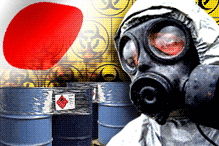 The 'war' was declared by various international and Malaysian environment groups in conjunction with Japan's National Foundation Day - which commemorates the enthronement of the nation's first emperor - on Feb 11.
Letters have been dispatched to Japanese ambassadors across Asia protesting what the NGOs said is a plan to dump toxic wastes in the region through bilateral trade pacts.
Two Malaysian NGOs - the Consumers' Association of Penang and Sahabat Alam Malaysia - said they joined groups worldwide in voicing their objection to the bilateral free trade agreements (FTAs) with Japan that 'encourages trade in hazardous wastes'.
Japan has signed FTAs with Singapore in 2002, Malaysia in 2004 and the Philippines in 2006. It also eyes FTA pacts with India, Indonesia, Thailand, South Korea and Vietnam.
Critics have claimed, however, that Japan exploits these poorer nations with weaker legal and social infrastructures to turn them - through the FTAs - into disposal sites for its toxic wastes.
"We join our Asian neighbours, including our friends in Japan, in standing firm against the illegal and immoral scheme to make our countries dumping grounds for Japanese toxic wastes, technologies and obsolete end-of-life products," said CAP president SM Mohamed Idris.
He cited the Japan-Philippines' Economic Partnership Agreement (JPEPA), which provides for 'unhindered entry of globally-controlled or prohibited wastes and substances from Japan, including extremely toxic materials with heavy metals and persistent organic pollutants such as polchlorinated biphenyls and dioxins.'
A message to Japan's PM
Among those spearheading the 'fax action' campaign is the Manila-based Global Alliance for Incinerator Alternatives.
It asked Japanese ambassadors to relay the NGOs' demands to their prime minister, Shinzo Abe, to remove 'waste trade liberalisation' from existing bilateral agreements.
It also demanded that Japan immediately ratify the Basel Convention's Ban Amendment, which prohibits the export of toxic wastes from developed to developing countries.
Letters have also been sent to secretariats in charge of several multilateral environmental agreements.
These included the secretariats of the Basel Convention on the Control of Transboundary Movements of Hazardous Wastes and their Disposal, the Stockholm Convention on Persistent Organic Pollutants, as well as of the United Nations' Convention on International Trade in Endangered Species of Wild Fauna and Flora, and the Human Rights Commission Special Rapporteur on Toxic Wastes.


