




And now folks, yes, yet another committee!
Doesn't Prime Minister Abdullah Ahmad Badawi's announcement of the formation of a high-profile task force Pemudah to inject vitality into the sagging government machinery bring us a sense of deja vu?
Pemudah (acronym for Special Task Force to Facilitate Business), which aims to improve the public delivery system through cutting unwieldy bureaucratic red tape, is made up of top civil servants who head relevant ministries and agencies as well as private sector individuals. It reports directly to the prime minister and has been given six months to deliver the results.
Doesn't Prime Minister Abdullah Ahmad Badawi's announcement of the formation of a high-profile task force Pemudah to inject vitality into the sagging government machinery bring us a sense of deja vu?
Pemudah (acronym for Special Task Force to Facilitate Business), which aims to improve the public delivery system through cutting unwieldy bureaucratic red tape, is made up of top civil servants who head relevant ministries and agencies as well as private sector individuals. It reports directly to the prime minister and has been given six months to deliver the results.
But didn't our prime minister Pak Lah also head another high-power committee to implement the much lauded 125 recommendations of the Police Royal Commission, announced at a time of unbearable deterioration of public security?
 Twenty months after the announcement amidst much expectation and all-round applause, Pak Lah has deeply disappointed the public by allowing the fizzling out of the implementation of the most important recommendation, one that would otherwise have effectively turned a new leaf for our corrupted and inefficient police force the establishment of the powerful Independent Police Complaints and Misconduct Commission (IPCMC).
Neither has the government implemented any of the key recommendations to repeal or amend the many repressive laws that have been traditionally abused by the police to violate basic human rights in contravention of our constitution, in particular the Police Act 1967 and the Internal Security Act 1960. As a result, the crime rate has relentlessly gone up while police continue to flout constitutional provisions for citizens' rights.
Another reminder to Pak Lah. Immediately after he assumed premiership in November 2003, didn't he order every cabinet minister and chief minister of every state to individually establish a task force to improve the delivery system in his own portfolio through cutting red tape and wiping out corruption? Strangely, no one seems to have heard of these task forces since.
Now, thirty-eight months later, Pak Lah is ordering another task force to carry out the same mission, using the same top civil servants though this time adding private sector individuals to the team. He expressed optimism that the present team comprising the public and private sectors would surely improve the business environment and encourage more investment.
Optimism justified?
What can we make of Pak Lah's latest move?
First, Pak Lah's effort to reform the civil service up till now has been a failure. He admitted as much when he said earlier that we have lost our competitiveness against our neighbours due to our cumbersome bureaucracy. The newly appointed co-chairman of Pemudah, Yong Poh Kon (Federation of Malaysian Manufacturers president) sang the same tune when he said that
he wanted the task force to help the Malaysian civil service to regain the edge that it 'used to enjoy in the region', reminiscing that our public servants once used to provide 'world-class service' to facilitate business activities.
Second, Pak Lah's present optimism seems to have sprung from the fact that in contrast to the last time, there is private sector participation this time around. (This, of course, is another subtle admission of the lack of confidence on the political leadership and the government machinery to make the grade on their own.)
So, is Pak Lah's optimism justified? Most likely not, for Pemudah is only an advisory body that investigates and proposes. The implementation is left to another committee the 3P, based on the Malay names for coordination, delivery and services which is made up of senior civil servants.
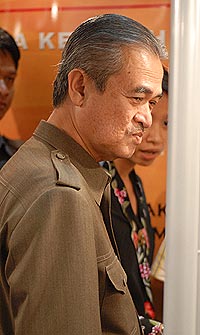 We all know that Pak Lah's policies are sound; the catch is in the implementation. He himself in a recent meeting with the staff of the prime minister's department had called on civil servants to pull up their socks, quoting a recent forum's verdict on his three- year premiership - excellent in announced policies but failing badly in execution.
Bad implementation is due to a decadent administration which metamorphosed after decades of corrupt misrule. Hence, in the absence of any visible reforms as pledged, how can the prime minister leading the same team of politicians and civil servants, who have proven to be failure in past, reverse the downtrend of the administration of the country?
It is not difficult to see that the responsibility of this failure must be placed squarely on the prime minister himself. There is no use putting the blame on civil servants or even his political colleagues, when he repeatedly failed to act decisively against them when they ostentatiously strayed wayward.
Defective leadership
Time and again, he disappoints the nation by failing to stand up for what is right. His philosophy seems to be to take the line of least resistance whenever the old forces of the corrupt and irrational put up a fight against reforms intended to steer the nation onto the right path. As the entrenched regressive forces seem to be always stronger, Pak Lah invariably takes their side, thus frustrating his own reform advocacy which had heartened so many Malaysians who gave him unprecedented endorsement in the last election.
Witness how he has retreated when sections of the police force and his own party opposed the implementation of the IPCMC, in spite of overwhelming public support and encouragement for its implementation.
And witness how he deals with the proposed Interfaith Council and the Article 11 movement. The former was a proposed consultative body aimed at promoting inter-religious understanding and harmony, while the latter represents a group of NGOs and civil rights advocates campaigning for greater understanding of our constitutional provisions for religious freedom. In the face of opposition to these movements from conservative Muslims, Pak Lah has banned both, thus forsaking the opportunities to forge better interfaith understanding and national integration in this multi-racial, multi-cultural and multi-religious society. By doing so, Pak Lah has ironically acted
against his own reform pledges to bring forth a more democratic and humane society.
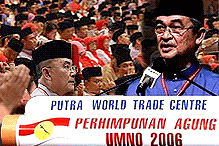 Pak Lah's feeble leadership was also painfully evident at the last Umno general assembly when the delegates, particularly the youth wing, indulged in an orgy of racial bashing. Witness how he sheepishly avoided showing disapproval to such racially incendiary conduct when questioned about his reaction to these clearly seditious speeches.
Worse, he even allowed himself to be misled by the ultras led by his own son-in-law into endorsing a retrogressive programme to intensify racially-discriminative practices in the grand economic master plan for the country the 9th Malaysia Plan. Again, this is another giant step backwards that runs contrary to the grain of his reform agenda.
It seems only too clear that Pak Lah is a leader who is being led by instead of leading others.
Apart from these obvious character weaknesses which will prove quite fatal for a leader, namely, deficiencies in forcefulness, persuasiveness, courage, and moral principles, perhaps there is another factor that may doom Pak Lah to fail as an anti-corruption crusader. And that is the question about his personal integrity.
Questionable integrity
When he took over from his much tainted predecessor Dr Mahathir Mohamad, Pak Lah's reputation as 'Mr Clean' was a refreshing change that kindled the hopes of many. However, running into the fourth year of his premiership, that image has faded. There are good reasons for this.
For one, he has not properly exonerated himself over accusations of nepotism over the business deals of his son and son-in-law. His claim of personal non-partisanship and ignorance is certainly unacceptable when he happens to hold the mantle as both premier and minister of finance. The favouritism granted to ECM-Libra both before and during its reverse take-over of a much larger state-controlled investment house Avenue Resources Bhd is obvious, and son-in-law Khairy Jamaluddin's murky association with ECM-Libra remains murky.
As for son Kamaluddin Abdullah, huge contracts granted by state enterprises to his company without transparency against the backdrop of his meteoric rise in wealth in recent years have continued to cast doubts on the propriety of such contracts.
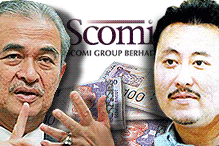 Then, Pak Lah's continued failure to honour his repeated pledge to restore open tenders to government contracts serves as a clear indication of his abandoned resolve to stamp out corruption and cronyism. Such failure could even be interpreted to imply his involvement in such practice.
Indeed such seems to be the case, as exemplified in an event much-publicised and documented in the Internet (but not in the press) about Pak Lah dishing out RM600 million in the form of contracts to Class F contractors, many of them who were among the delegates to the last Umno general assembly. The sum of RM 600 million was distributed to the 191 Umno divisions with each receiving RM 300,000.
Pak Lah's dramatic announcement of such surprise bonus at a closed-door meeting with Umno delegates on the eve of the Umno general assembly smacked unmistakably of money politics (read bribery) to buy influence in the face of potential rebellion from Mahathir loyalists at the assembly. Such squandering of public funds is an act of corruption and abuse of power. Having openly practiced such vices himself, what moral authority can he marshal to impose discipline on his subordinates? Is this the reason why he has ceased to carry out the earlier rhetoric of reforms in his speeches in recent times?
Economic fallacies
There has been a concerted media hype recently to paint a rosy picture of our economy, cashing in on the historical occasion of our foreign trade touching the trillion ringgit mark that timed in with the recent stock market surge, with ringgit appreciation as the back drop.
With irresponsible politicians and speculators ever ready to exploit these so-called good news, it is important to discern facts from fallacies, and not to lose sight on the real issues that confront our economy.
First, take our foreign trade.
True, the figure of one trillion does sound historical, but nothing more should be interpreted from that. The more relevant data to gauge the direction of our economy is the rate of growth of our total foreign trade. For 2006, it is 10.5%, which is no better than the 2005 rate of 9.9% , considering the unusually high prices that prevailed in 2006 for our primary products such as petroleum oil and gas, palm oil and rubber (average rate of growth for 1997 2006 is 10.8%).
This rate of growth is well below those of other developing economies like India and China or the developed economy of Singapore, but on par with world average of also 10.5% for 2006 (WTO). So, nobody should use the trillion ringgit mark to claim proof of a sudden surge in our economy.
 Next, our stock market.
The recent surge refers only to the Kuala Lumpur Composite Index (KLCI), which comprises 100 companies listed in the main board. So, it is not reflective of the entire spectrum of our listed companies. In fact, the average increase taken across the board is much less than that of KLCI.
Interests are mainly centered around the heavyweights within KLCI, and are largely driven by foreign funds and local institutions, without significant increase in participation by the general public. Foreign funds are mainly motivated by expectation of a double gain speculative gain from currency exchange as well as a stock price increase. Some funds are a diversion from Thailand where recent turmoil there has alienated foreign fund managers. These funds are, of course, the first to take off when local events turn sour or when their objectives are achieved.
In any event, our stock market still lags far behind others in the region, which surpassed their historical heights long ago.
A more reliable indicator of the level of investor confidence is FDI (foreign direct investment), which represents long-term commitment to the local economy, bringing in entrepreneurship, technology and market in addition to capital. In this respect, our FDI fares badly. Our 2006 FDI was a miserable US$1.44 billion which is lower than the 2005 figure of US$1.46 billion.
This level pales in comparison with those of our neighbours, where the 2006 FDI are (in billion US$) for Vietnam 9.87, Singapore 9.33, Indonesia 5.71, Phillippines 3.94 and Thailand 2.94. (extracted from market researcher Loco Monitor).
The hard question we must ask ourselves is this: why are we forsaken by foreign investors while others seem to be sailing ahead with new investors on board?
The full answer to this question is outside the scope of this article. But suffice to say here that unless there are structural changes in our country encompassing the political, social and economic fields, the present malaise will only worsen. And the only way to achieve those structural changes is to seek fundamental change to our present political leadership.
KIM QUEK is a retired accountant with an interest in current affairs.


