
KINIGUIDE | A littoral dive into the navy's RM9b LCS scandal
KINIGUIDE | Over the last two weeks, the country has been gripped by the latest multi-billion ringgit scandal involving the Royal Malaysian Navy’s (RMN) second generation patrol vessel - more commonly known as the littoral combat ship (LCS) - project.
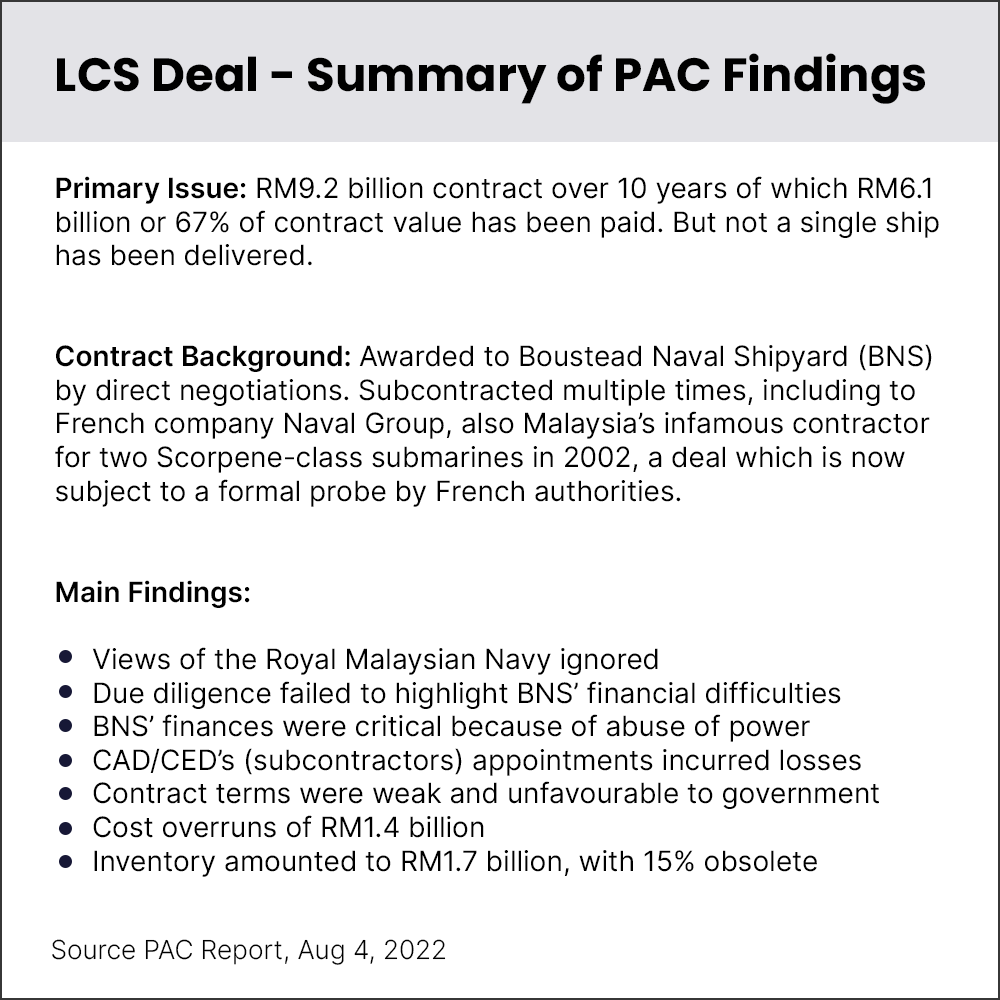
A report by the parliamentary Public Accounts Committee (PAC) revealed that the country’s largest defence procurement, worth RM9 billion for six LCS vessels, was in shambles.
The PAC’s report showed that since the project’s contract took effect in 2013, the government has paid out more than RM6 billion but not a single vessel has been delivered.
Malaysiakini sails into these stormy waters to provide a deep dive into what an LCS is, the current fiasco, and a brief history of the project.
How are modern naval vessels designated?
To help get a better understanding of what an LCS is, we have to take a brief look at the different types of modern warships.
Most modern navies designate their surface combat ships from largest to smallest, as cruisers, destroyers, frigates, corvettes, and fast attack craft.
These ships are combat vessels armed with guns, missiles, and torpedoes. Most of these vessels carry a helicopter.
They are different from offshore patrol vessels (OPVs) which have duties including maritime patrol, enforcement, as well as search and rescue.
OPVs usually mount limited weapons including a main cannon, machine guns, and depending on the size of the vessel, may also carry a helicopter.
What is an LCS?
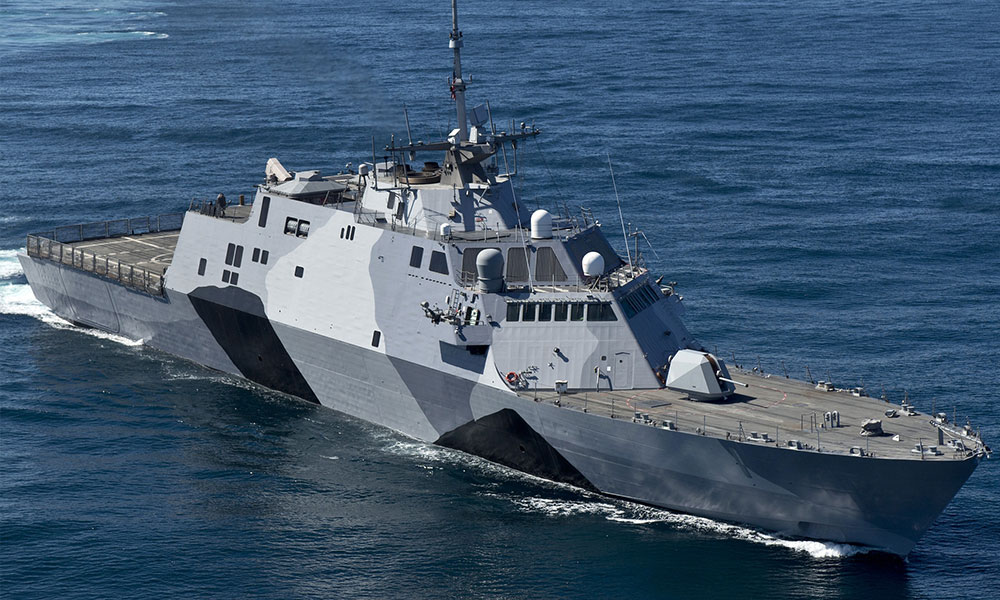
The concept was first introduced by the US Navy with two classes of LCS - Freedom and Independence. The concept is for cheap - for the US - small, and stealthy surface combat vessels for littoral zone warfare and operations.
The littoral zone can be described as nearshore waters starting from the shoreline to the edge of the continental shelf.
Littoral warfare means military operations in the littoral zone. The types of operations include maritime patrol and surveillance, mine-clearing, landing operations support, and naval combat operations.
The US Navy’s LCS was supposed to be modular, in theory at least, where different weapons, sensors, and equipment are changeable depending on need.
Apart from the US, Malaysia is the only country to have surface combatants designated as LCS.
However, the RMN’s LCS are very different, being smaller, significantly cheaper, slower, and non-modular.
What are the Gowind and Sigma designs?
One of the issues in the PAC’s report is how the Defence Ministry changed the LCS ship design from Sigma to Gowind - against the navy’s wishes.
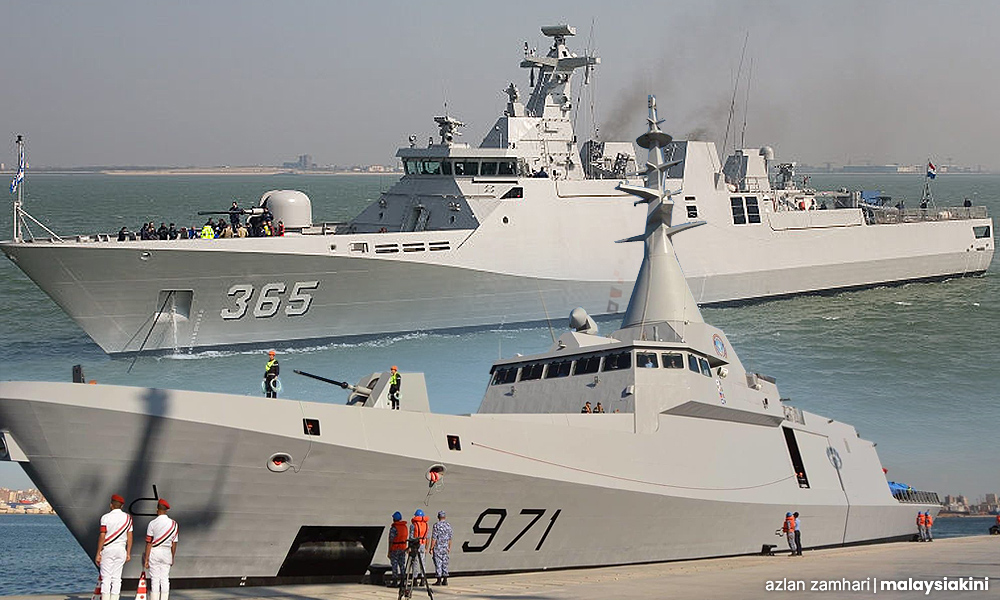
Sigma-class ships are combat ships designed by the Netherlands’ Damen Naval, while Gowind patrol ships are designed by French defence firm DCNS (now known as Naval Group).
Former navy chief Abdul Aziz Jaafar told the PAC that, at the time, the Gowind design was not proven, while Sigma-class ships were already operating in Indonesia and Morocco.
Secondly, Gowind vessels were not big enough for their intended use.
Publicly available information reveals the Gowind design was originally a series of corvettes displacing between 1,000 and 2,500 tons. The LCS design was a version modified to meet Malaysian requirements.
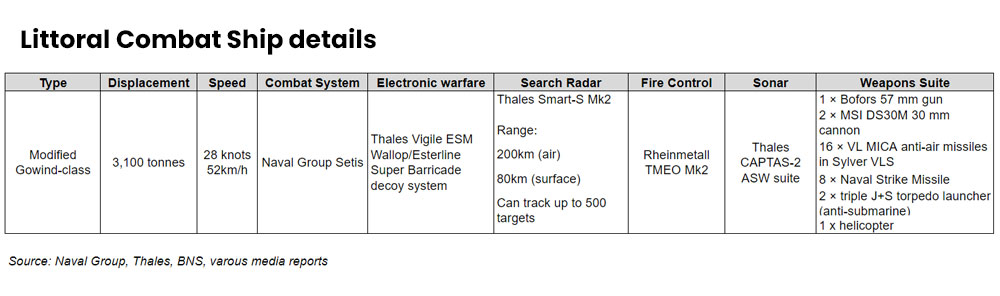
The Sigma series of vessels wanted by the navy comes with several versions ranging from 750-ton fast attack craft to 2,300-ton frigates.
Indonesia operates two different types of Sigma ships - the 1,700-ton Diponegoro-class corvettes and the 2,375-ton Martadinata-class frigates.
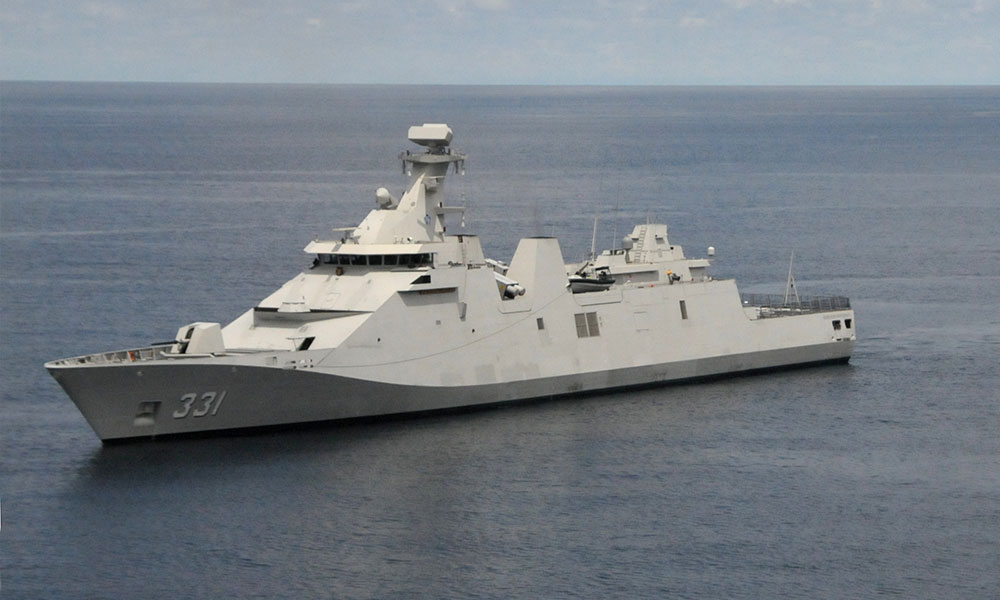
According to the Special Committee on Governance Investigation, Government Procurement, and Finance (JKSTUPKK) which conducted a forensic audit on the LCS project in 2019, the change in design was done by then defence minister Ahmad Zahid Hamidi in 2011.
Zahid initially greenlit the navy’s decision to use the Sigma design in May of that year but changed his mind in less than two months following recommendations from project contractor Boustead Naval Shipyard Bhd (BNS).
What else did the PAC report highlight?
a) Delivery failure
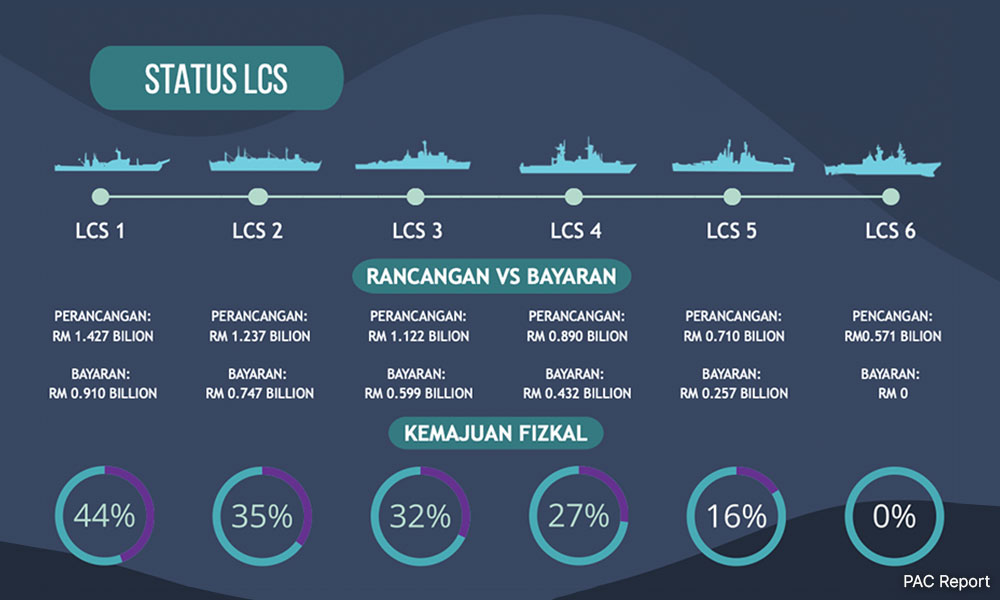
The first LCS was scheduled to be completed in 2019 but it is only 44 percent finished and the statuses of the remaining ships are even worse.
b) Cost overruns
The report also contained a long list of issues ranging from poor project oversight to ignoring the views of the navy, cost overruns, and contractual terms unfavourable to the government.
Why are there allegations of cost bloating?
In two of the project’s packages, PKR deputy president Rafizi Ramli claimed that multi-layered sub-contracts resulted in the cost ballooning almost three times from RM397 million to RM1.185 billion.
The three layers of contracts involved BNS, Contraves Advanced Devices Sdn Bhd (CAD), Contraves Electrodynamics Sdn Bhd (CED), and DCNS.
BNS appointed CAD as the sub-contractor for the two packages. In turn, CAD appointed CED as its sub-contractor, with a final cost of RM1.185 billion. However, DCNS, as the final supplier, only charged RM397 million for the two packages.
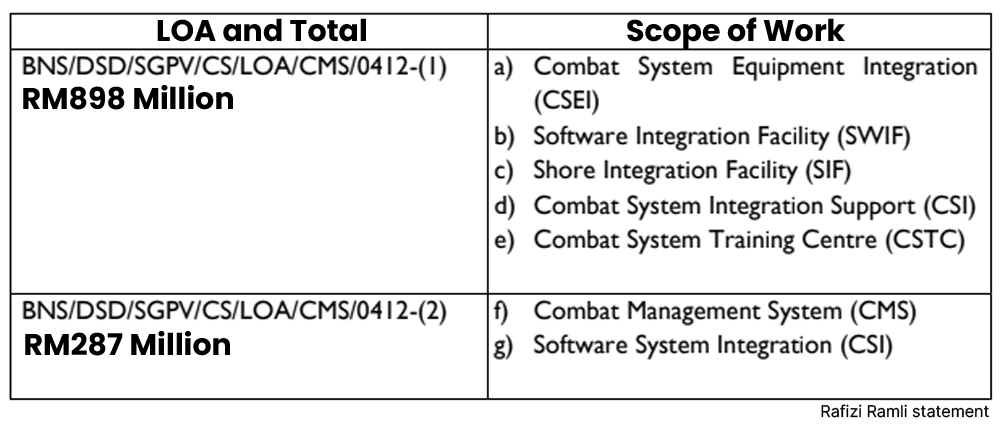
According to the PAC report, CAD and CED were joint ventures between Boustead Heavy Industries Corporation Bhd (BHIC) and Rheinmetall Air Defense AD.
BHIC has a 51 percent stake, while Rheinmetall Air Defense AG has 49 percent.
Wait, wasn’t an LCS launched in 2017?
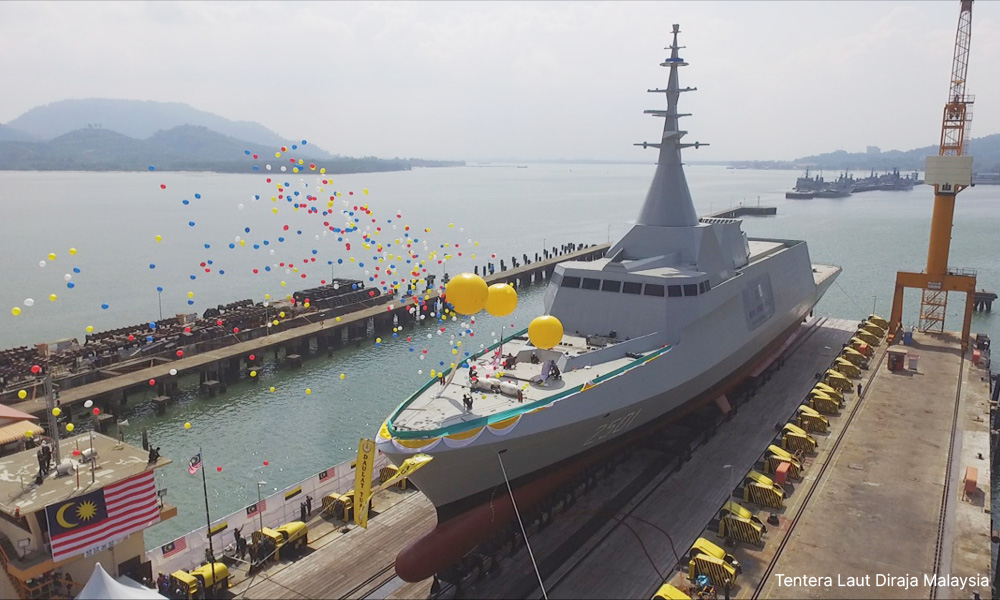
LCS1, KD Maharaja Lela, was launched on Aug 24, 2017. The ceremony was attended by Perak ruler Sultan Nazrin Shah and Raja Permaisuri of Perak Tuanku Zara Salim.
The raja permaisuri officially launched the ship.
So, it wasn’t a ‘dummy’ ship?
Former navy chief Ahmad Kamarulzaman Ahmad Badaruddin clarified that the ship was not a ‘dummy’ ship although it was incomplete.
He went on to say it was normal practice for navies around the world to launch ships before they were completed and that the practice had been explained to the PAC.
Kamarulzaman added that the ship mast wasn’t fake.
Contractor BNS, under questioning by the PAC, conceded that the company put up a "temporary" mast to make the ship look good for the launch before taking it down again.
BHIC CEO Sharifuddin Md Zaini Al-Manaf went a step further to state that the temporary mast was a “waste of money”.
The cost of the mast was RM400,000 and was kept in storage when the duo testified before the PAC in December 2021.
Are the delays Pakatan Harapan’s fault?
On Aug 7, former prime minister Najib Abdul Razak alleged on Facebook that the previous Harapan-led federal administration was responsible for the LCS project’s delay.
In his Facebook post, he mentioned that PAC chairperson Wong Kah Wor said LCS1 was 44 percent completed during its launch in 2017.
Najib added that Mohamad Sabu said the ship was only 55.7 percent completed when the then defence minister addressed Parliament in October 2019.
According to the PAC report, however, LCS1 was only 36.8 percent completed as of May 2019.
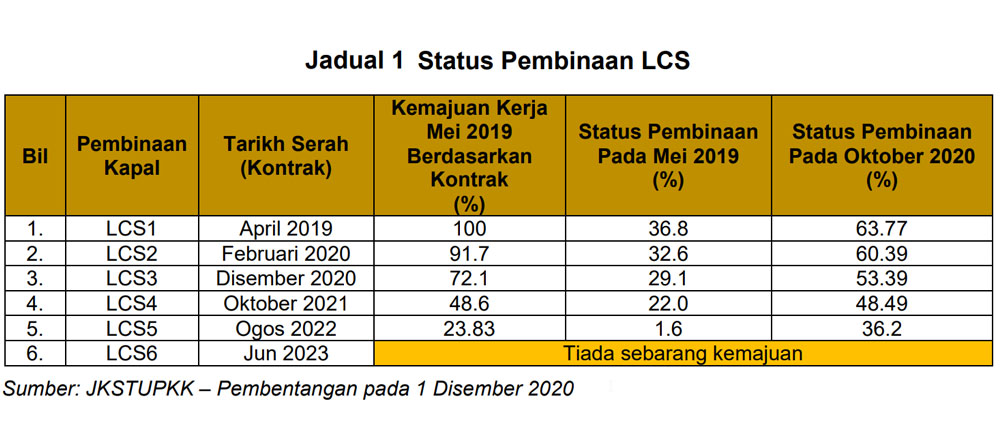
Mohamad and his then deputy Liew Chin Tong issued a rebuttal to Najib’s claims on Aug 9.
While Najib blamed the 2018 change in federal power from BN to Harapan for the delays, the navy’s former director-general for the LCS project told the PAC that the transition allowed him to find the root cause of the project’s problems and carry out a forensic audit.
Separately, the PAC was told in December 2020 that all original equipment manufacturers (OEMs) and subcontractors have stopped work due to non-payment. The only work carried out is by Boustead themselves.
The non-payment problems began in April 2018 according to the PAC report.
On Wednesday (Aug 10), Defence Minister Hishammuddin Hussein said in a statement that the ministry will hold discussions with OEMs, vendors, and financial institutions to mobilise the completion of the LCS.
Does the navy need the new ships?
Navy chief Mohd Reza Sany told the media back in April that 61 percent of naval assets are operating beyond expected service life.
He said new assets were needed to protect the country’s sovereignty and interests.
All of Malaysia’s major surface combat vessels are more than 20 years old.
The Lekiu-class frigates were commissioned in 1999. Meanwhile, the Kasturi-class corvettes were commissioned in 1984, and the Laksamana-class corvettes were first commissioned in 1997.
What were the reactions to the PAC report?
The resulting uproar has seen politicians from both sides of the aisle start finger-pointing.
Harapan politicians were quick to demand explanations from the government and past BN leaders in power at the time the LCS contract was signed.
Meanwhile, then defence minister and former deputy prime minister Zahid said that it wasn’t his fault and it was unreasonable to blame him.
Umno Youth, Amanah, and Bersatu have all called for a Royal Commission of Inquiry (RCI) to get to the bottom of the mess.
The government, meanwhile, has vowed to declassify the forensic audit into the LCS project - subject to approval from the attorney-general and auditor-general.
What led the navy to purchase the LCS?
Prior to the inception of the LCS programme, the RMN’s most modern surface combatants were the two Lekiu-class frigates, KD Lekiu and KD Jebat.
In 2006, then defence minister Najib announced that the government would buy two more Lekiu-type ships but the deal eventually fell apart.
Five years later, the government announced the Second Generation Patrol Vessel programme which would be the country’s largest defence deal budgeted at RM6 billion.
Shipbuilders bidding for the programme included DCNS, Damen Naval, and Germany’s ThyssenKrupp Marine Systems.
In December 2011, the Defence Ministry announced that DCNS’ modified Gowind-class vessel was the winning design and the construction contract was awarded to BNS.
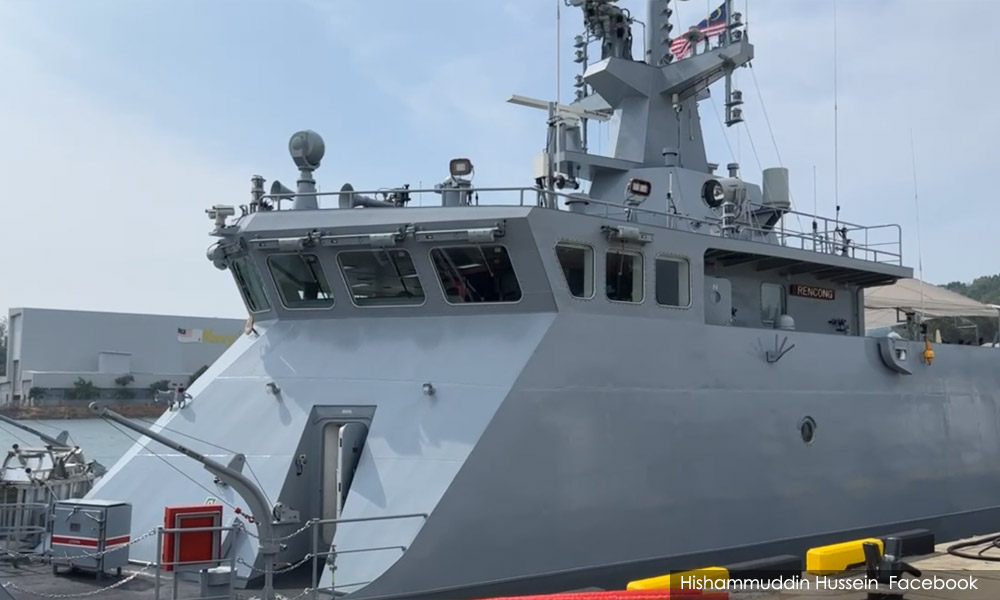
Something to take note of is that the LCS should not be mistaken for the littoral mission ship (LMS), which is the navy’s latest class of patrol vessels.
The LCS is considered to be a multi-mission frontline warship suitable for patrolling, frontline combat, anti-air, and anti-submarine warfare.
Then navy chief Abdul Aziz said in 2011 that the budgeted cost of RM1 billion per LCS was not excessive as:
“The cost covers the overall cost of building the LCS including the aspects of sophisticated weaponry, sensing, and radar equipment that have a very high capability, and also sonar to detect enemy submarines.
“LCS is equipped with sophisticated defence systems like command and control, electronic warfare, various modes of engine control, three-dimensional radar, sea and air missile systems, and anti-submarine torpedo capability.”
Are procurement issues in the military new?
The current issues faced by the LCS project would not be the first time the navy’s procurement resulted in controversies.
a) Scorpene deal
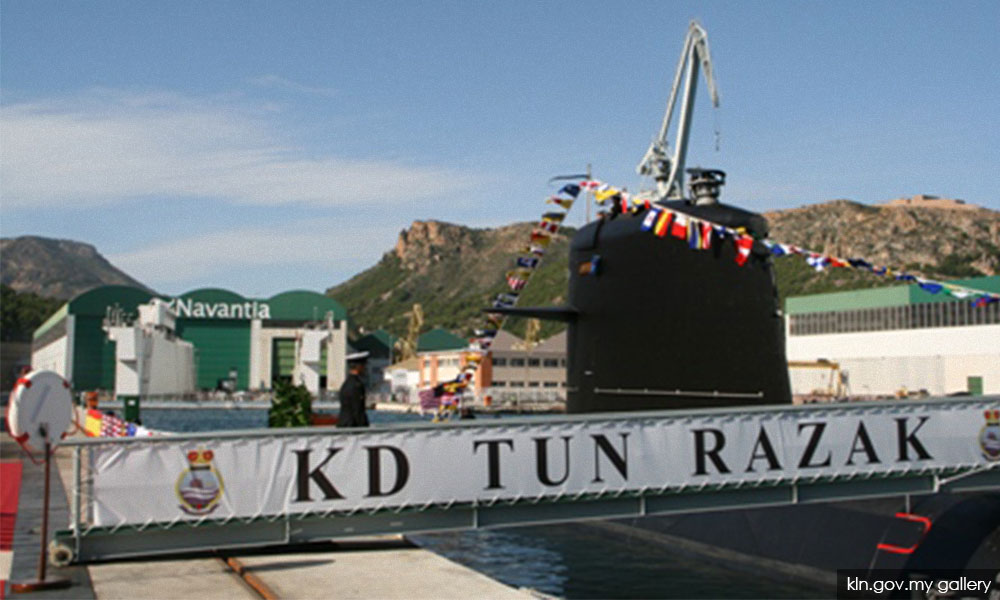
The most infamous is the Scorpene scandal involving Najib’s associate Abdul Razak Baginda. French authorities launched an investigation into the possibility of kickbacks being paid to secure the deal.
In April this year, a French judge charged defence firm Thales, one of the LCS project’s suppliers, with bribery to secure the Scorpene sale.
b) LMS procurement delay and cost reduction
Following the 2018 general election, the Harapan government reviewed the LMS project and decided to make changes to lower costs.
Originally, two of the four LMS were to be built in China and the remainder locally by BNS. After negotiations, the Harapan administration said building all four LMS in China would save RM122 million.
c) Kedah-class OPV construction
In 2006, construction of the Kedah-class OPVs was hit by a series of setbacks and delays.
A PAC investigation revealed serious problems with the main builder Penang Shipbuilding and Construction - Naval Dockyard Sdn Bhd (PSC-Naval Dockyard).
More than RM200 million was needed to meet unpaid bills and cost overruns.
The company eventually filed for bankruptcy and was folded into BNS.