
Forced labour: Loopholes in the law may keep M'sia in Tier 3 chasm
The lack of laws to enforce zero recruitment fees on migrant workers may be a lucrative loophole for employers in Malaysia but it will likely cause the country to remain in the bottom tier of the Trafficking in Persons (TIP) Report for a second year.
A government source confirmed that there was no legislation, policy or even directive to enforce the zero recruitment cost for migrant workers as part of the state’s effort to address debt bondage, exploitation and forced labour.
As a member-state of the International Labour Organisation (ILO), Malaysia adopted a “no recruitment fee” concept from its Fair Recruitment Initiative in 2014.
“On April 1, 2019, the government verbally implemented it so every recruitment expense borne by the employer could not be deducted from workers’ salaries.
“This comprises recruitment fees and related costs including medical tests, insurance coverage, skills and qualification tests, travel and lodging, training, administrative and levy,” said the source.
However, apart from making announcements and statements, the government had not converted it into...
The lack of laws to enforce zero recruitment fees on migrant workers may be a lucrative loophole for employers in Malaysia but it will likely cause the country to remain in the bottom tier of the Trafficking in Persons (TIP) Report for a second year.
A government source confirmed that there was no legislation, policy or even directive to enforce the zero recruitment cost for migrant workers as part of the state’s effort to address debt bondage, exploitation and forced labour.
As a member-state of the International Labour Organisation (ILO), Malaysia adopted a “no recruitment fee” concept from its Fair Recruitment Initiative in 2014.
“On April 1, 2019, the government verbally implemented it so every recruitment expense borne by the employer could not be deducted from workers’ salaries.
“This comprises recruitment fees and related costs including medical tests, insurance coverage, skills and qualification tests, travel and lodging, training, administrative and levy,” said the source.
However, apart from making announcements and statements, the government had not converted it into labour law or public policy.
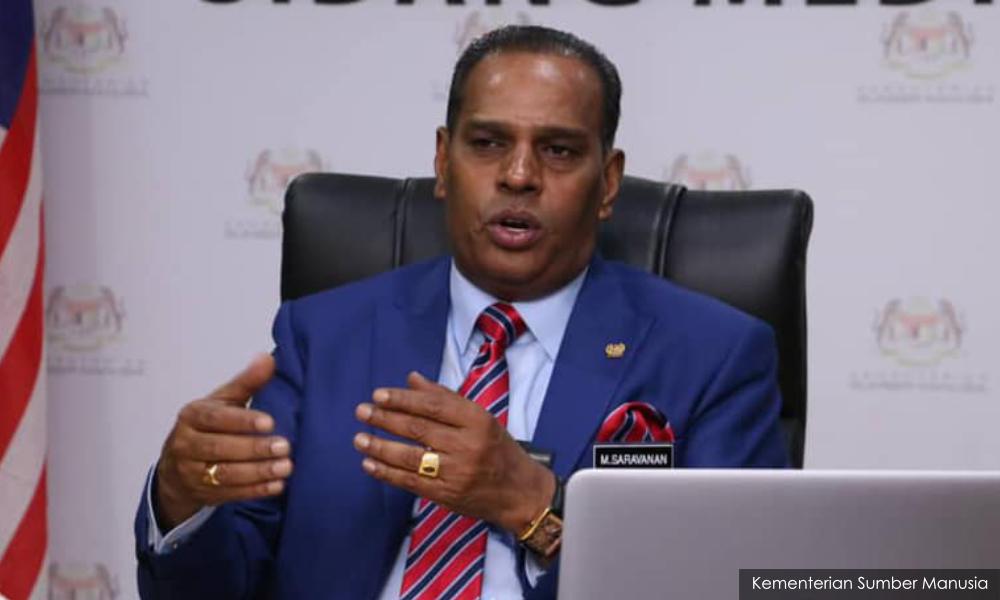
In early June, Human Resources Minister M Saravanan warned that the migrant worker quota for companies found to be deducting workers’ salaries will be terminated.
However, Saravanan expressed the government’s limitation as the ministry could not police the practices of recruitment agents in the respective workers’ countries of origin.
A year before, the minister said something similar when Reuters reported that he would review levies imposed by private recruitment agencies to check for hidden charges that might lead to risks of exploitation and debt bondage.
It quoted Saravanan’s statement dated July 5, 2021, which also revealed the minister’s intention to review “the memorandum of understanding that has been and will be signed with the source countries, in particular, to strengthen the element of protection of worker's rights and, at the same time, not burden employers”.
While stakeholders waited for something more concrete, all statements issued by the ministry in 2021 were removed from the ministry’s website.
Lack of policy leads to loopholes
The source explained that the prohibition of such salary deductions would be difficult to implement if it was not passed as an Act of Parliament, issued as a policy, introduced in workers’ contracts, or negotiated into a trade union collective agreement.
“For action to be taken by authorities, it has to be empowered by an Act, a policy, a directive, a regulation introduced to an Act, or even a circular but, there is nothing.
“If it is not documented as a directive or policy, it becomes a loophole that instead perpetuates exploitation,” cautioned the source.

This responsibility fell under the purview of the Human Resources Ministry as the Labour Department is empowered to monitor workers’ wage deductions.
Hoping for an upgrade
The United States State Department is expected to publish its latest TIP report which ranks countries on their compliance with its Victims of Trafficking and Protection Act 2000.
Malaysia is hoping for an upgrade in its ranking after last year’s report downgraded the country to Tier Three for not meeting the minimum standards and lack of significant efforts to eliminate trafficking.
Prior to this, Malaysia was placed on the Tier Two Watch List - a rank between Tier Two and Tier Three - for three consecutive years and despite this, the government was unable to improve.
A country can only spend three straight years ranked in this position, and if significant efforts are not made, it will automatically be downgraded to Tier Three.
Malaysia has been on the Tier Two Watch List for 11 years in the 21 years the US has been ranking its efforts in eliminating trafficking activities in the country.
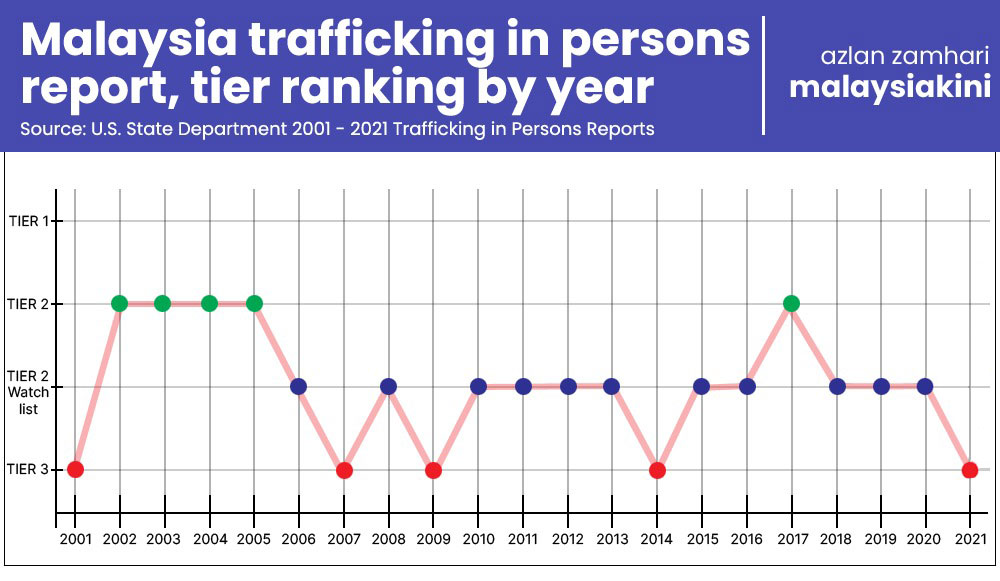
The highest ranking the country has received was Tier Two which it had reached five times. Four of those were at the turn of the century from 2002 to 2005.
The last time the government’s efforts were ranked above the Tier Two Watch List was in 2017.
Part two of this article will explore the government’s continued disregard of the recommendations to implement the zero-recruitment fees provided in the TIP report.