




Proton must 'ditch entire management'
Loss-making auto manufacturer Proton needs to dump its entire management or risk deteriorating even further, former prime minister Dr Mahathir Mohamad said today.
Loss-making auto manufacturer Proton needs to dump its entire management or risk deteriorating even further, former prime minister Dr Mahathir Mohamad said today.
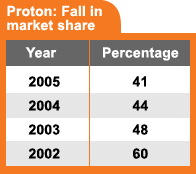
The government is currently negotiating a partnership deal aimed at providing Proton with the expertise it needs to arrest a sharp decline in market share in a newly competitive market.
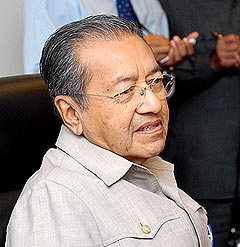
 "They need to have a change of management. It is quite obvious that this management has destroyed Proton completely," said Mahathir, an adviser to the automaker which he helped found in the 1980s.
"If it stays under the present management, it is going to go downhill," he told a press conference, adding that he had no objections to a foreign partner coming on board.
"Foreign, local, whatever. Whatever the government thinks is best," he said.
Mahathir said Proton's manufacturing facilities were running well below capacity.
"It bothers me because today, Proton sales are very poor, the vendors are suffering, some have folded up, the dealers are suffering because they cannot sell," he said.
Gov't owns 59% of Proton
The government owns 59 percent of Proton, including a 43 percent stake held by its investment arm, Khazanah Nasional.
 Three Malaysian automotive companies - DRB-Hicom, the Naza group and the Mofaz group - have expressed interest in acquiring all or part of the government's stake.
However, The Edge financial weekly reported on Sunday that the government will instead choose either Germany's Volkswagen AG or PSA Peugeot Citroen of France to take a stake in Proton.
The Edge said Volkswagen intended to acquire a controlling stake in Proton's manufacturing division, which could see Proton turn into a manufacturing hub for the German firm.
Peugeot was more inclined towards a relationship which would preserve Proton's identity while collaborating on cheaper models for export regionally and with a controlling stake less of a priority, it said.


