




A fresh look at race relations
As one reads through this important book, it emerges that this study fulfils more than it sets out to do, that is, to provide an account of the sequence of events that led up to Malaysia's "finest hour".
 The book in fact challenges us to re-visit our history so as to understand why we Malaysians still remain a long way from our goal of forging a "Bangsa Malaysia". While the book's title and primary focus does not make it immediately apparent, a careful reading of it reveals that (Dr Collin) Abraham uses the historical evolution of the routes of resistance movements to colonial rule in Malaya to draw insights into the nature and development of Malaysian society.
In his re-reading of Malaysian history and Left-based political groups, including the Malayan Communist Party (MCP), the author suggests that it was the suppression of these movements by the British colonial administration that was responsible for inhibiting the promotion of a more inclusive and just society, factors that would have been fundamental to the creation of a "Bangsa Malaysia".
As one reads through this important book, it emerges that this study fulfils more than it sets out to do, that is, to provide an account of the sequence of events that led up to Malaysia's "finest hour".
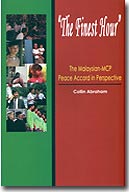 The book in fact challenges us to re-visit our history so as to understand why we Malaysians still remain a long way from our goal of forging a "Bangsa Malaysia". While the book's title and primary focus does not make it immediately apparent, a careful reading of it reveals that (Dr Collin) Abraham uses the historical evolution of the routes of resistance movements to colonial rule in Malaya to draw insights into the nature and development of Malaysian society.
In his re-reading of Malaysian history and Left-based political groups, including the Malayan Communist Party (MCP), the author suggests that it was the suppression of these movements by the British colonial administration that was responsible for inhibiting the promotion of a more inclusive and just society, factors that would have been fundamental to the creation of a "Bangsa Malaysia".
Another significant argument made by Abraham is that militant resistance to British presence in Malaya was initiated not by parties such as the MCP, as is the conventional understanding, but by Malays.
He argues that, from the outset, Malaya was the only British colony that actively resisted colonial intervention, with the earliest example of this being the assassination of James Birch, the first British resident in Perak, in 1875.
This is interesting as Birch's murder has historically been depicted not as an act of colonial insurgence but as that perpetrated by those interested in protecting their interests in the slave trade, which was outlawed by the new colonial power.
Abraham goes on to show that Malay opposition to colonialism gradually intensified in the peninsula, emerging as a key and persistent problem for the British, who reacted by attempting to stamp out these movements, by incarcerating or banishing their leaders, or later by suppressing the community's economic development.
The need by the British to quickly and effectively curb the rise of indigenous movements, that had the legitimacy to call for the withdrawal of the colonialists from their land, was imperative as Malaya was the colony that provided the British government with the greatest revenue, generated by its highly lucrative tin and rubber industries.
The Perak Outrage
Leading on from this, another key argument by Abraham is that Malay militancy to colonialism was primarily a response to the British resolve to prevent this community from actively participating in the rubber and tin industries that were then beginning to thrive with the growing international demand for these commodities.
Abraham also argues that the colonial government moved expeditiously to decimate the Malay Left for fear that if it were to become the new center of the backlash against colonialism, this movement, when it came to power, would create a Malayan political system that would not accommodate British economic interests.
To check Malay resistance, the British astutely exploited intra-ethnic Malay class divides by aligning themselves with the Sultans and rewarding them handsomely for their support.
The feudal system, an unjust mechanism of social control, was restructured and reinforced by the British ostensibly as a sign of their respect for Malay culture and Islam.
With the Sultans placed at the apex of this new colonial state structure, the semblance of Malay rule was retained. Real power, however, was vested in British hands.
To further impede the rise and spread of Malay resistance, the British, as Abraham notes, sought to transform the structure of governance.
After the "Perak Outrage", the British established the Perak State Council, which comprised the Malay ruling class, the Chinese "comprador-capitalist" class, and Indian commercial interests.
While the elites of the main ethnic communities came together to forge an alliance that would help protect their economic interests, this Council, though ostensibly vested with power, was extremely subservient to the British.
This long history of elite cooperation, especially between the Sultans and the British, during colonial rule, begs the question as to why it was the Sultans who became the figurehead around whom the movement for Independence evolved, specifically during Malay opposition to the Malayan Union.
Umno's failure
In May 1946, an assortment of Malay clubs, associations, and political organisations joined forces to form a new mass-based protest movement, the United Malays' National Organisation (Umno), which managed to mobilise widespread resistance to the idea of the Malayan Union.
Although Umno was then headed by a member of the aristocratic class, Onn Jaafar, the organisations within this protest coalition with the most grassroots support were the more radical Malay Nationalist Party (MNP) and Angkatan Pemuda Insaf (API).
Both parties later withdrew from the protest movement, citing as reason that Umno's policies were formulated in a manner detrimental to the interests of the Malay community, a point which suggests that Umno's ability to represent the interests of the Malay community was already questioned very early in its history.
Although the British went on to retract their proposal for the Malayan Union, they readily acceded to the creation of the Alliance, which comprised Umno, led by aristocratic Malays keen to secure political power, and the Malayan Chinese Association (MCA) and Malayan Indian Congress (MIC), parties under the control of the Chinese and Indian bourgeoisie respectively who wanted to preserve and enhance their economic base in independent Malaya.
British promotion of an alliance between ethnic elites was not a new phenomenon. Through the Alliance, the British were replicating the strategy they had originally and successfully deployed to consolidate control over the state of Perak.
Most historical accounts have it that the British would only grant Independence to a Malayan party that was multi-racial in orientation. While the Alliance fitted this bill, its component parties clearly only served elite interests.
The Alliance did not share a common political vision, which was unsurprising given that the individual objectives of Umno, MCA, and MIC have been described as being based on "ethnic ideologies".
Ethnic patrons
However, in spite of the Alliance's bourgeois orientation, the emergence of ethnopopulism through the active mobilising of ethnic sentiment by its leadership helped camouflage the issue of class dominance.
In fact, the very pattern of institutional formation implicit in the Alliance enabled its component parties to present their leaders as ethnic patrons or champions.
While Abraham deftly traces the bourgeois origins of the Alliance, what is not recorded is that Umno had a tacit agreement with the colonialists to allow British companies to retain their ownership and control over large segments of the economy after Independence.
Umno's reason for this unwritten accord was its fear that Chinese capitalists would secure control over the economy after the departure of the British. The Alliance was evidently, then, a marriage of convenience, with little trust between its partners.
Abraham reveals that the basis of the Umno-MCA relationship was that the Chinese party generously funded the Alliance's electoral campaigns in return for greater presence in post-colonial federal and state governments.
What Abraham does not point out is that the federal cabinet portfolios of Finance and Trade and Industry were under the control of ministers from the MCA. The MCA continued to hold on to these key cabinet positions until Umno consolidated its hegemony over the government following the formation of the Barisan Nasional, an enlarged coalition created in response to the ethnic riots of 13 May 1969.
An interesting contention of this study is that British fear of Malay resistance far outweighed their concern about the impact of the MCP, although the declaration of Emergency was justified on the grounds that such a repressive measure was vital to deal with the rise of communism.
Abraham goes on to demonstrate that the British made a concerted effort to ensure that the Malay Left did not establish any links with the MCP.
Inter-dependence
It was essential for the British to crush the Malay Left, for the cultivation of any ties between Malays and the non-racial MCP, whose membership predominantly comprised ethnic Chinese, would have heralded the emergence of a non-racial union that would have had little or no interest in preserving or protecting British economic interests in post-colonial Malaya.
Most studies of Malaysian history to date have argued that a single multi-racial party would not have been able to muster broad-based support. For this reason, the system of consociationalism offered by multi-party, multi-ethnic coalitions, such as the Alliance, was seen as an effective means to secure and reinforce electoral support.
Abraham, however, makes the alternative argument that a union between the Malay Left and the MCP would probably have been able to mobilise considerable support from the people, and he goes on to provide compelling evidence to substantiate this argument.
In his historical narrative, Abraham invokes events in daily Malayan life that vividly capture the growing inter-dependence between the various ethnic communities, leading to the forging of close relationships.
In villages, small Chinese businesses required Malay patronage to survive. For the Malays, on the other hand, these Chinese enterprises were an important resource for funds, in the form of loans between harvesting seasons, as well as an avenue to secure their daily supplies, usually on credit.
Such circumstances inevitably gave rise to some measure of Malay resentment towards the Chinese, especially the middlemen who were seen to be exploiting the farmers' need for food and funds.
Importantly, however, this relationship, and the mistrust or antagonism that it occasionally invoked, was not one that was characterised by violence.
This reading of history by Abraham suggests that civic engagement between the different ethnic communities was of a nature that could contain communal differences or potential conflict, helped immeasurably by the absence of political leaders espousing ethno-national sentiments to galvanise support.
Historical (re)interpretation
By capturing the daily scope of inter-ethnic relations, Abraham also draws our attention to the diversity of peoples that made up colonial Malaya. In so doing, he helps to dispel the illusion of homogeneity or coherence in common understandings of the character and constitution of ethnic communities.
This de-homogenisation of ethnicity is evident, for example, in his point that large numbers of Indonesian immigrants were granted legal status as "Malays" in the country.
Abraham also notes that by 1931, one-fifth of the Malayan population was locally born, constituting a new generation that would most likely be oriented not to their parents' or ancestors' immigrant past but to their own Malayan present and future.
These two significant points capture the demographic as well as identity changes that have taken place in Malayan society. The conclusion one can draw from them is that these changes involved identity transformations that, as Abraham suggests, helped foster communal co-existence and solidarity, a factor that would have enabled a multi-racial Left to secure power if there had been a democratic space for it to practise and disseminate its politics.
This is indeed a significant conclusion given that what this study clearly reveals is the successful endeavour by the British to thwart any attempt to develop a truly multi-racial party in Malaya.
The banning of the Left effectively restricted the capacity of its leaders to promote the rise of non-race based parties.
The need to check the possible inception of multi-racial political organisations became even more urgent when Left-based coalitions, such as the All-Malaya Council of Joint Action-Pusat Tenaga Rakyat (AMCJA-PUTERA), began to cooperate with the Associate Chinese Chambers of Commerce (ACCC).
The crackdown on these institutions and the arrests of their leaders swiftly brought an end to their political cooperation and to any form of social mobilisation that transcended race in the colony.
This much-needed historical (re)interpretation of race relations in colonial and immediate post-colonial Malaysia poses a serious challenge to historians, sociologists, and political economists.
It raises important new issues that merit serious study, especially involving the salient themes of generational change and identity politics in Malaysia. Abraham has done well to draw our attention to forms of identity shifts and transformations that have occurred with the emergence of new generations of Malaysians, an issue that compels us to review our understanding of what it is that constitutes a "Bangsa Malaysia".
This study should also be read by all politicians, for inherent in it is the call for a check on political parties that exploit ethnic differences in society for their own vested interests, specifically to secure and consolidate political power.
Ultimately, however, this book is a call to all Malaysians to give further thought to patterns of institution building and forms of political mobilization in our country, issues that would need to be seriously considered to help promote social harmony and that are integral to the idea of creating a truly "Malaysian" nation.
DR EDMUND TERENCE GOMEZ is Associate Professor, Universiti Malaya and Research Coordinator, United Nations Research Institute for Social Development (UNRISD). The above is one of the four prefaces for the recently launched book authored by social scientist Dr Collin Abraham entitled The Finest Hour The Malaysian-CPM Peace Accord in Historical Perspective .


