




A monumental mistake
We all love old friends. It is one of the blessings of old friends that we can afford to be stupid with them. But unfortunately, our politicians cannot enjoy such a privilege with our Malaysian public. Too many of them overvalue themselves on what they are and undervalue what they are not.
If a politician thought the earth was flat, he was wrong. When another state politician thought the earth was spherical, he was also wrong. But if other unthinking politicians think that thinking the earth is spherical is just as wrong as thinking the earth is flat, then their views are doubly wrong. Hence, Malaysians have learnt easily that the dumbest politicians we know are those who claim to know all.
It brings to memory what John Newton Mitchell - the US attorney-general convicted and imprisoned for having engineered the Watergate affair during Richard Nixon's presidency - had in his familiar stupid fashion, publicly said: 'The conservation movement is a breeding ground of Communists and other subversives. We intend to clean them out, even if it means rounding up every bird watcher in the country'.
We all love old friends. It is one of the blessings of old friends that we can afford to be stupid with them. But unfortunately, our politicians cannot enjoy such a privilege with our Malaysian public. Too many of them overvalue themselves on what they are and undervalue what they are not.
If a politician thought the earth was flat, he was wrong. When another state politician thought the earth was spherical, he was also wrong. But if other unthinking politicians think that thinking the earth is spherical is just as wrong as thinking the earth is flat, then their views are doubly wrong. Hence, Malaysians have learnt easily that the dumbest politicians we know are those who claim to know all.
It brings to memory what John Newton Mitchell - the US attorney-general convicted and imprisoned for having engineered the Watergate affair during Richard Nixon's presidency - had in his familiar stupid fashion, publicly said: 'The conservation movement is a breeding ground of Communists and other subversives. We intend to clean them out, even if it means rounding up every bird watcher in the country'.
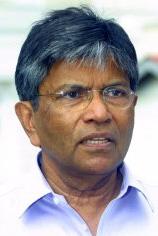 Little wonder then that our information minister openly claims that he was part of history, he bore witness to history and he understood history. Zainuddin Maidin added: 'Therefore, I definitely haven't made a mistake or misunderstood history'. To support his monumental claim, he said he did not understand the Chinese language and would not know how the Chinese press reported this statement of his, but that the Malay press had not misunderstood his remark.
Zainuddin had on Dec 16 said monuments for 'communists' were erected in Sarawak and Nilai. He said erecting such memorials were insensitive and disrespectful as many Malaysians were killed during the communist insurgency. Negeri Sembilan Menteri Besar Mohamad Hasan then joined in and urged the Nilai Memorial Park, a privately owned cemetery, to demolish the monument commemorating those who fought against the Japanese invasion during the Second World War.
Unfortunately for the information minister, being part of Malaysian history may not be wise enough. Abraham Lincoln historically once said: 'Tis better to be silent and be thought a fool, than to speak and remove all doubt'. In that sense, Zainuddin suggested the media interview former police officers who had fought the communists as well as historians like Prof Emeritius Khoo Kay Kim.
Guess what? Dr Khoo refuted Zainuddin's remark that the anti-Japanese fighters were communists. Khoo said he was compelled to correct the misconception. He stressed that one should not equate anti-Japanese fighters with communists. 'Although MPAJA was set up by the communists, not all anti-Japanese fighters joined the MPAJA'. The historical fact? The anti- Japanese movement was not led by the communists and the fighters included Malays and Indians.
No absolutes in reality
Hence, Malaysians are left with this simple choice - should we believe a politician who claimed 'to be part of history, claimed to understand history and bore witness to history'? He valued himself, saying: 'I was a reporter before, I have studied history and I can easily see through the thoughts of those who support the communists and those who don't. Of course, I know who these people are, but I don't want to mention names, so I definitely will not apologise'.
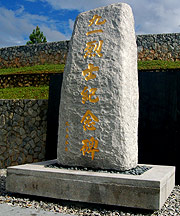 A Malaysian wrote in his favorite blog: 'As for Zam, the memorial is to all who perished defending the country against the Japanese irregardless of their political beliefs. My uncle died fighting them (the Japanese) and we have no idea where his body was buried. He was a simple working man who fought the Japanese simply because he believed that the Japanese had no right to occupy this country and not because he was a communist.
'He knew nothing about politics. So Zam, please do not smear his memory and legacy with your idiotic remarks. If you do not wish to do any thing to honor these fallen heroes, at least keep your mouth shut'.
The Chinese idiom conveys a simple wisdom, ' Shi shi mei you jue dui ' (in reality there are no absolutes). In truth, it is erroneous and unjust to judge that all those who fought the Japanese were communists.
Historical knowledge is communicable but not wisdom. It has also been proved again and again that two things are infinite - the universe and stupidity.
The monument issue is a misery for some Malaysians whose forefathers and relatives had sacrificed their lives fighting the Japanese but are now branded as communists even though in truth they were not.
Even a monument to commemorate their sacrificed lives is under threat of demolition. As for us Malaysian voters who have witnessed the immature behavior of our information minister and the Negeri Sembilan menteri besar, we begin to understand our national state of affairs.
'At least two-thirds of our miseries arising from unnecessary contentious issues, spring from human stupidity, human malice and those great motivators and justifiers of malice and stupidity, idealism, dogmatism and proselytizing zeal on behalf of religious or political idols," quipped the famous writer Aldous Huxley once.
Or simply, between a historian and a politician, who should we believe?A Malaysian who has spent his entire professional life studying history or a politician who claims to know best with regards to history? It is so obvious that the answer will not be a stupid one.
A 'monstrous injustice'
John Stuart Mill was correct in saying that political conservatives are not necessarily stupid, but most stupid people are conservatives. On Nov 16, 1942, a resolution was unanimously passed by a general meeting of members of the Malayan Association which sought the British colonial government to take drastic actions against 'quislings' or persons who had assisted the Japanese to be banished forever from Malaya together with their families.
The rationale or views of the stupid mover (of the resolution) was: 'There is no necessity for people in Malaya to cooperate with the enemy, and the only reason one can deduce for their doing so is that the person would hope to gain something for his own benefit but against the interests of the Allied Nations." ( Malayan Problems by Tan Cheng Lock, 1947).
Tun Tan Cheng Lock (founder of the MCA) vehemently opposed the resolution saying it was unjust, unwise and impracticable. He sought the precise definition of the term 'quisling'. He argued that when the Japanese invaded Penang, practically only the Europeans were evacuated from Penang while the Asians were left behind entirely at the mercy of the looters and Japanese invaders.
Cheng Lock wrote: 'The racial discrimination left them no alternative but submit to Japanese rule which they had to bear though no fault whatsoever of their own. The people of Penang were compelled to swear or acknowledge allegiance to their divine Emperor (Japan) to invariably bow their heads low when passing a Japanese sentry, to learn Japanese and generally to collaborate with the Japanese authorities in every way whether they liked it or not'.
'Imagine the feelings of all these and other inhabitants of Malaya, who were let down or thought they were left in the lurch or deceived in such a manner and circumstances as to make them terribly embittered, when they should be told that we, who have had the good fortune to escape from Japanese rule and atrocities, have resolved to ask the British government that immediately upon the reoccupation of Malaya, all of them together with their families are to be banished forever from the country simply because in order to have to eat, to get shelter and to live they have had in the face of overwhelming force majeure to submit to the rule of the ruthless conqueror and 'assist the Japanese either in the civil government of the country or otherwise' or to suffer death, hunger or spoliation under the circumstances absolutely beyond their control and in which they had no other alternative. Is this a simple act of justice?'
He continued: 'In this way, it is conceivable that half, if not all, of the population of Malaya, including the Sultan with their families, would have to be banished forever, for every one there must be compelled somehow to work in order to live and thereby assist the Japanese whether directly or indirectly in the governance of the country. I would rather call it (the proposed banishment) an act of monstrous injustice!' The proposed move was later dropped.
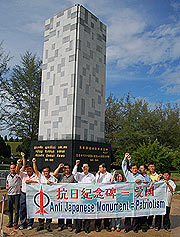 We see a paralleled foolishness in the proposed banishment call of the 1940s' and the call to demolish the Nilai Memorial Park monument. This issue will be another platform for our voting decision.
Anne Morrow Lindberg's advice? 'The sea does not reward those who are too anxious, too greedy or too impatient ... patience, patience, patience, is what the sea teaches. Patience and faith. One should lie empty, open, choice-less as a beach ... waiting for a gift from the sea'. We then, the voters, will decide who is right, the historian or the politician at the next general election.
Nevertheless we should always forgive those politicians who behave like tea bags because they inevitably always land themselves in hot water. After all, many will become history after the next general election.
STANLEY KOH is a Buddhist monk and works for a local think-tank.


