




What's behind Mahathir-Soros reconciliation?
Yesterday, former premier Dr Mahathir Mohamad publicly announced, in a rather dramatic fashion, that he has buried the hatchet with Jewish American self-made billionaire George Soros.
Yesterday, former premier Dr Mahathir Mohamad publicly announced, in a rather dramatic fashion, that he has buried the hatchet with Jewish American self-made billionaire George Soros.
Equally, if not more, dramatic was the fact that the man whom Mahathir and his propaganda machinery once vilified as a 'moron' and accused of being responsible for 1997 Asian financial crisis was present at his former enemy's press conference in Kuala Lumpur.
In the ensuing years between the outbreak of the 1997 crisis and Mahathir's retirement in October 2003, a variety of NGOs as well as independent media malaysiakini were attacked to have been funded by George Soros as part of the "American" or "Western" conspiracy to destabilise his government.
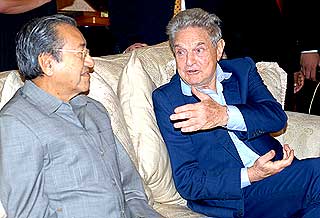 Mahathir now reportedly said that Soros was not responsible for the 1997 crisis.
Soros, who once attacked Mahathir as a 'loose canon' and 'menace to his own country', was also quoted as praising Mahathir for doing the right thing in pegging the ringgit in the wake of the financial crisis, which helped stabilise the situation.
So, it was a happy ending to the nine-year feud between the two men who have now found a common enemy in US President George W Bush and his administration.
While Mahathir has been well known for his criticisms against Bush's Middle East policy and war against terror, Soros funded the anti-Bush campaign in the 2004 US presidential election when Bush was returned for the second time.
Their shared opinions on global war and peace is said to prevail over their difference of moral judgement on currency speculation.
To observers of US politics and international relations, the reconciliation between the two most prominent non-state actors in world affairs also coincides with the defeat of Bush's Republican Party in the recently concluded congressional mid-term elections, enduring anti-American sentiment in the Islamic world, continuing leftwing swing in Latin American politics, an evidently rising China and Russia's creeping assertiveness as well as the strategic dilemma now confronted by the Bush administration over the issues of Iran's and North Korea's weaponisation of the nuclear energy.
So, there are various speculations on the largest forces or ideas behind the Mahathir-Soros reconciliation, including the building up of a global coalition against American neo-conservatism in the next US presidential election.
Mahathir's forward
However, many more Malaysians and observers of Malaysian politics still prefer to read the Mahathir-Soros reconciliation more charitably at a lower level as personal efforts to establish role models for peacemaking in today's troubled and troubling world, especially where and when racial and religious stereotypes are involved as principal factors of conflicts.
On his part, for example, Mahathir decided in July this year to launch a book sponsored by a Chinese Malaysian businessman and community leader Ngan Ching Wen whom he once called a 'communist and extremist'.
 The former premier of Malaysia for 22 years also wrote a forward to a highly acclaimed or controversial book
The Finest Hour - The Malaysian-CPM Peace Accord in Perspective
(Kuala Lumpur, SIRD, 2006) in which the author, retired public servant and renowned social scientist, Dr Collin Abraham re-interprets anew Malaysia's history of the struggle for independence to include the contributions of hitherto marginalised and vilified communists, Islamists and left-wing Malay nationalists.
The former premier of Malaysia for 22 years also wrote a forward to a highly acclaimed or controversial book
The Finest Hour - The Malaysian-CPM Peace Accord in Perspective
(Kuala Lumpur, SIRD, 2006) in which the author, retired public servant and renowned social scientist, Dr Collin Abraham re-interprets anew Malaysia's history of the struggle for independence to include the contributions of hitherto marginalised and vilified communists, Islamists and left-wing Malay nationalists.
In his forward to the book, Mahathir called for Malaysians to do research on the CPM (Communist Party of Malaya) and the 'Emergency' "because so far most of the books written about it are by the British" and "quite naturally their writings have been biased".
It was during Mahathir's tenure as the prime minister that the government of Malaysia signed a peace treaty with the CPM in Thailand on Dec 2, 1989, ending the 32-year civil war.
Whatever the interpretation of the Mahathir-Soros reconciliation and their intentions, one certain effect is that it has opened up even larger psychological space for public discourses in Malaysia.


