




Bailed-out foundry adopts new business model
The Kuching-based wafer foundry, once owned by the Sarawak government, today announced it is adopting a new business model to concentrate on analog products during a three-year transition period by gradually phasing digital and flash products.
The Kuching-based wafer foundry, once owned by the Sarawak government, today announced it is adopting a new business model to concentrate on analog products during a three-year transition period by gradually phasing digital and flash products.
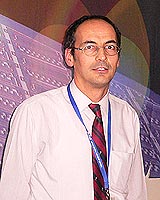 X-Fab (Sarawak) Sdn Bhd chief executive officer Roger Diels (
left
) told a press briefing this afternoon that with the new model, the existing equipment costing billions at the facility on the outskirts of Kuching can be used without having to be upgraded or replaced at least for the next 10 years.
X-Fab (Sarawak) Sdn Bhd chief executive officer Roger Diels (
left
) told a press briefing this afternoon that with the new model, the existing equipment costing billions at the facility on the outskirts of Kuching can be used without having to be upgraded or replaced at least for the next 10 years.
Under the previous company, state-owned 1st Silicon (Malaysia) Sdn Bhd, the foundry reportedly incurred losses of about RM3 billion in trying to concentrate on the fast-moving market for digital and flash products.
"The global demand for analog keeps on increasing," said Diels, adding that he believed the semi-conductor industry is 25% driven by analog.
In September this year, 1st Silicon merged with a German-controlled semi-conductor company X-Fab Semiconductor Foundaries AG, leading to the State Financial Secretary (SFS) taking a 35% equity stake in the Belgium-based holding company X-Fab-1st Silicon Foundaries NV, with the foreign partners holding the rest.
Diels said 1st Silicon's liabilities remained with the Sarawak government.
Figures not known
The assets - plant and machinery - were injected into the joint venture company X-Fab (Sarawak) Sdn Bhd.
Diels said the Kuching facility's new business model will run through a three-year transition period, concentrating on analog products, upgrading quality and research and development to take it further to the next stage with an expanded market base that is expected to focus on the US and Europe.
The Sarawak government's investment in 1st Silicon was heavily criticised by the opposition after the reported huge losses, and financial analysts said the decision to sell to X-Fab which has been in the semi-conductor manufacturing business for more than 10 years appears to be a timely saviour.
But the state government has so far failed to reveal exactly how much was invested and how much losses were incurred up to the time of the X-Fab's take-over.


