




Further flaws in EPU methodology (Part 3)
The government has partly unveiled its methodology to calculate the corporate equity ownership in the wake of a heated public debate on whether the 30 percent bumiputera share has been reached.
It doesn't change anything. The Economic Planning Unit (EPU) has not addressed the flaws highlighted by malaysiakini but only commented on the unsuitability of using market value in its methodology, because it may be subjected to window dressing.
The government has partly unveiled its methodology to calculate the corporate equity ownership in the wake of a heated public debate on whether the 30 percent bumiputera share has been reached.
It doesn't change anything. The Economic Planning Unit (EPU) has not addressed the flaws highlighted by malaysiakini but only commented on the unsuitability of using market value in its methodology, because it may be subjected to window dressing.
If one were to list the flaws of market-value methodology alongside those of par-value methodology in redressing wealth imbalance, one would come to the conclusion that the former is a far superior formula.
Market-value methodology may be window dressed a little (much limited by proliferation of accounting standards after the Enron case), but par-value methodology is akin to changing the whole window altogether - giving the viewer a different scenery from the original.
 The
contention
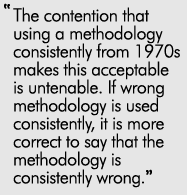
that using a methodology consistently from 1970s makes this acceptable is untenable. If wrong methodology is used consistently, it is more correct to say that the methodology is consistently wrong.
The
contention
that using a methodology consistently from 1970s makes this acceptable is untenable. If wrong methodology is used consistently, it is more correct to say that the methodology is consistently wrong.
In fact, the 30 percent mandatory allotment of shares to bumiputeras by public-listed companies may not even count as bumiputera equity.
From what has been unveiled, the EPU has collated all the paid-up capital of some 600,000 companies registered with the Companies Commission of Malaysia (CCM) and other institutions in computing the share capital ownership according to ethnicity.
One of the points that Deputy Finance Minister Dr Awang Adek Hussin brought up was that EPU only treats companies with more than 50 percent bumiputera equity as bumiputera companies.
This means that the mandatory 30 percent allotment by public-listed non-bumiputera companies may not have been counted by the EPU as bumiputera equity at all.
Different results
I have used a simplified example to illustrate how different methodologies can produce vastly different results ( see chart ). It should not be taken to mean that this correlates to the actual situation.
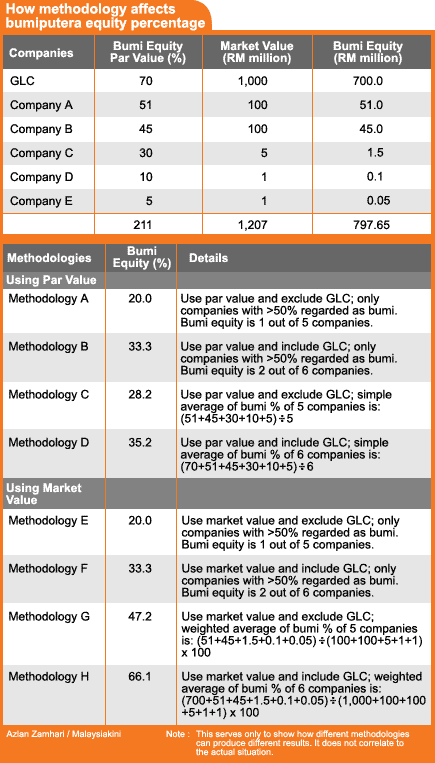
If the EPU uses Methodology A (only >50 percent bumiputera equity regarded as bumiputera company), only one company out of the six contributes to bumiputera equity. The result is 20 percent bumiputera ownership.
Flaws:
- Notice that the bumiputera equity in government-linked companies (GLCs) Companies B, C, D and E are ignored. This effectively means that the 30 percent mandatory allotment by public-listed companies is not counted. Even a layman knows that simple average methodology would be a fairer representation of total bumiputera equity. No wonder such a low figure of 18.9 percent has been derived.
Comments:
The example shows that the percentage could range from 20% to 66%. By pre-studying the ethnic demographic structure, one can certainly choose a methodology best suited to one's agenda.
But what is the point of using inappropriate methodology? The end result would be a farce. It is not going to be considered credible and no one will assign much weight to it.
It can't bridge the gap between the rich and poor. Instead of narrowing the gap, it may even widen the gap.
Fair methodology needed
For any methodology to be accepted, it has to be fair and acceptable to all citizens and serve to meet the stated objectives.
It should be transparent. Citizens should be invited to give their ideas and feedback and participate in the formulation process. In other words, the citizens must 'buy into' the policies formulated by the government.
 If the objective is to redress wealth imbalance, then use of par-value methodology is not only ineffective but counter-productive.
Deputy Minister in the Prime Minister's Department Abdul Rahman Suliman said a special committee comprising EPU, CCM, Securities Commission, Bursa Malaysia and PNB was formed during drafting the Ninth Malaysia Plan to determine the "best methodology" in calculating corporate equity ownership.
If this is the best methodology that this special committee can come up with, then one really wonders about the calibre and independence of its members.
It is always hard for government-linked institutions to critique their own findings as they may not have the full independence to do so.
What the present methodology tries unsuccessfully to do is akin to using a mouse trap to catch ants and elephants as well. Can such simple par-value methodology derived from 600,000 companies be used for making so many important policies?
What we need is in-depth and carefully thought out study for specific issues and problems faced by citizens. That task cannot be left solely to the EPU. It needs input from people of calibre, independence and people without political inclinations or agendas.
If the present administration really has the citizenry (not NEPutras) at heart, then it must immediately set up an independent think-tank to look into this worsening situation. It must be allowed to think, not pushed into coming up with a solution that suits the administration's agenda.
The first task for this think-tank is to evaluate the cost-benefits of the outdated New Economic Policy (NEP) used since the 1970s. If it finds that the costs/disadvantages outweigh the benefits/advantages of continuing with the NEP, then the policy should be scrapped.
If not, it must be revamped to meet the changes demanded by the circumstances today.
Flaws in EPU apparent methodology : Part 1 and Part 2
LJ WONG is a chartered accountant by profession. He worked in a tax consultancy firm and a public-listed company before he retired. He is now involved in an Internet-based business.


