




'Wanted' Thai Muslims exploited in M'sia
Many Thai Muslims in Malaysia who are made to believe they have been blacklisted by their government have long been exploited by certain quarters here seeking cheap and permanent labour.
Many Thai Muslims in Malaysia who are made to believe they have been blacklisted by their government have long been exploited by certain quarters here seeking cheap and permanent labour.
Their self-imposed exile stem from being told by employers that their return to Thailand will be met with arrest, said the Thai consul in Langkawi Shazryl Eskay Abdullah.
"This way, they manage to keep many Thai Muslims working for them for very low wages and without losing their labour even temporarily for visits to friends and relatives in southern Thailand," he added when contacted today.
Said to be in the thousands, Shazryl said these Thai Muslims work illegally throughout Malaysia in'tomyam' restaurants and plantations.
"Some of them work in restaurants, but many more are in the rubber or other plantations, for wages lower than usual and for hours longer than the ordinary.
"Believing what they are told by their employers, they get upset with the Thai government for not being able to return, not being able to send money to their parents back home. They may also be paying 'protection money' in order to remain in Malaysia," he added.
The beliefs are reinforced by their reluctance to approach official figures to clarify their status as they are afraid of being arrested and deported upon arriving at the consulate, he said.
"It's high time that we set the record straight so that these people can be 'legalised' once more upon verifying with the authorities (in Thailand), so that they can return home and, if they choose to do so, acquire passports and come back here to work legally," he added.
The Star today reported on the consulate's willingness to help in 'clearing' the names of those who believe they had been blacklisted by their government for being involved in the insurgency.
Violence-ridden provinces
Violence engulfed the three provinces of Yala, Narathiwat, and Pattani in southern Thailand when groups of Thai Muslims, who are Malays, began to emerge after the 1960s to fight against perceived discrimination, marginalisation, victimisation and colonisation by the Thai 'Siamese' government.
Two weeks ago, it was revealed that former premier Dr Mahathir Mohamed had brokered informal talks between leaders of the main insurgent groups and the Thai government. Formal negotiations are said to begin next month.
Among the proposals that have been floated as mechanisms to quell the unrest in the South is the resuscitation of the defunct 'So Or Bo Tho' Council that had served as a platform for the Thai Muslim community to address their grievances to the Thai authorities.
Formed in 1980, it consisted of religious leaders, academicians, professionals, businessmen, police officers, army officers and other local leaders.
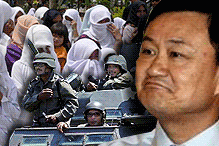 It was disbanded in 2002, however, by former premier Thaksin Shinawatra. Many believe the dissolution of the Council reflected Thaksin's hardline and predominantly 'security' approach to the insurgency.
Misinformation and mis-communication on all sides worsened the mutual distrust and fuelled further hatred. Insurgent 'cells' mushroomed in every village to conduct attacks against the military, police and non-Muslim civilians in retaliation for injustices - real and rumoured - against Muslims.
Responding to a report in malaysiakini yesterday on the existence of such informal groups and individuals in villages who might pose a threat to the current climate of peace talks, Shazryl said the So Or Bo Tho council was among the mechanisms that can address that issue.
"It has less to do with religion and all to do with people on the ground frustrated with injustices... and a breakdown in communications between the authorities and the community," he said.
Shazryl also suggested that the leaders of established groups such as Bersatu and Pulo involved in the peace talks could help in this matter by going to the ground and villages and explain the current efforts to arrive at a peaceful resolution of the conflict.


