
COMMENT | Mutual aid and gathering: An artistic coexistence
COMMENT | Mutual Aid Projects does not take up much space. The gallery occupies an office lot close to the end of a corridor at Wisma Central, Kuala Lumpur, itself an anomaly on the upmarket stretch a couple of minutes’ walk from the Petronas Twin Towers.
In its early days, it would have overlooked the old racecourse, and thanks to the quirks in its ownership system, the building has resisted demolition as hotels and high-end malls have increasingly invaded this prime location.
Behind the gallery’s glass walls, ideas and projects take flight – the latest being an investigation into the ideas of foreignness, coexistence and overlooked interactions of the natural world.
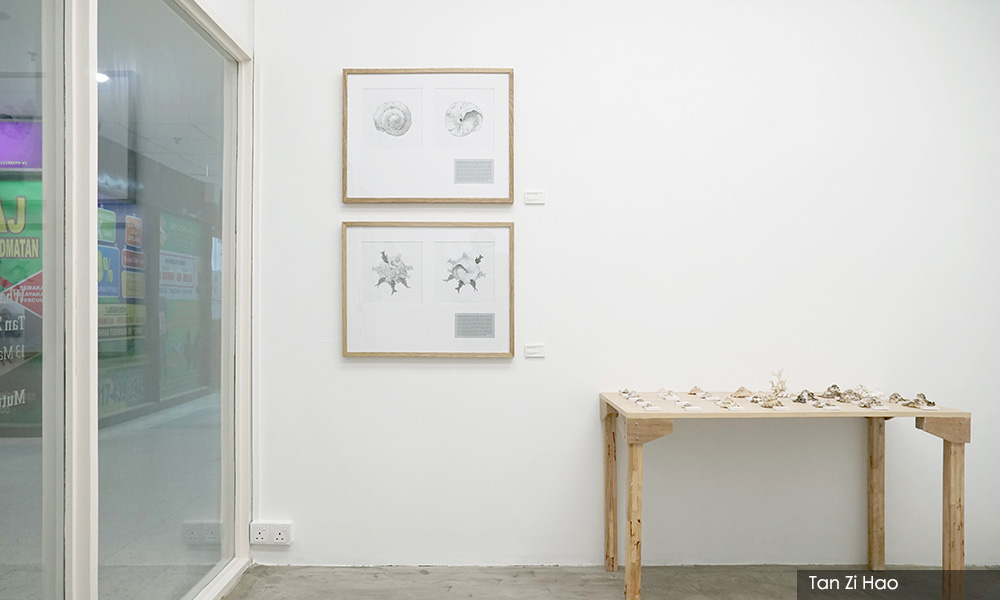
Tan Zi Hao’s “What’s Left for Gathering” works on many levels, taking as its foci two humble genera: Xenophora and Phereoeca. Dredged from the seabed and plucked from the corners of one’s home, juxtaposed against each other on the white walls, the exhibition samples tell stories about the idea and concept of gathering, of incorporating foreignness in a time of ecological degradation when the threat of scavenging and making do with what is left of the natural world seems imminent.
In Tan's conception, nature isn’t invariably red in tooth and claw. Sometimes, more collaborative models of living can take root.
Here, Tan's collection of Xenophora shells is laid out on display, each one incorporating fragments of broken coral or studded with rocks, collected over time as the animal that once inhabited them grows and moves along, forming part of its protective coat as time goes on.
Some of them, coming across human trash littering the seas, have begun integrating manmade objects, such as...
COMMENT | Mutual Aid Projects does not take up much space. The gallery occupies an office lot close to the end of a corridor at Wisma Central, Kuala Lumpur, itself an anomaly on the upmarket stretch a couple of minutes’ walk from the Petronas Twin Towers.
In its early days, it would have overlooked the old racecourse, and thanks to the quirks in its ownership system, the building has resisted demolition as hotels and high-end malls have increasingly invaded this prime location.
Behind the gallery’s glass walls, ideas and projects take flight – the latest being an investigation into the ideas of foreignness, coexistence and overlooked interactions of the natural world.
Tan Zi Hao’s “What’s Left for Gathering” works on many levels, taking as its foci two humble genera: Xenophora and Phereoeca. Dredged from the seabed and plucked from the corners of one’s home, juxtaposed against each other on the white walls, the exhibition samples tell stories about the idea and concept of gathering, of incorporating foreignness in a time of ecological degradation when the threat of scavenging and making do with what is left of the natural world seems imminent.
In Tan's conception, nature isn’t invariably red in tooth and claw. Sometimes, more collaborative models of living can take root.
Here, Tan's collection of Xenophora shells is laid out on display, each one incorporating fragments of broken coral or studded with rocks, collected over time as the animal that once inhabited them grows and moves along, forming part of its protective coat as time goes on.
Some of them, coming across human trash littering the seas, have begun integrating manmade objects, such as bottle caps and pull tabs, into their mobile homes. Commonly called carrier shells, they work beautifully as a metaphorical undersea antidote to the narratives of disunity and division on the surface world. Translated from the Greek, the name of the genus literally means “bearing foreigners”.
On the wall, Tan invents his own species – Xenophora extracta, which he uses to tell a story of family legacies and migration. Here, the imagined shell is studded with tin fish, the type that would have been once used as currency in the pre-colonial period, and also used in pawang-led rituals.
When mines were opened, rituals incorporating the tin animals would have been used to appease local spirits, a ritual that the largely Chinese migrant miners would also have found reassuring when they arrived in the humid interior, where large scale tin-mining emerged.
This is where Tan's family background becomes infused with his art, becoming a statement of how personal histories intertwine with the complexities of colonial and economic narratives. “Life is a patchwork. Of frictions and super fictions with symbiotic afterlives,” he writes.
On another wall, blown-up images of household casebearers, courtesy of the Microscopy Unit of Universiti Putra Malaysia in Serdang, provide a deeper look at the discarded remains of the cases (they are not technically cocoons) often found dotting our walls, the type we are inclined to dust away without a second glance.
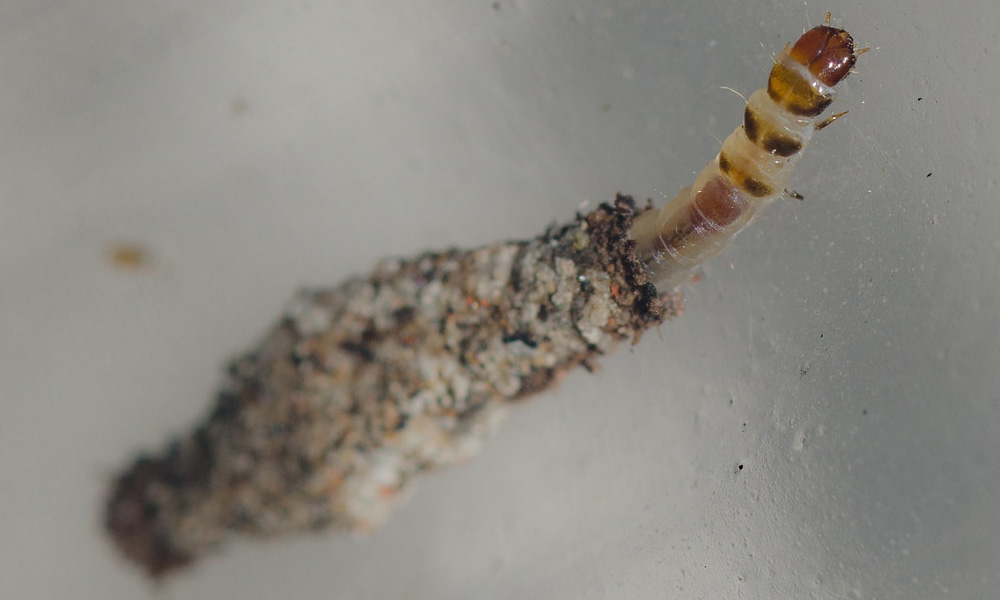
Constructed by moths of the genus Phereoeca during their larval stage, on a microscopic level you have a sense of aesthetics at play, a certain sensibility of repetition and deliberate creation emerging from the patchwork of the gathered dust and refuse of human spaces.
One particular casebearer had integrated paint pigments from the wall of Tan's home, green specks sparkling from inside its case. Other cocoons are available for closer examination under a digital microscope, in a simulation of a scientist’s study. This veritable cabinet of curiosities can keep one occupied for hours, invoking the ideas of Eduardo Kohn, Anna Tsing, among others.
The idea of slowing down, collecting and reflecting has to be a deliberate act, alien in a society that is focused on atomising, subdividing and quantifying resources. Even its precursor, the traditional agrarian society, is at odds with our nostalgic idea of humans farming in harmony with the natural world.
Such a society hinged on its power to control, exploit and capitalise on resources (human and ecological alike) in a ruthlessly efficient manner. Hunter-gatherer societies, although arguably more in sync with the patterns of the natural world, do also contain their own modes of control and dominant narratives.
Looking at the idea of gathering, curator/gallery owner Eric Goh revisits the late Ursula K Le Guin’s observation that “stories of gathering, although fundamental to humanity, are eclipsed by those of hunting and killing”.
The Russian anarchist Peter Kropotkin looks to the natural world for an important analogy: how animals band together to survive: gathering, as it were, the interactions necessary for them to live while avoiding conflict – engaging in natural forms of mutual aid.
Kropotkin’s philosophy of coexistence is reflected in Goh's choice of the name of the gallery. With Tan's exhibition of natural interactions, the gallery has seemingly come full circle, as the lease on the space now looms a matter of months ahead, and he prepares to resume his studies.
Mutual Aid Projects is necessarily ephemeral, but in the fleeting moments of its brief existence, there have been opportunities for growth, for building networks and collaborations.
This particular exhibition has lent itself to the broader ideas of suspicion, xenophobia and alienation, and the broad themes and scope have allowed the involvement of seemingly unexpected groups such as Beyond Borders Malaysia – in short, leading to the creation of something that is more than the sum of its parts, breaking out beyond what we perceive as art.
The problem with the local art scene is the dominant conception of art as a vehicle for the elite, who (naturally, it seems) have separate concerns from the broader working public. The art world is also fractious, broken up by linguistic and class divisions. So while public art institutions and galleries certainly exist, there is a formality and rigidity that does not seem to go away.
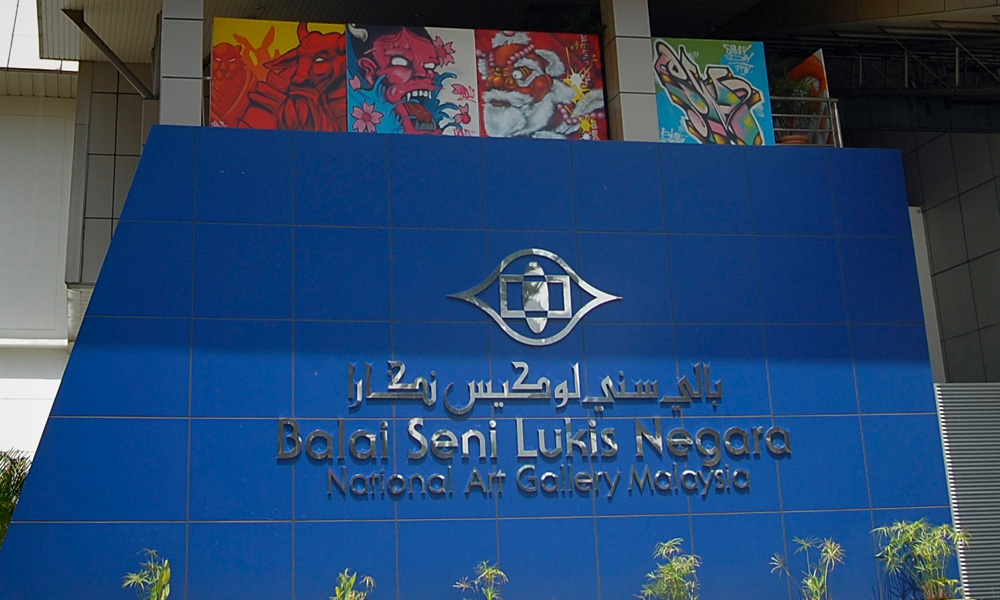
At places such as at the Balai Seni Negara, there is a nagging sense that there is a certain highbrow way to behave, a certain way to interpret and consume the art on display. Here, at least, Mutual Aid’s doors are open to workers who are here in the corridors on lunch breaks, to the tenants and cleaners passing by.
People do stop at the windows and peer in, even if they do not necessarily step through the doors. Perhaps this proximity, of being able to interact to some degree, is a way to navigate the misconception that art seemingly belongs on its lofty pedestal.
But at the same time, there is the practical, day-to-day cost of engaging in art. That art and those working in this field remain in a precarious position, chasing after funds and grants from organisations such as Cendana while forming networks to make their way around the financial challenges, now more salient than ever.
What Goh particularly wanted was for a space where experimentation could take place for practitioners, to have “a discursive space where they can take on more experimental projects without having to succumb to market forces and pander to the needs of collectors or commercial gallerists.”
By offering it to artists needing a space to work, in between exhibitions, some reflections on the necessity of coexistence emerged. “One of the most important things I’ve learnt is the necessity of compromising when working with others. But the other very important thing is also to listen. A space cannot be discursive if everyone talks and no one listens because we end up talking over each other.”
Whatever the case, there remains something tangible about being able to interact with art in person. While it seems that digitisation, especially in the wake of Covid-19, would seem like a foregone conclusion, what Goh does sense is that the institutions are attempting to engage with audiences inventively as possible, making do with existing limitations, especially as online options begin to show their limits.
“Online exhibitions will always be a poor compensation for the physical thing, because artworks need to be experienced in person, as online platforms fail to capture the nuances and materiality of an artwork that makes it such a fascinating source of sensorial and cognitive stimulation.”
WILLIAM THAM WAI LIANG is an editor at Gerakbudaya and the author of two novels. His new novel, The Last Days, is set in 1981 and covers the continuing legacy of the Emergency. His first book, Kings of Petaling Street, was shortlisted for the Penang Monthly Book Prize in 2017.
The views expressed here are those of the author/contributor and do not necessarily represent the views of Malaysiakini.