




Software can help seat allocation, says Azmin
Parti Keadilan Rakyat's (PKR) development of a computer programme that analyses the 2004 general election results and electoral roll can help towards a more empirical determination of seat allocation among Barisan Alternatif parties, its vice-president Azmin Ali said today.
Parti Keadilan Rakyat's (PKR) development of a computer programme that analyses the 2004 general election results and electoral roll can help towards a more empirical determination of seat allocation among Barisan Alternatif parties, its vice-president Azmin Ali said today.
The party's election committee has come up with a software that merges the 2004 election score-sheet with the electoral rolls as gazetted by the Election Commission (EC).
 It also provides data that can be the basis of seat allocation between PKR and fellow opposition parties PAS and DAP, said Azmin, who heads the elections committee.
"With this software, we can analyse the data and performance of each political party and discuss the often thorny issue of seat allocation based on facts and figures rather than emotions and sentiments," said Azmin when contacted.
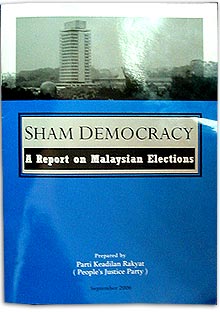
He was commenting on the software, - SISMEP12 - ( Sistem Menang Pilihanraya Ke-12 ) - which PKR announced in its report entitled 'Sham Democracy: A report on Malaysian elections' had enabled them to detect not only in-depth voting trend but also fraud and other irregularities in the electoral roll.
"This data doesn't come from any of the political parties, media or other such organisations. It comes from the EC itself," he added.
Irregularities stand out
Azmin said SISMEP12, apart from merging the 2004 elections score-sheet and electoral roll, also re-formatted the latter - originally categorised according to electors' identity card (IC) numbers - into localities, which made certain irregularities immediately stand out.
"When it was in order of IC numbers, it made it difficult for political parties to verify. (With the reformatting), we are able to determine, for example, that there were more than 223,950 voters in Selangor alone without polling booths.
 "We were also able to see irregularities in the number of voters who allegedly live in one house. At my mother's house, for example, we found that there were five other (unknown) voters who had been registered at the same address whereas my mother lives alone!" said Azmin.
According to the report, computer analysis of the electoral rolls in Selangor, Kuala Lumpur, Penang, Perak, Pahang and Kedah uncovered 20,048 cases of voters aged between 90 and 122 years.
"In one case, grouping of electors of one district in Kedah into ages revealed 38 who had voted were between the ages of 100 to 122. Our workers who went on the ground to check discovered that 36 had already died," said Azmin.
"If these are not phantom voters, then we don't know what phantom voters are," he added.
Azmin also decried the near-incredulous cost - RM47,000 - of the CD (compact disc) version of the national electoral rolls as sold by the EC.
Report for embassies
"That's almost RM50,000. How can they expect the people to afford that kind of money? EC should not be in the business of selling (at such exhorbitant amount) as it is their responsibility to provide such information to the public," he said.
Commenting on this, chairperson of the Malaysians for Free and Fair Elections Abdul Malek Hussin said EC should change the laws to enable ordinary people to obtain the electoral rolls.
"It's not the EC deciding thus. It's in the laws, that every electoral record is to cost about 20 sen. But EC does have to rectify the laws so that the people can gain access to such information," he said when contacted.
The elections committee will be submitting its report to all embassies in Kuala Lumpur on Monday, said Azmin.
He added that as the EC has agreed in a meeting with PKR a few days ago to conduct a meeting with all political parties to discuss specifically the electoral rolls, PKR will take the opportunity then to submit its report.


