
COMMENT | Addressing the 'address' problem in postal voting
COMMENT | With the recent proclamation of emergency by the Yang di-Pertuan Agong, the by-election in Batu Sapi will not proceed for now (only to be held after the emergency has concluded).
This has prompted calls from various NGOs like Bersih to expand postal voting in order to allow the Batu Sapi by-election to proceed safely in view of the ongoing Covid-19 pandemic. In this process, an unaddressed issue was unpacked.
Based on the Election Commission's (EC) data, of the 32,962 registered voters in Batu Sapi, there is an estimated 16,000 voters which have incomplete addresses. These voters only have general addresses without house numbers.
As a result of incomplete addresses, the implementation of postal voting for voters in Batu Sapi would be more complicated. Hence, this by-election highlighted an issue that is rarely discussed in depth - the issue of addresses in the country.
We, Tindak Malaysia, classify the housing address discrepancy (for both electoral and non-electoral purposes) issue into a few types
COMMENT | With the recent proclamation of emergency by the Yang di-Pertuan Agong, the by-election in Batu Sapi will not proceed for now (only to be held after the emergency has concluded).
This has prompted calls from various NGOs like Bersih to expand postal voting in order to allow the Batu Sapi by-election to proceed safely in view of the ongoing Covid-19 pandemic. In this process, an unaddressed issue was unpacked.
Based on the Election Commission's (EC) data, of the 32,962 registered voters in Batu Sapi, there is an estimated 16,000 voters which have incomplete addresses. These voters only have general addresses without house numbers.
As a result of incomplete addresses, the implementation of postal voting for voters in Batu Sapi would be more complicated. Hence, this by-election highlighted an issue that is rarely discussed in depth - the issue of addresses in the country.
We, Tindak Malaysia, classify the housing address discrepancy (for both electoral and non-electoral purposes) issue into a few types:
(1) Negative address (i.e. -192)
(2) No/ incomplete address (i.e. issue of Batu Sapi)
(3) Non-existent address
The staggering effect of this discrepancy has far-reaching impacts on both election and non-election matters in the country.
In this article, we examine who has the authority to create an address, relationship to voter registration, consequences of problematic address and some resolutions for the issue at hand.
Responsible authority
Let's examine the case of Batu Sapi parliamentary seat. The Local Government Ordinance (Sabah) 1961, Section 45 (1) states that:
"An Authority may from time to time cause the houses, buildings or erections fronting upon any street or other public place to be marked with such numbers as it may think fit, and may cause the name by which any street or other public place is or is to be known to be put up or painted on a conspicuous part of any house, building, fence, wall or place fronting thereon, and may at its discretion change or vary any such number, whether or not such number existed before the commencement of this Ordinance."
According to this Ordinance, the "authority" refers to the district council, town board or municipal council.
Batu Sapi is located within Majlis Perbandaran Sandakan, an authority created for the purposes of local government. Hence, the power to give addresses to a house or building (which refers to "any structure of whatsoever material constructed") in Batu Sapi falls under the hands of Majlis Perbandaran Sandakan.
Proceeding from this Section, Section 45(2) of the 1961 Ordinance also makes it an offence for "any person who destroys, pulls down, or defaces any such number or name or, without the permission of the Authority and anyone who puts up any number not having been approved by the Authority or name not being approved under the Town and Country Planning Ordinance".
This reinforces the responsibility of local councils in the maintenance of addresses in their domain.
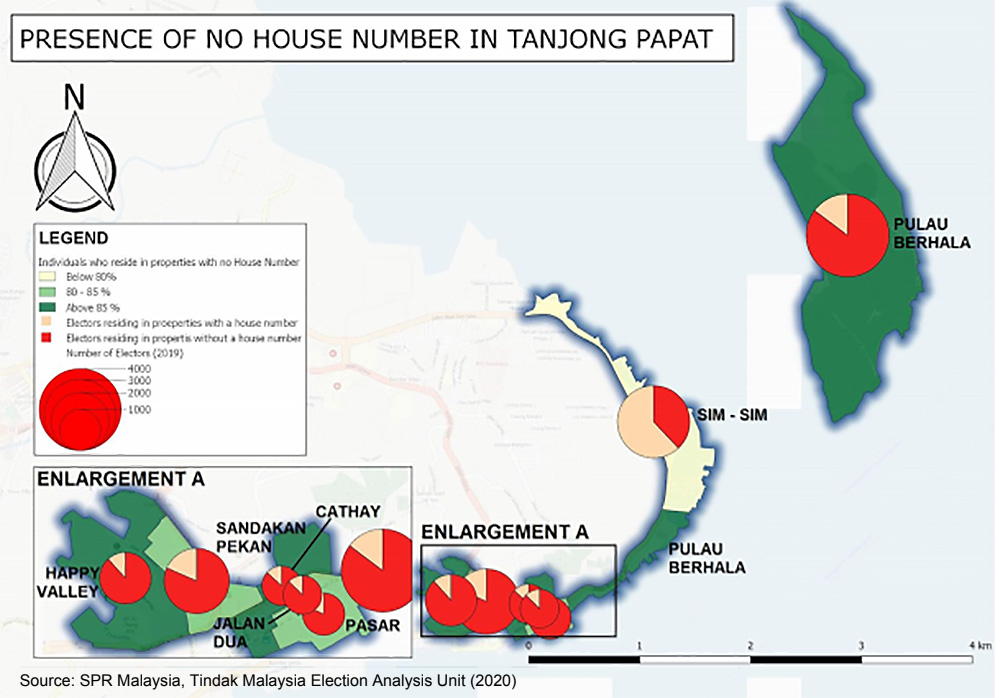
Similar to Batu Sapi, more than half of the electors of neighbouring Tanjong Papat state assembly (Dun) constituency (one of the Dun seats in the Sandakan parliamentary seat) have no house numbers during the 2019 Sandakan by-election.
Tanjong Papat is located under the domain of Majlis Perbandaran Sandakan. Surprisingly, the majority of these electors (with no house numbers) were found in urbanised Sandakan.
The other local authorities in Peninsular Malaysia and Sarawak also have similar provisions on the naming and numbering on houses, buildings, streets and other public places as provided under Section 68 the Local Government Act 1976 for Peninsular Malaysia (for names) and for the local authorities in Sarawak it is provided under Section 103 of the Local Authorities Ordinance (Sarawak) 1996.
A similar provision is also provided under related legislation on the function of the local authorities, which is the Street Drainage and Building Act 1974 (for Peninsular Malaysia only).
Section 31 of the 1974 Act provides that the local authority has the "discretion to allot a number to any house or building and may fix a mark displaying such number in a conspicuous place on the outside of any house or building or at the entrance of the enclosure fronting the street".
For example, Pasir Mas District Council of Kelantan has a dedicated manual on house number sequencing, naming of streets and housing area and rules on amending house numbers.
The only issue with the Local Government Ordinance of Sabah and similar laws in rest of Malaysia is they don't obligate local councils to assign house numbers and enforce the marks of such house numbers. With this in mind, we shall link the issue of house numbers to the registration of voters.
Registration of electors (voters)
Aside from requirements of citizenship and minimum age qualification, an important prerequisite for voter eligibility is the condition that the voter must be a resident in the constituency that they are voting on the qualifying date in as provided under Article 119(1)(b) of the Federal Constitution.
When a citizen of Malaysia wants to register as a voter, Election (Registration of Electors) Regulations (2002) requires the said citizen to fill Form A, which requires an address to be filled. With the address in Form A, EC assigns the voter to a locality, polling district, state and parliamentary constituency. EC relies on our National Registration Department (JPN) for our identity card details (which includes address).
Currently, JPN requires supporting documents (inclusive of assessment tax notice from the local council) from the public for change and validation of address. In order to ensure the accuracy of the electoral roll, it is essential the addresses of the registered voters are complete, correct and regularly updated in preparation for any general elections or by-elections.
As new voters appear by registration or migration to a new constituency, the registrar of the EC may carry out house-to-house or any form of inquiry to validate the existence of such voters, and this may involve sending notice of ordinary letter or personally to the said voter (hence the necessity of proper address).
If the said voter fails to provide necessary information to the registrar, the voter will be expunged from the supplementary electoral roll. In short, a correct and complete address constitutes a vital element in electoral roll integrity.
Consequences of problematic addresses
As we understand the relationship of address (emanating from local authorities) and voter registration (reliance from identity card), a problematic address has far-reaching consequences on our country.
Following are some of the implications of this unaddressed issue:
1. Creating loopholes for dubious voters to be planted in a constituency as validation of incomplete address will be a difficult exercise.
2. Adding unnecessary roadblocks for EC to assign voters for a given constituency.
3. Placing roadblocks on any forms of expansion of postal voting.
4. Adding unnecessary difficulties in tax collection.
Moving forward
With the recent case of Batu Sapi, important key measures must be undertaken to resolve a basic yet vital issue for the country's governance.
Firstly, adherence to Malaysian Standard MS 2039:2006 (Malaysian Standard for Address System) must be upheld by every local authority. This standard has stipulated that street and non-street address requires the compulsory presence of street or premise number (which may not have been followed in some areas).
Secondly, to complement the address requirement of MS 2039:2006, geographical components of latitude, longitude and altitude (especially condominium units) should be integrated. Each address should have a unique alphanumeric identifier (whether built-in national description or using applications such as what3words).
Thirdly, local authorities should inform EC within two weeks of occurrences of creation of new housing names, demolition of building units and gazetting of new road names.
Fourthly, EC needs to collaborate with local authorities to inform the scope of incomplete addresses as EC has aggregated data at a micro-level.
Finally, the Malaysian government must act on the Bersih's 2019 memorandum on the creation of a unique national address registry with a unique identifier.
It is important that the collective will of EC, JPN, local authorities, Ministry of Housing and Local Government and ultimately, the present government are required to address the address issue in a holistic and conclusive manner.
Resolving the address issue is one of the necessary keys to effective governance and service delivery.
DANESH PRAKASH CHACKO is Tindak Malaysia’s mapping advisor and research analyst at Jeffrey Sachs Center on Sustainable Development (Sunway University).
FORK YOW LEONG is an activist with Tindak Malaysia and specialises in law.
The views expressed here are those of the author/contributor and do not necessarily represent the views of Malaysiakini.