




Protesting the Thai-US FTA
Even as Malaysia negotiates a Free Trade Agreement (FTA) with the US, a broad-based civil society coalition in Thailand is protesting its government's attempts to 'sell sovereignty' under a similar agreement.
FTA Watch was shaped to closely monitor the process from a public interest perspective, with special focus on issues of access to medicine, use of genetically modified organisms in agriculture, and patents.
The last round of talks took place in Chiang Mai in January, with 10,000 people protesting in the streets and disrupting the meeting. As the Thai political crisis continues, the US is continuing to press for a swift conclusion of the FTA.
Jon Ungpakorn, a Thai senator who has been working closely with people with HIV/Aids, has become an anti- FTA activist. He shares his views in an interview.
Even as Malaysia negotiates a Free Trade Agreement (FTA) with the US, a broad-based civil society coalition in Thailand is protesting its government's attempts to 'sell sovereignty' under a similar agreement.
FTA Watch was shaped to closely monitor the process from a public interest perspective, with special focus on issues of access to medicine, use of genetically modified organisms in agriculture, and patents.
The last round of talks took place in Chiang Mai in January, with 10,000 people protesting in the streets and disrupting the meeting. As the Thai political crisis continues, the US is continuing to press for a swift conclusion of the FTA.
Jon Ungpakorn, a Thai senator who has been working closely with people with HIV/Aids, has become an anti- FTA activist. He shares his views in an interview.
Malaysiakini: Tell us more about the public protest against the FTA .
Jon : Thailand currently has a FTA with three countries - China, Australia and New Zealand - all of them pushed through with little public scrutiny. The US and Thailand initiated negotiations on a comprehensive bilateral FTA in June 2004. Like other recent bilateral FTAs with the US, (it) will cover investment, services, government procurement, intellectual property and agriculture.
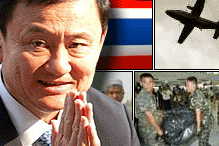 There is a long list of objections despite the rosy picture being painted by the government of Prime Minister Thaksin Shinawatra, (who says) that a trade deal with Washington is much needed. To support its argument, the administration is citing remarkable trade figures. Last year, for instance, the volume of trade between the two countries reached US$28 billion, up from US$21 billion in 2003. In both years, Thailand had an edge with higher exports.
Academics and other critics say Thaksin has lost his political legitimacy since he has put the national interest at stake by negotiating a FTA with the US. He has also been accused by civil society of trying to amend laws to allow him to sell the nation's important state assets to foreign investors.
The FTA would make certain drugs more expensive which would effectively limit access to medicines among poor patients. Pharmacists are closely observing the Thaksin government's 30-baht healthcare scheme, which has successfully provided medical services to segments of the population which cannot afford any medical care, but has strained the financial resources of hospitals and forced some to close.
Who were the main protesters in Chiang Mai?
More than 800 groups of people representing those living with HIV, farmers, NGOs, consumer right activists and opposition parties, and senators.
How did they get public support?
We organised a series of press conferences to educate the media and the public about the disadvantages and hidden agenda of the FTA. These attempts called attention to a general lack of clarity, perspective and constructive debate on the proposed FTA. (Such) debate is needed on the real costs and potential benefits of the FTA.
When did they first mobilise?
A couple of years ago, some NGOs and groups of academics in the fields of law, pharmacy, economy and agriculture warned the public about the disadvantages of the FTA. They had found out that the Thai-China FTA had reduced crop prices and jeoparised the livelihood of Thai farmers.
In the beginning, their voices were not loud enough. Subsequently, NGOs educated farmers and SME entrepreneurs whose businesses would be affected. Activists then asked the government to hold a public hearing or debate.
What will Thailand lose out on, if it signs the FTA?
Restrictive intellectual property rights would prevent Thailand from using affordable locally produced generic drugs. Anti-viral HIV drugs would be extremely expensive when the FTA is enforced.
Thai farmers will be worse off because local farm products cannot compete with US counterparts. The US annually spends billions of dollars in subsidies for farmers, allowing them sell products like corn in the world market, including Thailand, at low prices.
How did activists get media support?
In Thailand, there are media practitioners who cover issues of public interest. Even though the media has been controlled under Thaksin's government, some still do investigative reporting and report what we say. When we first started, we held press conferences to alert the media which, in turn, educated the people.
Any advice for Malaysians? How can they learn from Thais?
Academics, NGOs and politicians have to work so hard to educate society, enlighten them to be aware of what they are going to lose. In order to educate the people, we have to educate the media first. The media will inform civil society.
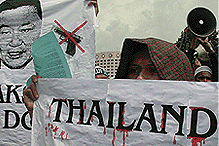 We have to raise only some influential and impacting issue to inform the public, (and) then they will support us. Initially, we have to raise dominant issue that really have an impact on the public in order to get their attention and raise their concern.
For example, in access to medicine, if someone enjoys exclusive rights to certain medical procedures, it means that the person is making money from the health of people. The 30-baht scheme will be badly hit since doctors will have to pay much more for using patent-protected medical procedures.
What irks the Thais is that a sweeping new clause to protect patents is not evident in the FTAs the US government has signed with Singapore, Chile, Bahrain and Morocco. We have to learn from other countries' experiences.
KIM SUBUNRUK is a malaysiakini intern from Thailand.


