
Covid-19 testing doubled since August but is this enough?
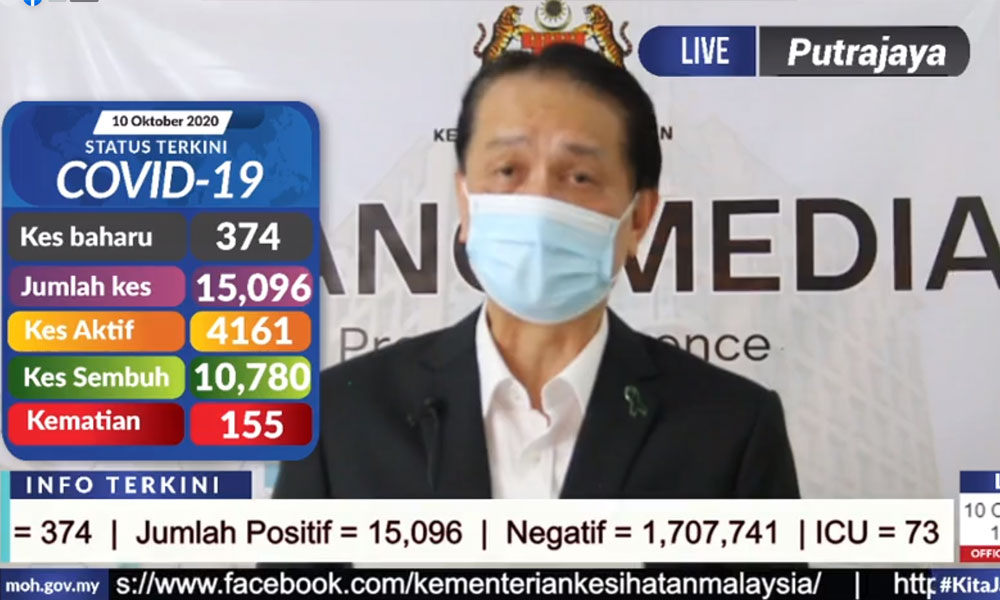
COVID-19 | At his regular briefing on the national Covid-19 situation today, Health Ministry director-general Dr Noor Hisham Abdullah highlighted some figures regarding various countries' efforts to test for the presence of the disease in its population.
“The testing rate per 1,000 population (in Malaysia) is comparable to other countries,” he said, as he quoted the Oxford Martin School’s numbers on testing and positivity rates for Malaysia, South Korea, Thailand, Japan, New Zealand, Australia, the United States and the United Kingdom.
However, a closer look at the figures compiled by the UK-based institution presents a less rosy picture of Malaysia’s Covid-19 situation.
Quoting the Oxford Martin School figures, which are available from the Our World in Data website, Noor Hisham said Malaysia has conducted 51.96 tests per 1,000 population with only 0.8 percent of those tests returning a positive result.
This meant that a Covid-19 case is ...
COVID-19 | At his regular briefing on the national Covid-19 situation today, Health Ministry director-general Dr Noor Hisham Abdullah highlighted some figures regarding various countries' efforts to test for the presence of the disease in its population.
“The testing rate per 1,000 population (in Malaysia) is comparable to other countries,” he said, as he quoted the Oxford Martin School’s numbers on testing and positivity rates for Malaysia, South Korea, Thailand, Japan, New Zealand, Australia, the United States and the United Kingdom.
However, a closer look at the figures compiled by the UK-based institution presents a less rosy picture of Malaysia’s Covid-19 situation.
Quoting the Oxford Martin School figures, which are available from the Our World in Data website, Noor Hisham said Malaysia has conducted 51.96 tests per 1,000 population with only 0.8 percent of those tests returning a positive result.
This meant that a Covid-19 case is found for approximately every 125 individual tests conducted.
Noor Hisham went on to say that South Korea conducted 45.41 tests per 1,000 population with a positivity rate of one percent; Thailand conducted 6.57 tests per 1,000 population with a positivity rate of 0.8 percent and Japan conducted 17.72 tests per 1,000 population with a positivity rate of 3.9 percent.

Meanwhile, New Zealand conducted 45.41 tests per 1,000 population with a positivity rate of 0.2 percent; Australia conducted 309.61 tests per 1,000 population with a positivity rate of 0.3 percent; the US conducted 3.38.72 tests per 1,000 population with a positivity rate of 6.7 percent; and the UK conducted 333.63 tests per 1,000 population with a positivity rate of 2.4 percent.
However, these figures are long-term averages that start from the beginning of the pandemic, hence may not represent the current situation as the outbreak ebbs and flows in each country.
Malaysia, for example, saw a large outbreak earlier this year beginning with the Sri Petaling Tabligh cluster, but then the number of confirmed cases reduced to almost zero on in June and July, only to experience a resurgence in the number of cases from September onwards.
As the outbreak grew, so did the number of tests performed to keep pace with the spread of the disease.
South Korea, which is often cited as a model for its extensive Covid-19 testing policy, is now conducting far fewer tests than Malaysia (despite its larger population) as the outbreak there is subsiding.
Note: Malaysia's apparent spike in testing in mid-May as depicted in the chart above is due to a change in reporting, and does not reflect an actual increase in testing.
Level of infectivity
Hence, to get a better sense of the level of testing done in Malaysia, it is more appropriate to focus on more recent data than to look at the whole picture.
According to Our World in Data, Malaysia was testing an average of 16,423 people per day or 0.51 per 1,000 people in the seven days up to Oct 8 according to the latest data available at the time of writing,
In comparison, the country was testing only half that rate in August.
While the number of tests per population gives an indication of whether testing is widespread, another key metric is the positivity rate which would indicate whether the level of testing is adequate for the size of a country’s outbreak.
Here, the figure for Malaysia is 2.5 percent, which is several times more than the cumulative average of 0.8 percent. This is equivalent to finding a Covid-19 case for every 40.2 people tested.
More concerningly, looking at the most recent figures also reveal that despite the increased level of testing, the positivity rate in Malaysia is also on the uptrend.
Just two months ago in August, the rate briefly dipped below 0.1 percent, which meant that the disease was so rare that more than 1,000 tests would have to be done before a case is found.
But just how much testing is enough?
In previous press conferences, Noor Hisham had said that the threshold is 10 percent. If the positivity rate exceeds that figure, it means the level of testing is inadequate and there are likely many more Covid-19 cases to be found.
Meanwhile in the guideline, “Public health criteria to adjust public health and social measures in the context of Covid-19”, the World Health Organisation suggested several criteria that could be used to gauge whether an epidemic is under control.
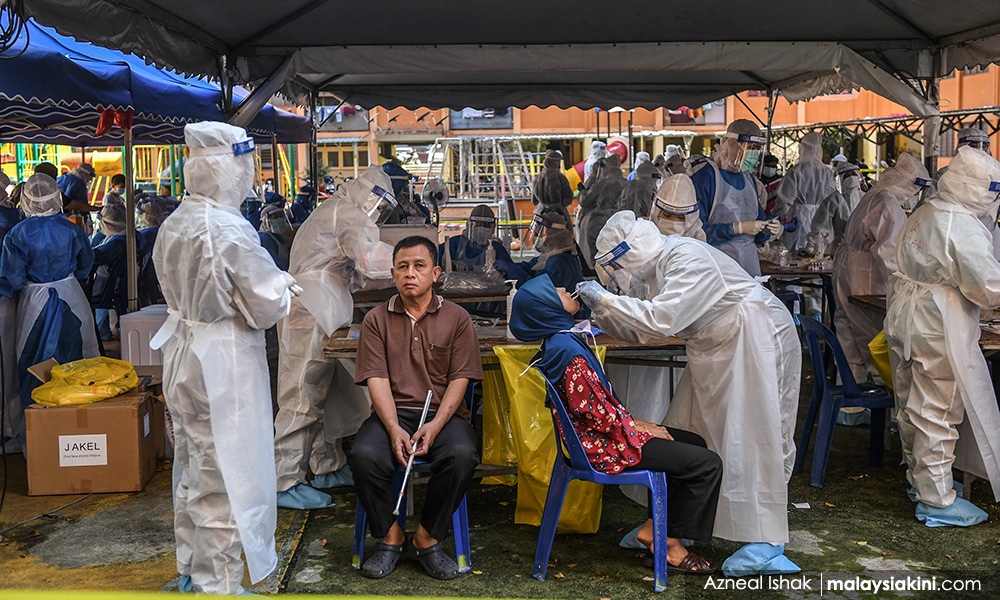
These criteria may be used if a country’s disease surveillance was insufficient to estimate Covid-19’s level of infectivity.
One criterion, it said, was to see whether the positivity rate drops below five percent at least in the preceding two weeks. This assumes surveillance and testing of suspected cases is comprehensive, in the order of at least 1 in 1,000 population per week.
However, the preferred method to determine whether an outbreak is under control is by the disease’s infectivity, as measured by its effective reproduction number (Rt).
“Theoretically, Rt (the effective number of secondary cases per infectious case in a population) below one (for at least two weeks) is the best indication that the epidemic is controlled and declining,” the document states.
Noor Hisham had last provided an update on the Rt for Covid-19 in Malaysia on Sept 29. At the time, the figure was on an uptrend and had reached 1.39; while in Sabah, it was even higher at 1.42.
Since then, the number of cases in Malaysia has continued to grow, reaching a peak of 691 cases reported in a single day on Oct 6.